Get Full Government Meeting Transcripts, Videos, & Alerts Forever!
Get email alerts on the Infant Safe Sleep topic
No spam. Unsubscribe anytime.
Child-welfare officials warn committee of rise in infant deaths linked to unsafe sleep and caregiver substance use, including cannabis
Summary
Oregon Department of Human Services child welfare officials told the Senate committee that critical-incident reviews show an increase in infant deaths where high-risk sleep practices and suspected caregiver substance use, including cannabis, were present. Officials urged expanded prevention, prenatal education and cross-system coordination.
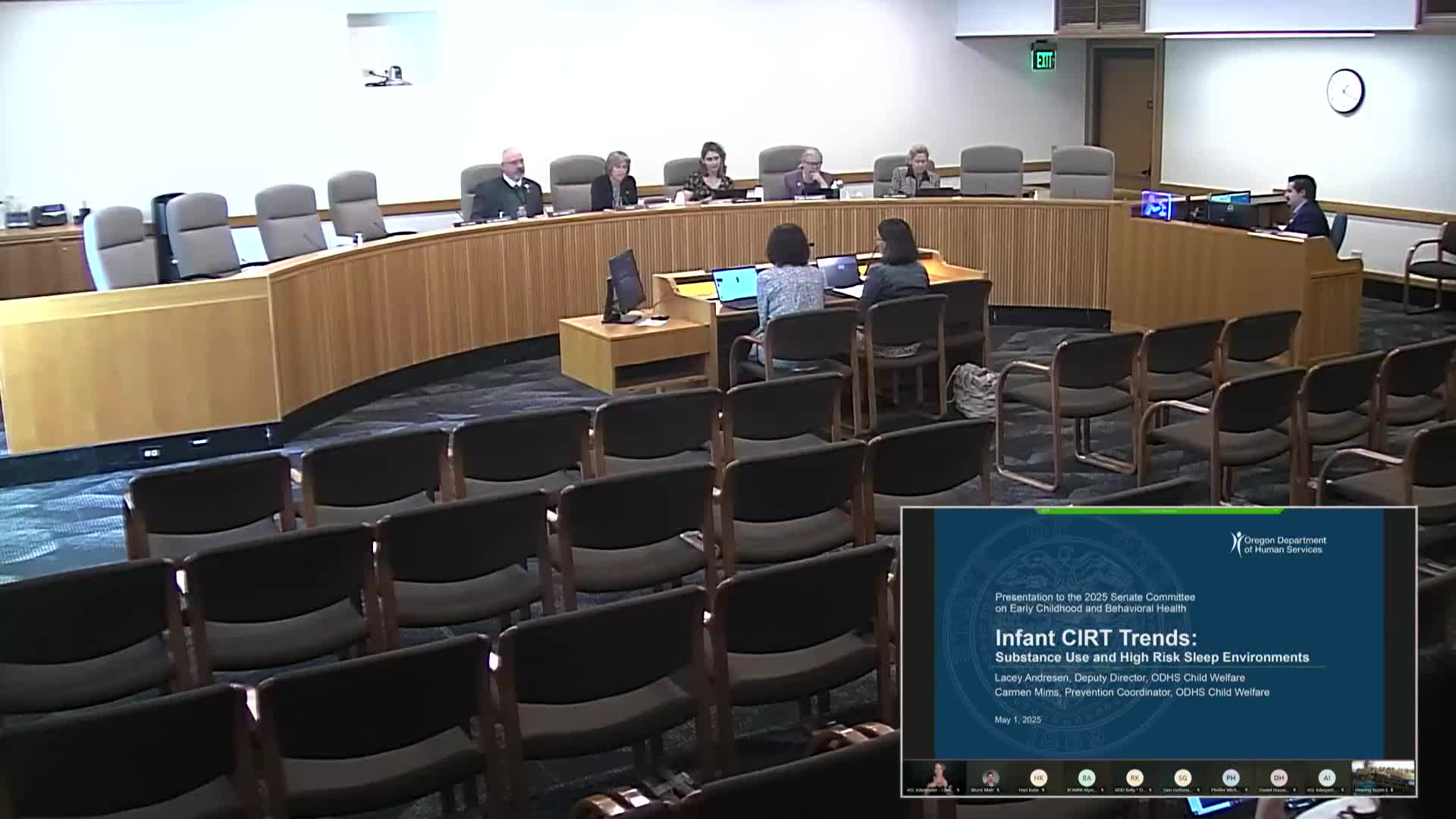
Oregon Department of Human Services child-welfare officials told the Senate Committee on Early Childhood and Behavioral Health that a recent rise in infant-related critical incident review cases has included incidents where high-risk sleep practices and concerns about caregiver substance use, including cannabis, were documented.
Lacey Andresen, deputy director for the ODHS Child Welfare division, described the critical incident review team (CERT) process as a statutorily mandated quality-improvement review for child fatalities believed to result from abuse or neglect when the child is known to the department. "The purpose is to review together the critical incident as well as any case history that we may have with the family, and we're looking to identify system improvement," Andresen said. She explained the CERT statute requires participation by ODHS leadership, local staff and outside subject-matter experts.
Carmen Mims, a prevention coordinator with ODHS Child Welfare, told the committee that Oregon typically records 30 to 40 sudden unexpected infant deaths (SUID) each year, including sudden infant death syndrome (SIDS) and accidental suffocation and strangulation in bed. Mims said the CERT subset is narrower but concerning: by May 5, 2025, ODHS had already convened seven infant-related CERTs, exceeding last year's total and nearing 2023 levels.
Mims reported that when staff examined CERTs that involved high-risk sleep practices, a subset also had documented concerns about caregiver substance use. "In 2025 includes cannabis as a substance of concern in all of them," she said of CERT cases counted so far; in 2024 three of five infant-related CERTs included cannabis concerns. Committee members asked whether cannabis was the sole substance in those cases; Mims said she could provide specific breakdowns on request.
ODHS described actions taken since mid-2020: increased training for staff and resource families on safe-sleep best practices; distribution of over 3,000 safe-sleep items using approximately $200,000 in Child Abuse Prevention and Treatment Act funds; development of a safe-sleep checklist for CPS workers; collaboration with recovery-support leads and prenatal partners; and participation in multi-system workgroups such as the Oregon Sleep Coalition and the National Partnership for Child Safety Affinity.
Witnesses and committee members emphasized prevention and education, particularly during the prenatal period, and recommended tailored messaging for caregivers taking sedating substances (including prescription sedatives, alcohol and cannabis). "Legal does not equate to safe," Mims said, urging that public-health messaging and provider education address sedating legal substances as well as illicit drugs.
The committee heard from senators and clinicians that messaging to parents must be nonpunitive and reach multiple caregivers (parents, grandparents and partners). Officials said they would return with more detailed data if the committee requested it.