Get Full Government Meeting Transcripts, Videos, & Alerts Forever!
Get email alerts on the Wildfire Funding topic
No spam. Unsubscribe anytime.
Oregon revenue committee hears wide-ranging public testimony on HB 3940 A as bottle-bill surcharge draws opposition
Summary
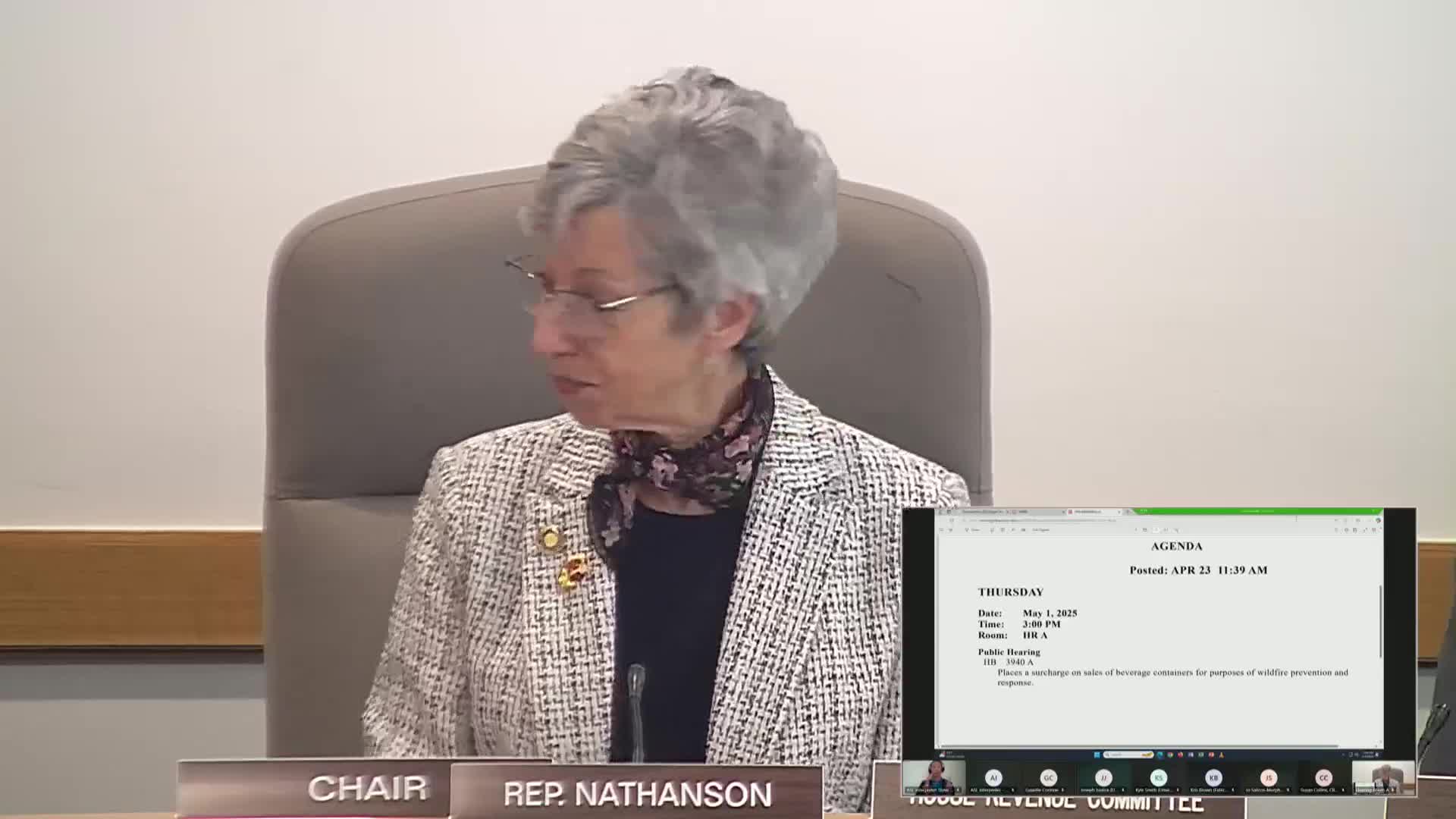
The House Committee on Revenue opened a public hearing May 1 on House Bill 3940 A, a package of revenue and policy changes aimed at long-term wildfire suppression and mitigation funding in Oregon.
The House Committee on Revenue opened a public hearing May 1 on House Bill 3940 A, a wide-ranging package meant to create dedicated funding for wildfire suppression, mobilization and landscape resiliency across Oregon.
The bill would package multiple revenue options and policy changes: a proposed 5¢ surcharge on beverage containers, a redirection of the state's retaliatory insurance tax, changes to landowner assessment rates and forest harvest taxes, a one-time transfer from the rainy day fund and a proposed target to provide about $280 million per biennium for wildfire suppression and mitigation programs. "The governor's recommended budget identified $150,000,000 to be redirected from going into state reserves to help proactively pay the fire costs and support the fire programs," said Doug Graff, wildfire and military advisor to the governor.
Why it matters: testimony showed broad consensus that Oregon needs a durable revenue solution for larger, costlier wildfire seasons, but sharp disagreement over how to raise the money. Supporters said the bill bundles revenue and policy fixes to stabilize the Oregon Department of Forestry (ODF), the Oregon State Fire Marshal (OSFM) and rural fire protection districts. Opponents — including recycling organizations, beverage industry groups and many nonprofits — warned that a 5¢ surcharge on beverage containers would damage Oregon's longstanding bottle bill system and the social programs it funds.
Legislative staff gave committee members an overview of the bill. "Sections 1 through 5 are the new funding pieces for wildfire costs," said Chris of the Legislative Revenue Office, who walked the committee through the bill's table of sections and amendments. He and other staff described six possible revenue sources across related bills: a 5¢ container surcharge; a dedication/diversion of retaliatory tax receipts; changes to how the general fund ending balance is allocated; a one-time rainy day fund transfer; proposals in the Senate (SJR 11 and SB 1177) related to the personal kicker and constitutional lottery dedication; and alternative payroll tax options in amendment A9.
Revenue and fiscal estimates discussed in the hearing included: a target floor of about $280 million per biennium identified by stakeholders (roughly $150 million for large wildfire suppression and $130 million for mitigation and readiness), an estimated biennial yield near $200 million for a 5¢ beverage surcharge, a rough $150 million biennial yield for redirecting retaliatory tax receipts, and a one-time rainy day fund balance transfer that stakeholders noted could be on the order of hundreds of millions depending on balances at the time. Legislative counsel and staff cautioned that some transfers and new taxes could trigger supermajority (three-fifths) vote requirements under statute; in particular, staff said the bottle surcharge and certain rainy day fund moves are the most likely to raise constitutional or statutory voting thresholds.
Supporters' perspectives: Representatives who served as ex officio members of the Fire 35 stakeholder group framed the bill as honoring the Fire 35 consensus and the need for an all-Oregon solution. "This is an all Oregon problem," said Rep. John Lively, House District 7. Rep. Bobby Levy and Rep. Christine Drazen also described participating in the Fire 35 process and urged colleagues to consider shared responsibility for statewide wildfire costs. Leaders from fire and rural-response organizations urged passage of the A7 package because it couples funding with policy changes to support rural fire protection districts and long-term mitigation. "House Bill 3940 A with the dash 7 amendment provides fiscal options and the policy changes they need," said Brian Stewart, assistant chief with Clackamas Fire District and director with the Oregon Fire Chiefs Association.
Landowner and timber-industry speakers told the committee that existing assessment and harvest-tax arrangements have become unsustainable in many eastern Oregon landscapes. Speakers described large percentage increases in assessment bills since 2020 and warned that escalating fees threaten working lands, local economies and fire-protection participation. "Our current wildfire funding formula is unsustainable," said John Davis of Green Diamond Resource Company, a member of the Fire 35.
Opposition and bottle-bill concerns: The hearing included extensive testimony opposing the proposed 5¢ beverage surcharge. Jason Jordan, president of the Oregon Beverage Recycling Cooperative (OBRC), urged the committee to adopt the A8 amendment to remove the surcharge and called the bottle program a "world-class" recycling system that delivers high redemption rates, jobs and nonprofit fundraising. OBRC, recycling nonprofits and beverage distributors warned that diverting container revenues or adding a surcharge would disrupt redemption centers, shrink or end the blue/green bag programs that supply nonprofits, and confuse consumers used to a full deposit refund.
"Please note that to get the money out of this system, you're having to make a decision to break a world-class bottle bill that's serving all Oregonians today to solve an unrelated challenge," Jason Jordan said. Multiple environmental and recycling witnesses, including the Recycling Partnership and Oregon Environmental Center, asked the committee to adopt the A8 amendment or otherwise remove the container surcharge.
Other revenue options and policy details: Testimony covered several non-container options still under consideration, including redirecting retaliatory insurance tax receipts, structural changes to rural fire protection district assessments (for example expanding levy bases and changing acreage triggers), and a proposed mechanism for the state treasurer to loan agencies funds to carry suppression costs until the legislature can appropriate them (a tool intended to reduce the need for special sessions).
Several speakers described the package's interlocking nature: industry groups such as the Oregon Forest Industries Council supported the harvest-tax and assessment changes only if they move alongside rural fire district reforms and the broader funding package. County officials and local fire district representatives said the bill could relieve sharp increases in county and landowner assessments while stabilizing local response.
Open questions and next steps: Committee members asked for concrete new-revenue ideas and cautioned against relying entirely on reallocations of existing general fund receipts. Several members said they wanted proposals that create sustainable new revenue rather than repurposing general fund or constitutionally constrained dollars. Chair Nathanson closed the hearing after roughly two hours of testimony and directed members and stakeholders to continue submitting written testimony and alternatives to the committee record.
Ending note: The hearing made clear there is substantial agreement that Oregon needs a long-term wildfire funding strategy, but no consensus on which revenue mechanisms are politically or legally feasible. The committee will weigh the mix of revenue options, statutory thresholds and policy trade-offs as it considers amendments and potential votes in coming days.