Get Full Government Meeting Transcripts, Videos, & Alerts Forever!
Get email alerts on the Accessible Education Materials topic
No spam. Unsubscribe anytime.
Utah program details braille, large-print textbook production and April 1 ordering deadline
Summary
Utah’s State Instructional Materials Access Center (USIMAC) outlined the multi-step process to produce accessible textbooks — braille, large print, tactile graphics and audio — and urged schools to submit complete orders by April 1 to meet timelines that can take weeks to months.
Armando Venegas, a staff member at the Utah State Instructional Materials Access Center, described how the state converts standard textbooks into accessible formats such as braille, large print, audio and digital versions for blind and low-vision students across Utah.
The process begins at each school when the general education teacher, special education teacher and teacher of the visually impaired meet to identify needed textbooks for the coming school year. "Many schools start as early as January," Venegas said, and the teacher of the visually impaired must add a new order to USIMAC’s production portal with format details, pacing guides and deadlines. He emphasized: "The most important thing that you can do is ensure that a complete order is received by April 1."
USIMAC staff review each submitted order to determine the most efficient procurement route. Venegas said the center will (1) purchase a provider’s already-completed accessible version, (2) use funds received through the American Printing House for the Blind to produce the text, (3) pull from USIMAC’s inventory, or (4) produce it in-house or contract with a certified transcriber if no other option is available. A complete order must include the portal entry, a hard copy of the textbook and a pacing guide; the pacing guide is particularly important for braille production so chapters or sections are delivered when students need them.
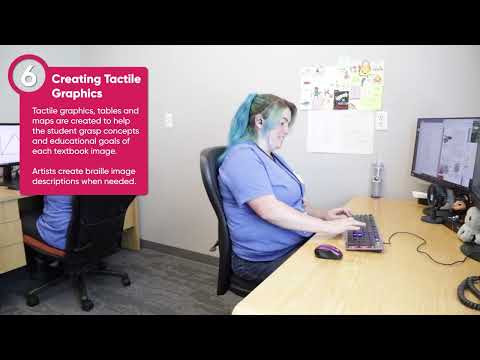
USIMAC’s production steps include scanning, editing, braille translation, tactile-graphic creation, proofreading, embossing and binding. Venegas said instructional-material technicians scan textbooks and import the files into editing software; scanning and editing can take "up to two, four, six weeks depending on the complexity of the scan." Braille transcribers parse volumes and run files through translation software, then check details such as capitalization, punctuation and highlighting. Tactile graphic artists either convert images into tactile graphics or, if an image cannot be rendered tactually, produce a braille description that matches the image. The proofreading team pairs a sighted reviewer with a braille reader to compare the transcription and may proofread a volume two or three times before final embossing and binding.
Once a volume is completed, it is embossed and spiral-bound; the finished package includes a braille cover label and title pages for the teacher. Venegas said shipping generally takes four to six weeks under standard methods and that USIMAC ships most textbooks as "free matter for the blind," but can expedite via commercial services such as FedEx next-day when timelines are tight.
Venegas also described the range of timelines and staffing involved: scanning and editing can take weeks; braille conversion requires careful, page-by-page attention; tactile graphics require collaboration between artists and transcribers; and the proofreading step is deliberately redundant to ensure accuracy. He said certified transcribers or certified companies are used when production is contracted out.
Why this matters: accessible-format textbooks are a statewide service paid by the Utah Legislature and federal support via the American Printing House for the Blind supplements production. Providing accurate, timely materials affects classroom pacing, students’ ability to access the same curriculum as sighted classmates and teachers’ planning. Missing or incomplete orders can delay delivery and jeopardize a student’s access to required materials.
For schools planning next school year materials, USIMAC staff instructed that orders contain three elements: the completed portal entry, a hard copy of the textbook, and a pacing guide indicating when chapters or sections are needed. Venegas said those elements let USIMAC determine whether to purchase an existing accessible version, use inventory, contract production, or produce the materials in-house.
No formal vote or policy change was recorded in the presentation. The session was informational, describing operational procedures, timelines and recommended deadlines for submitting material requests.
Contact and next steps: schools and teachers of the visually impaired should use USIMAC’s production portal and supply hard copies and pacing guides by the April 1 deadline to maximize the chance that braille and large-print volumes arrive before they are needed in the classroom.