Get Full Government Meeting Transcripts, Videos, & Alerts Forever!
Get email alerts on the Historic Preservation topic
No spam. Unsubscribe anytime.
Palatka board approves porch, column and painting work for Bronson Holland House amid debate over decking material
Summary
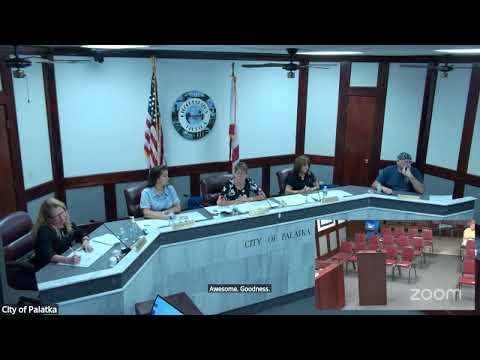
The Palatka Historic Preservation Board on May 1 approved repairs to the city-owned Bronson Holland House, including porch replacement, column repairs and exterior painting, after debate over whether decking should be cedar or pressure-treated lumber.
The Palatka Historic Preservation Board on May 1 approved repairs to the city-owned Bronson Holland House intended to restore porches, repair columns and repaint the exterior while the board debated whether to require cedar decking or allow pressure-treated lumber as a lower-cost option.
Miss West, historic preservation staff for the City of Palatka, told the board the project is funded through a Florida Department of State, Division of Historical Resources preservation grant and that "the city of Palatka was awarded $500,000 with a $100,000 matching from the city." She and other staff said the grant timetable and available local matching funds make the procurement timeline tight.
The board’s decision followed a staff presentation and comments from the project architect, Christopher Nardoga, who described the design work and said, "the only thing different that's not historical is that we're at 42 inches" for the upper railing height to meet modern code. Nardoga also described plans to wrap structural elements and add subtle lighting and improved foundations to stabilize the building.
Public commenters and board members pressed staff and the architect on materials and historical accuracy. Miss Kitchens, a public commenter, said she researched the house and asserted, "It was built in 1854," which differs from staff material that describes an approximate mid-19th century construction date. Resident Michael Sheffield, who lives behind the house, urged the board not to apply a lower standard to city-owned properties, saying: "I don't want to shrink the standards because it's the city project."
Board members debated the decking material at length. Several members and the architect noted that modern pressure-treated lumber can split and deteriorate and that older, historic-growth pine or cedar is preferable for longevity and historical appearance. Staff and others said, however, that cedar or higher-grade lumber could push the project over the available budget and risk the city needing to request additional funds from the Community Redevelopment Agency, which would delay work.
Board member Brianna Pierce moved to approve the plans "as presented," and a second was recorded. The roll call vote was 4 in favor, 1 opposed; the motion passed. The board did not adopt a formal requirement for cedar decking in the final motion but discussed using cedar as an alternate bid item to allow procurement of higher-grade lumber if prices and timing permit.
Staff said procurement steps would proceed promptly to meet the grant schedule; they said bid opening and timelines could be adjusted if staff can identify sources and prices for cedar lumber without jeopardizing the grant. Miss West told the board the grant expires in June 2026, and additional funding requests to the CRA would likely push work into next year.
The board and public recounted past repair work that failed to stabilize the porch and noted the urgency of doing durable, code-compliant repairs. The board directed staff to proceed with the approved plans while exploring cedar as an alternate in the bid process so that contractors can provide both options for evaluation.
The vote concludes the board’s action on Certificate of Appropriateness application Case 2506 for 100 Madison Street (Bronson Holland House).