
Committee advances resolution to relax apartment‑zone development standards to spur small/medium housing
Get AI-powered insights, summaries, and transcripts
Sign Up Free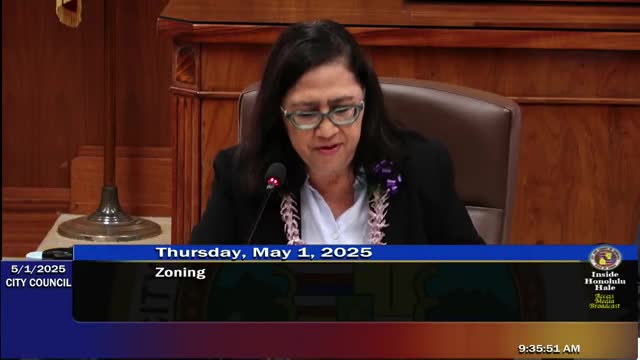
Summary
Resolution 25‑105, proposing modest increases to floor‑area‑ratio (FAR) and other development standards in apartment and apartment mixed‑use districts, was reported out for adoption; the measure would send the proposal to the Department of Planning and Permitting and the Planning Commission for drafting and public review.
The Honolulu City Council Committee on Zoning on May 1 reported out for adoption Resolution 25‑105, which would direct the Department of Planning and Permitting to propose amendments to Chapter 21 of the Revised Ordinances of Honolulu 2021 to modify development standards for apartment (A1–A3) and apartment mixed‑use (AMX1–AMX3) districts.
Vice Chair Dos Santos Tam, the resolution’s primary sponsor in committee, said the intent is to modestly relax floor‑area‑ratio (FAR) and other dimensional limits so small and medium apartment projects can be built in existing apartment zones without rezoning. He said the current development standards date to the late 1960s and early 1970s and make it difficult to build small apartment buildings; the proposal would not change zoning designations or rezone areas.
Vice Chair Dos Santos Tam said the proposal is informed by outreach to the development community and an analysis by UHERO that found modest FAR increases could yield hundreds of new units at heights typically below four to six stories. Council Member Weir (co‑sponsor) said stakeholders sought solutions that increase housing without harming surrounding neighborhoods.
Public testimony included Wilford Montosue, a developer who said raising FARs in apartment zones would make small development projects financially viable and increase housing stock; he recommended the city consider FAR of 4 in some zones and asked that small projects be exempted from Ordinance 18‑10 (the city’s affordable housing requirement) to reduce barriers for small developers. Angela Melody Young testified for CARES in strong support and said the change would help align county planning with state density goals and transit‑oriented development practices.
The Department of Planning and Permitting told the committee it is supportive and will process the proposal; the chair reminded members that if the council adopts the resolution the department will prepare a bill for three readings, allowing additional public input and review by the Planning Commission.
The committee reported the resolution out for adoption with no objections recorded. The record indicates further technical work will be needed by DPP and the Planning Commission to draft ordinance language and to assess infrastructure and plan consistency before any zoning code changes are adopted.