Get Full Government Meeting Transcripts, Videos, & Alerts Forever!
Get email alerts on the Docks And Wharves topic
No spam. Unsubscribe anytime.
Wolfeboro selectmen review Chapter 36 docks ordinance, debate barge fees, enforcement and accessibility
Summary
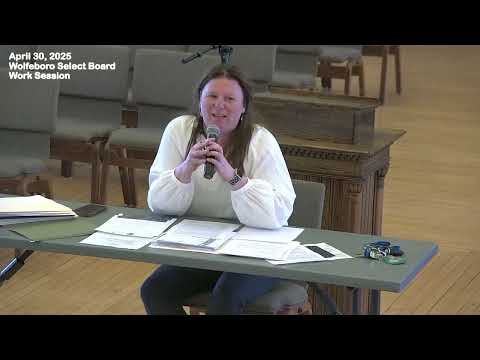
Wolfeboro selectmen spent more than two hours April 30 reworking Chapter 36 of the town ordinances governing docks and wharves, focusing on enforcement of commercial landings, the structure of barge landing fees, trailer parking rules, and whether the town should add a handicapped‑accessible docking spot.
Wolfeboro selectmen spent more than two hours April 30 reworking Chapter 36 of the town ordinances governing docks and wharves, focusing on enforcement of commercial landings, the structure of barge landing fees, trailer parking rules, and whether the town should add a handicapped‑accessible docking spot.
At the outset the board asked town staff to confirm what authority the town has to regulate vessels anchoring near town docks and to get that guidance in writing from state authorities. Selectmen asked staff to contact marine patrol and the state police in Guilford and to return with documented guidance on permission processes for moorings and for moving wake or swim buoys farther from town docks.
The most sustained debate centered on commercial barge operations at the Libby Museum ramp and other town landing areas. Board members described complaints from some barge operators that other users leave barges unattended for long periods, clogging the landing. The ordinance currently limits loading and unloading to two hours in some places; members proposed shortening that to reduce congestion but did not settle on a new limit.
Selectmen also questioned whether the current fee schedule is appropriate. The transcript records prior proposals of $300, $1,500 and $3,000 for annual commercial permits; some suggested the earlier $3,000 figure felt arbitrary and asked staff to compare Wolfeboro’s rates with other lakeside towns before recommending a change. The board asked staff to poll local barge operators for concrete examples of problems and to provide benchmarking on fees in Meredith, Moultonborough and Guilford.
Enforcement options drew vigorous discussion. The ordinance contains language that “a flagman wearing a fluorescent vest shall be in attendance to direct traffic” during loading, wording several selectmen said is not being implemented. Staff described options including (1) requiring barge operators to manage traffic, (2) hiring dock attendants or dock officers (a model used by Center Harbor), and (3) using camera footage from town Wi‑Fi connected cameras to verify complaints. Selectmen asked the town to identify what work can be supported from restricted dock funds and what would require operating budget or voter approval.
On finance, staff said the town maintains a restricted dock fund used for repairs and that they will report specific balances to the board; one figure mentioned during the discussion was $72,000 for a designated account and a separate Dockside capital reserve figure of $52,257. A staff member also said she had found a December 2022 Attorney General letter describing limits on using barge fees, and selectmen asked staff to bring the AG opinion and to clarify permissible uses of collected fees.
The board reviewed several other ordinance items. They directed staff to: clarify the public parking/loading space next to the main launching ramp so signage reads specifically that the spot is for launching/unlaunching with a short time limit (board members discussed 10–15 minutes); consider whether the town should require permits or fees for launches (some neighboring towns charge a launching fee); and formalize the Pop Whalen trailer parking practice to move the island trailer permit parking to Filter Bed Road once construction there is finished.
Selectmen discussed island trailer permits in detail. The existing policy limits island‑taxpayer trailer permits to a season (previously described as May 1–Oct 1) and requires a permit sticker; staff said enforcement relies on visible stickers and occasional outreach by a local volunteer who reports violations. One option discussed was creating a small number of managed seasonal trailer spaces at Filter Bed Road and charging a seasonal fee (one board member suggested $500 as an example); others warned that doing so would compete with local marine businesses that already offer commercial trailer storage.
On accessibility, the board agreed by consensus that the town should provide a handicapped docking location but deferred any commitment to purchasing a lift until staff can estimate costs and return with options. Selectmen noted that a lift capable of serving widely varying boat types may be impractical and that having a marked handicapped dock space and signage is an immediate, lower‑cost step.
Procedurally, staff (Amy) told the board she would assemble the meeting notes, prepare a strike‑out redraft of Chapter 36 for further review, and solicit written feedback from barge operators and commercial vessel permittees. The Mount Washington vessel is scheduled to appear before the board at the next meeting under the existing ordinance; any ordinance changes would not apply retroactively and would take effect only after public hearings and votes.
The board made no formal votes during the workshop. Instead, members directed staff to gather legal guidance, prepare a draft ordinance with proposed clarifications, provide financial detail on restricted and capital reserve dock funds, poll commercial operators about operational problems, and return with recommended signage and permit language for the next meeting.
Community members who watched or attended the session urged clarity and modest fee adjustments rather than abrupt changes. One resident who spoke during public comment thanked the board for preserving downtown waterfront activity and asked the board to quantify any economic tradeoffs before raising fees.
The board recessed the work session after the Chapter 36 review and scheduled additional work sessions to complete the ordinance update and related policy choices.