Get Full Government Meeting Transcripts, Videos, & Alerts Forever!
Get email alerts on the Solid Waste topic
No spam. Unsubscribe anytime.
Houston County officials review 2024 solid-waste annual progress report and collect signatures
Summary
Maddie Golds of the Greater Nashville Regional Council presented Houston County’s 2024 Solid Waste Annual Progress Report, highlighting recycling tonnages, financials, staffing gains, and equipment needs; county officials collected signatures to finalize the report, with no roll-call vote recorded in the transcript.
Maddie Golds, a planner with the Greater Nashville Regional Council, presented Houston County’s 2024 Solid Waste Annual Progress Report to county officials, reviewed recycling and finance figures, described recent convenience-center improvements and grant-funded equipment, and had officials sign the report to finalize it.
The APR is submitted under the Solid Waste Management Act of 1991 and serves as an annual update to Houston County’s 1994 10-year solid-waste plan; Golds told officials the state uses the reports to track recycling, funding and capacity across Tennessee counties. "I'm here to talk a little bit about Houston County's annual progress report for 2024," Golds said during her presentation.
Golds summarized operational and program highlights for 2024. The county reported receiving 892.9 tons of mixed metals for recycling in the prior year and is on track for a similar amount this year. County staff are waiting to ship cardboard until truckloads are full to increase revenue per load, and the county now accepts air-conditioning units at its convenience center. Golds said mattress volumes — a recent problem — have declined compared with the prior year.
On finances, Golds said fiscal-year statements for 2023 and 2024 are included in the APR; she told officials the two years are similar, with the largest year-to-year differences tied to changes in grant awards. She noted the sale of recyclables was nearly unchanged, with a roughly $1,000 difference between the two years.
Golds described staffing improvements at the convenience center. Based on prior staffing levels of two full‑time employees and one part‑time employee, she said the county has added at least one full‑time position and additional supporting staff, bringing staffing to and above the previously targeted ratio.
The presentation listed several success stories: purchase of a new skid steer to move cardboard, the first household hazardous‑waste day in two years with another planned for 2025, and a used‑oil grant that funded a carport, a used‑oil collection tank and improved equipment at the convenience center. Golds also noted ongoing needs: a new shredder, a new loader, paving and concrete work, and continued outreach to increase recycling diversion where financially feasible.
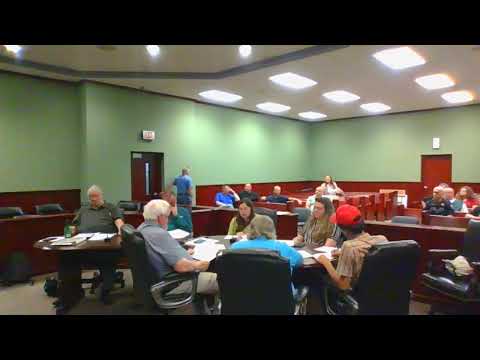
Officials proceeded to sign the APR. A meeting participant identified as Chair said, "What we need to do is approve this," and later added, "We're good for another year." The transcript shows signatures were collected to finalize the document; the meeting record in the transcript does not include a mover/second or a roll‑call vote tally.
During a brief Q&A, an official asked how many Tennessee counties do not charge for services outside of taxes; Golds said she did not have the number on hand and wrote to follow up by email.
The APR presentation covered both statutory reporting requirements and practical county operations. Golds pointed officials to the county’s 1994 10‑year solid‑waste plan (noted in the packet) for historical context and said the regional council provided grant‑funded support to prepare the APR. Officials indicated interest in exploring a new convenience center on the county’s west side around the end of 2026 and in identifying funding for equipment and site improvements.
Meeting context: the discussion was a presentation followed by brief questions and the collection of signatures to finalize the APR. The transcript shows no formal roll‑call vote; the record supports that officials finalized the APR by signing the document.