Get Full Government Meeting Transcripts, Videos, & Alerts Forever!
Get email alerts on the Legislative Audit Cooperation topic
No spam. Unsubscribe anytime.
Senate panel advances bill to require state agencies to furnish audit data in requested form
Summary
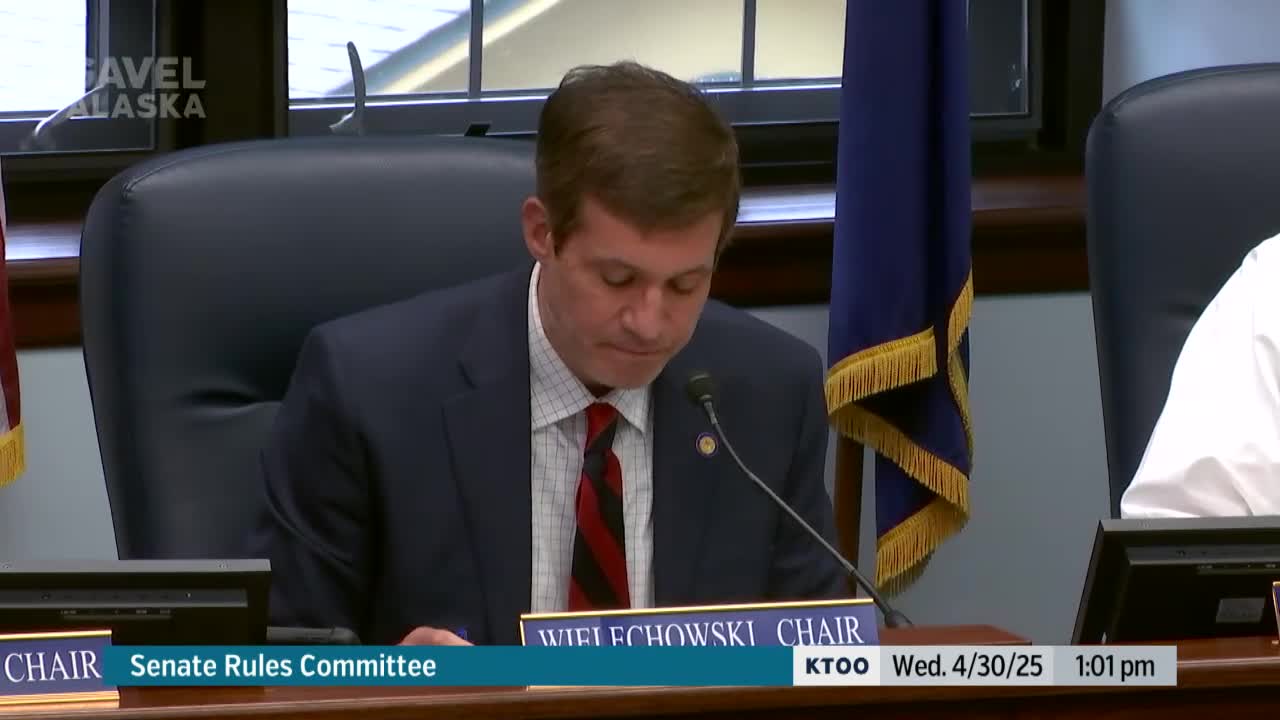
The Alaska Senate Rules Committee on April 30, 2025 moved Senate Bill 183 from committee after testimony that the measure is needed to compel state agencies to provide audit information — including form and format — to the Legislative Budget and Audit Committee and the legislative auditor.
The Alaska Senate Rules Committee on April 30, 2025 moved Senate Bill 183 from committee after testimony that the measure is needed to compel state agencies to provide audit information — including form and format — to the Legislative Budget and Audit Committee and the legislative auditor.
Senator Grama Jackson, chair of the Legislative Budget and Audit Committee and sponsor of SB 183, said the measure is “simply a housekeeping bill to clarify the authority of our legislative auditor.” The bill, she told the committee, responds to difficulties the Legislative Audit Division encountered obtaining Department of Revenue records needed to complete a previously authorized review of oil and gas production tax audits.
The nut graf: Committee testimony described the audit at issue as material to Alaska’s finances — the division presented historical tables showing about $1,300,000,000 in tax and interest assessed for tax audit years 2006 through 2011 — and said portions of those assessments remained listed as “not yet resolved” in earlier reports. Legislative Auditor Chris Curtis told the committee the division began the special audit in early 2024 but has been unable to obtain information from the Department of Revenue in a usable format.
Curtis, identified in committee as the legislative auditor, testified that “the need for this bill comes from my division's inability to complete an audit.” She described the audit directive approved by the Legislative Budget and Audit Committee in December 2020 and said the department’s recent position was that agencies are required only to provide raw data, not to compile or produce information “in the form or format requested.” Curtis warned that that interpretation “opens the door for all state agencies to refuse to provide or compile information in the format requested, therefore, preventing legislative oversight.”
Committee members pressed on specifics. Curtis said the December 2020 audit request tasked the division with updating tax-assessment tables previously presented in 2018 and with reporting additional tax, interest and penalties assessed for each audit cycle. She cited Table 1 in the meeting packet, which reports total tax and interest assessed for audit years through 2011 and, she said, sums to roughly $1.3 billion for the years shown. Committee discussion highlighted a 2008 row marked “not yet resolved” of about $170,000,000 and an aggregate “not yet resolved” amount approaching $400,000,000 across several years; Curtis said the audit would report updated figures.
Members asked whether the bill would allow the auditor to force agencies to create data not otherwise collected. Curtis and other witnesses agreed an auditor cannot compel an agency to collect information the agency is not statutorily required to collect. Senator Schauer and others emphasized that audit objectives are directed and vetted by the Legislative Budget and Audit Committee; Curtis said the power “first resides in the committee and they are providing that power to [the legislative auditor] to go and seek and audit and report back.”
Legislative Legal Services Director Emily Nauman told the committee that, in her view, the bill’s language does not allow the legislative auditor to “go rogue.” In her words, “I don't see where the legislative auditor under this bill could sort of go rogue and just ask the executive branch to generate any information that the legislative auditor saw fit. It has to come through the direction of the LBNA committee.”
Sponsor and staff walked the committee through the bill’s provisions. According to testimony, sections 2 and 3 amend the parts of Alaska Statutes (Title 24) that govern the Legislative Budget and Audit Committee and the Legislative Audit Division to require auditees to cooperate by providing information “in the form or format requested.” Sections 1 and 4 make conforming changes to a criminal statute regarding hindering the Legislative Budget and Audit Committee and to personnel-related provisions to support enforcement; section 5 clarifies nonretroactivity for new criminal standards and section 6 makes the act effective immediately.
After invited testimony and public testimony (none offered), the committee took up a motion. Senator Stevens moved to report SB 183 from committee “with individual recommendations and attached fiscal notes.” The committee chair asked, “Is there any objection?” Committee members recorded none, and the chair announced SB 183 “is moved from committee.” The committee did not record a roll-call vote.
What happens next: SB 183 leaves the Rules Committee and will be reported to the Senate with the committee’s recommendations and fiscal notes. The measure’s sponsor and the legislative auditor said the bill is intended to preserve legislative oversight of oil and gas tax audits and similar functions by ensuring the legislature can receive information in a usable form.