Get Full Government Meeting Transcripts, Videos, & Alerts Forever!
Get email alerts on the Antisemitism On Campus topic
No spam. Unsubscribe anytime.
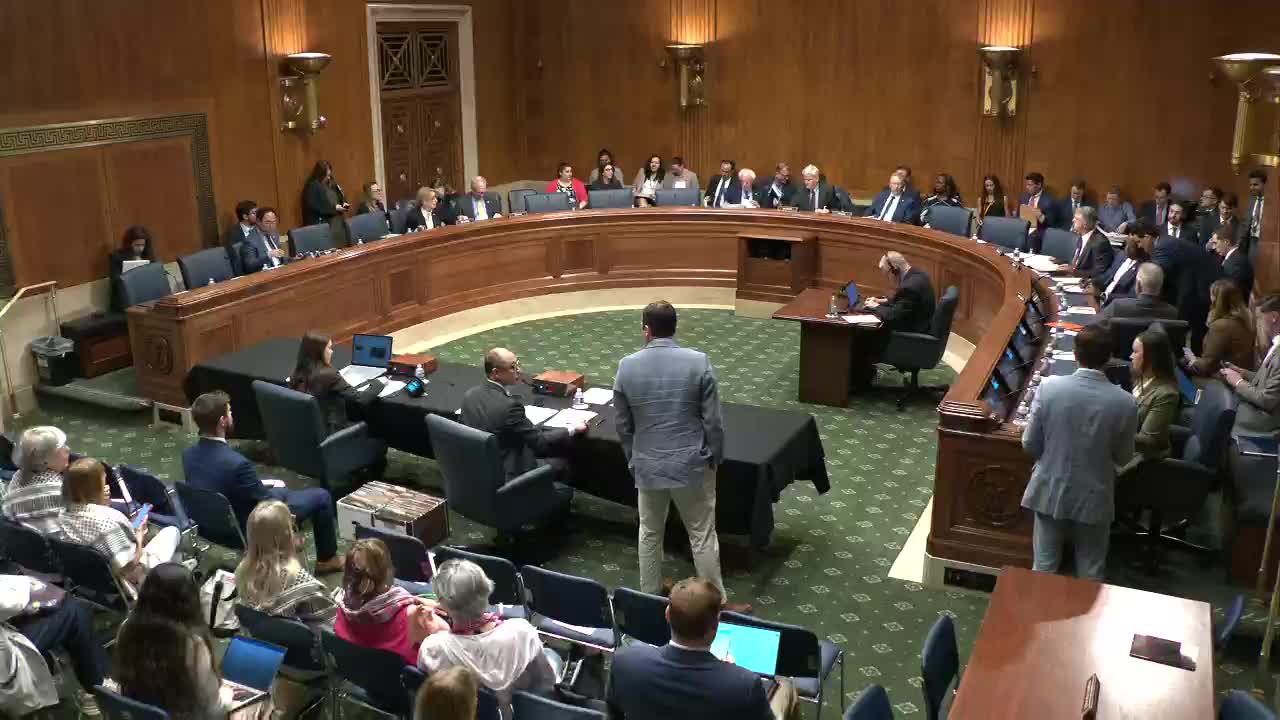
Senate HELP committee advances campus antisemitism bills amid heated First Amendment fight; final passage deferred
Summary
The Senate Health, Education, Labor and Pensions Committee on Thursday moved forward with bipartisan legislation aimed at protecting students from antisemitic harassment while sparking a bruising debate over First Amendment limits and committee procedure.
The Senate Health, Education, Labor and Pensions Committee on Thursday moved forward with bipartisan legislation aimed at protecting students from antisemitic harassment while sparking a bruising debate over First Amendment limits and committee procedure.
Chairman Bill Cassidy, chairman of the Senate Health, Education, Labor, and Pensions Committee, opened the markup by framing the bills as a response to on‑campus threats: "There is no nuance in bigotry. Chasing Jewish students into a room, pounding on the door, and threatening them with violence is wrong. That is not free speech." The committee considered S.558, the Antisemitism Awareness Act of 2025, and S.163, the Protecting Students on Campus Act of 2025.
The measures, crafted with bipartisan sponsors, would standardize how the Department of Education’s Office for Civil Rights evaluates complaints of discrimination against Jewish students and would create a civil‑rights outreach effort so students know how to file complaints. Supporters said the bills would offer clearer enforcement tools; opponents warned statutory language and illustrative examples risk chilling constitutionally protected speech.
Why it matters: The committee’s work would affect how colleges and K‑12 institutions respond to civil‑rights complaints and how the Department of Education enforces Title VI protections. Members also clashed over how the bills intersect with academic freedom and the First Amendment, and about whether the committee should be permitted more time to debate complex amendments.
Key actions and outcomes
- The committee adopted the manager’s amendment in the nature of a substitute to S.558, the Antisemitism Awareness Act of 2025, by voice vote, replacing the bill text for purposes of amendment.
- A motion from Senator Rand Paul to extend amendment introduction time to five minutes (instead of the chair’s two‑minute limit) was defeated (vote recorded in the transcript as 11 ayes, 12 nays). The procedural fight over debate time recurred throughout the markup; the chair repeatedly said the committee was operating under a two‑hour limit that had not been waived.
- An early substitute amendment offered by Senator Paul to change the bill’s language and emphasize condemnation of Hamas while narrowing speech restrictions was defeated (vote recorded as 11 ayes, 12 nays).
- Committee members offered and debated many amendments. Senators Bernie Sanders and others secured amendments intended to underscore First Amendment protections and to clarify that criticism of the Israeli government, including its actions in Gaza, is not by itself antisemitic; at least one amendment emphasizing First Amendment protections was adopted (vote in transcript recorded as 13 ayes, 10 nays).
- Several amendments unrelated to the central civil‑rights definitions — including proposals to require notice to Congress before cutting certain university research funding and amendments addressing Department of Education staffing and reorganization — were offered and repeatedly tabled or ruled out of order by the chair as outside the bills’ scope. Multiple tabling votes and rulings to table amendments recorded 12 ayes to 11 nays on the roll calls shown in the transcript.
- Committee leaders announced that, because of member scheduling and the two‑hour limit, the committee would defer final passage votes on both bills until later, and the markup adjourned with final passage rolled to another day.
Debate highlights
Supporters emphasized the bills provide enforcement clarity. Senator Tim Scott, the lead sponsor on S.558, told the committee: "There can be no equivocating when it comes to anti‑Jewish violence and harassment. It's critical that the Department of Education has the tools to investigate antisemitism and root out the vile hatred wherever it rears its ugly head." Scott framed the legislation as a clarification for investigators and universities.
Opponents warned the statute’s illustrative examples — drawn from the International Holocaust Remembrance Alliance (IHRA) guidance — could be read as regulating speech. Senator Bernie Sanders said: "Hate and discrimination of any kind is beyond unacceptable and has no place in American society," but also argued the committee must protect free expression. He repeatedly proposed amendments to make explicit that criticism of the Israeli government or the Netanyahu administration is not, by itself, antisemitic.
Senator Rand Paul framed his objections in constitutional terms, arguing that codifying examples risks chilling protected speech and invoking the Supreme Court’s Brandenburg v. Ohio precedent on imminent lawless action. "A free society is strong enough to confidently and persuasively ignore arguments, not silence them," Paul said.
Procedural context
A recurring point in the markup was time. Chairman Cassidy noted at the outset the committee was operating under a two‑hour limit that "was not waived for the committee hearing," and pressed members to limit remarks to two minutes on amendments. Senators pressing for more debate said there were roughly "60 amendments filed" and that the time constraint could preclude thorough consideration. Minority members asked the floor to waive the two‑hour limit; their unanimous‑consent request was objected to on the floor, and the committee recorded that final votes would be postponed.
What was not decided
Final passage of both S.558 and S.163 was deferred; the committee did not record a final passage vote on either bill during this session. Several amendments were debated and either adopted, tabled, or ruled out of scope, but committee members indicated floor time and follow‑up sessions would be available for additional debate.
Ending
Committee members left the markup with both bipartisan support and clear divisions over statutory drafting and speech protections. The chair and ranking members said there will be further opportunities on the floor and in subsequent sessions to resolve outstanding issues and complete final votes.