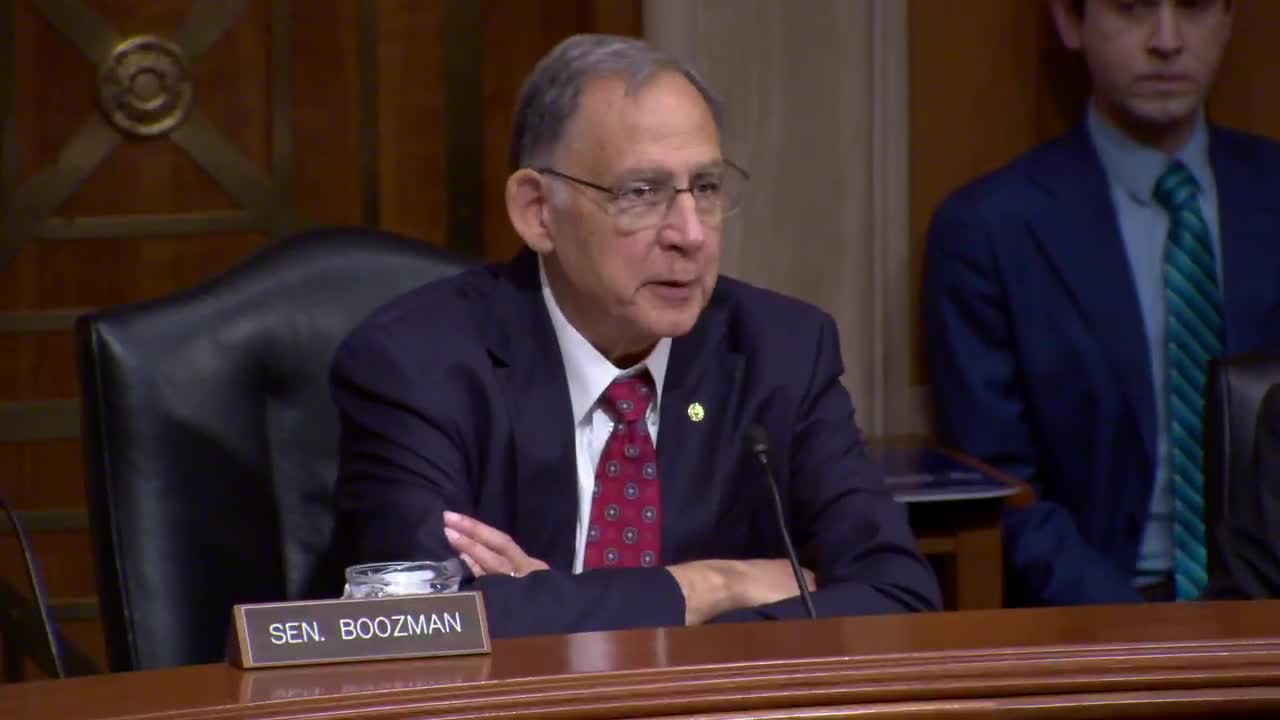
Witnesses tell Senate EPW state revolving funds, technical assistance and flexible subsidy rules are key to getting projects built
Get AI-powered insights, summaries, and transcripts
SubscribeSummary
Utility and rural-water witnesses credited Clean Water and Drinking Water State Revolving Funds, principal forgiveness and technical assistance for enabling projects in small and underserved communities, and described barriers including match requirements, staffing and planning capacity.
Witnesses from utilities and rural-water associations told the Senate Environment and Public Works Committee that state revolving funds (SRFs), IIJA principal forgiveness and state-level technical assistance have enabled projects that would otherwise be unaffordable, but obstacles remain for smaller systems.
Kyle Dreyfus Wells, chief executive officer of the Northeast Ohio Regional Sewer District and treasurer of the National Association of Clean Water Agencies (NACWA), described the Clean Water SRF as "an essential financing tool" for large and small projects. He said his district operates with a $191,000,000 annual operating budget and a $276,000,000 capital program, and cited a $220,000,000 shoreline storage tunnel financed through the SRF at 1.57% interest for 40 years with deferred principal. Dreyfus Wells said those terms equated to roughly $50,000,000 in savings over alternatives for that single project and praised program flexibilities — below-market interest, deferred principal, extended terms and reduced bond costs — for stabilizing long-term rates.
Tom Gillett, president of the Nebraska Rural Water Association, and city administrator/utility superintendent in West Point, Nebraska, described how SRF loans and principal forgiveness made a $2,760,000 filter and treatment upgrade feasible after iron and manganese issues affected hospitals, schools and restaurants. Gillett said the project used a 1.5% SRF loan, an administrative fee and $553,000 in principal forgiveness.
Both witnesses and state drinking water administrators said smaller communities struggle with matching requirements and limited staffing to prepare and manage complex applications. Dreyfus Wells and others urged more targeted technical assistance and longer funding windows. Eric Oswald, president of the Association of State Drinking Water Administrators (ASDWA), recommended greater flexibility in meeting subsidy requirements and noted that a prescriptive 49% principal-forgiveness requirement for lead-service-line work has created administrative burdens and can prevent coordinated 'dig once' projects.
Examples cited on the record:
- Maple Heights, Ohio: more than $875,000 in principal forgiveness since 2023 to address basement flooding and replace 56,000 linear feet of sewers. - Shoreline storage tunnel (Northeast Ohio): $220 million project financed via SRF tools; cited as saving about $50 million compared with typical bond financing assumptions. - West Point, Nebraska: $2.76 million drinking water upgrade including $553,000 in principal forgiveness.
Lawmakers asked about match waivers, streamlined application processes, and workforce training. Witnesses urged continued funding, streamlined federal guidance, and stronger state–federal coordination to ensure SRFs remain reliable low-cost financing that local utilities can layer with grants and local funds.