Get Full Government Meeting Transcripts, Videos, & Alerts Forever!
Get email alerts on the Ohio Latino Affairs Commission topic
No spam. Unsubscribe anytime.
Ohio Latino Affairs Commission seeks to maintain staff and programs supporting Latino communities
Summary
Executive Director Giovani[/Giovanna] Alvarez summarized the Ohio Latino Affairs Commission’s education, health, workforce and mental‑health initiatives and asked the committee to support the governor’s biennial recommendation to preserve commission staffing and funding.
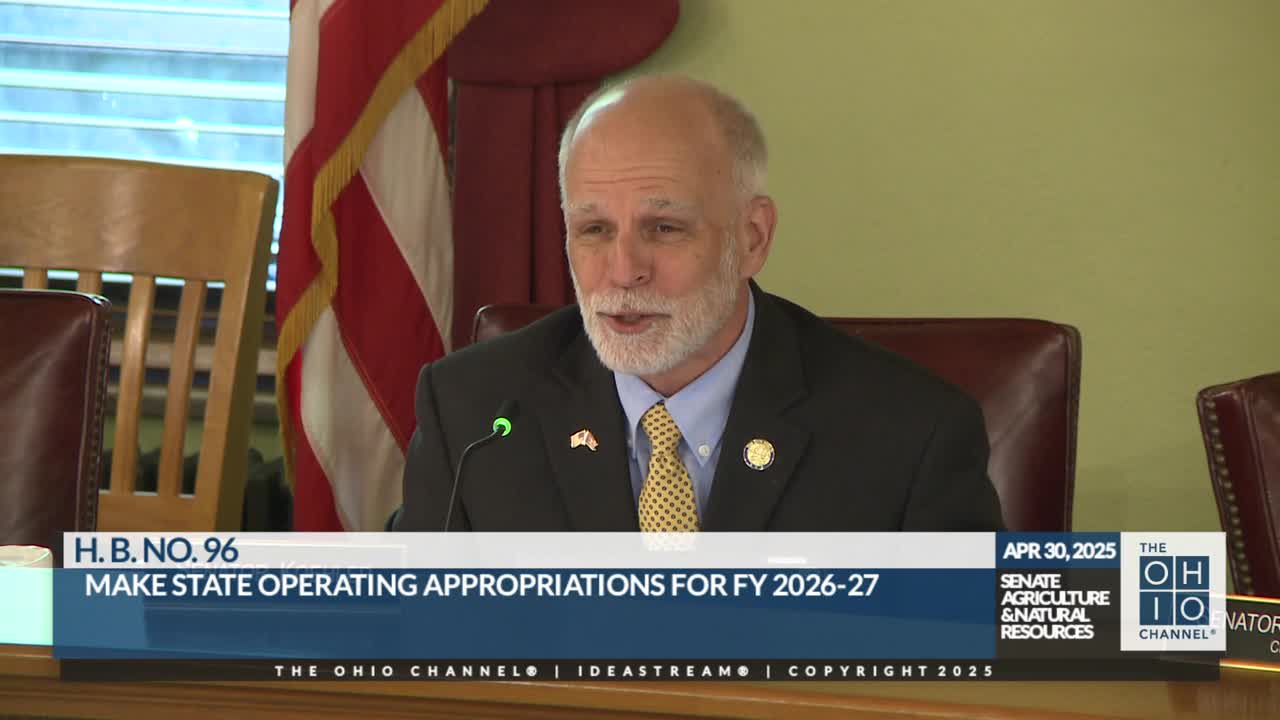
The Ohio Latino Affairs Commission asked the Senate Agriculture and Natural Resources Committee to support the governor’s proposed budget so the commission can continue community outreach, capacity building and programs in health, education and workforce development.
"Our commission will continue to support organizations that serve the Latino community with capacity development efforts," Executive Director Giovanni (recorded as Giovanna in the hearing introduction) Alvarez told senators. He said the commission represents a fast‑growing population — about 566,000 Hispanic‑Latino Ohioans per 2020 census figures cited in testimony — and that the commission employs a small staff (3.5 full‑time equivalents) and an 11‑member governor‑appointed board.
Alvarez highlighted three priorities for FY 2026–27: (1) maintain constituent services and online resource directories such as OlaNet, (2) increase capacity building in education, health, workforce and economic development, and (3) advise state leaders on issues affecting Hispanic and Latino Ohioans. He described recent mental‑health programming carried out in partnership with the Department of Mental Health and Addiction Services (now Department of Behavioral Health) that has secured more than $2 million in grants over five years.
Alvarez told senators the commission supports workforce pipelines for agriculture and other industries and emphasized bilingual and culturally competent service needs across education and behavioral health. Committee members asked whether current funding levels were sufficient; Alvarez said a recent vacancy and a lost administrative professional led to a lower baseline appropriation, but the commission expects to operate with three full‑time staff and an intermittent position while leveraging interns and partner relationships to stretch resources.
The commission’s request proceeds through the budget process; senators had no objection at the hearing.