Get Full Government Meeting Transcripts, Videos, & Alerts Forever!
Get email alerts on the Career Technical Education topic
No spam. Unsubscribe anytime.
Director urges mandatory career planning, middle‑school CTE access and updated credential list
Summary
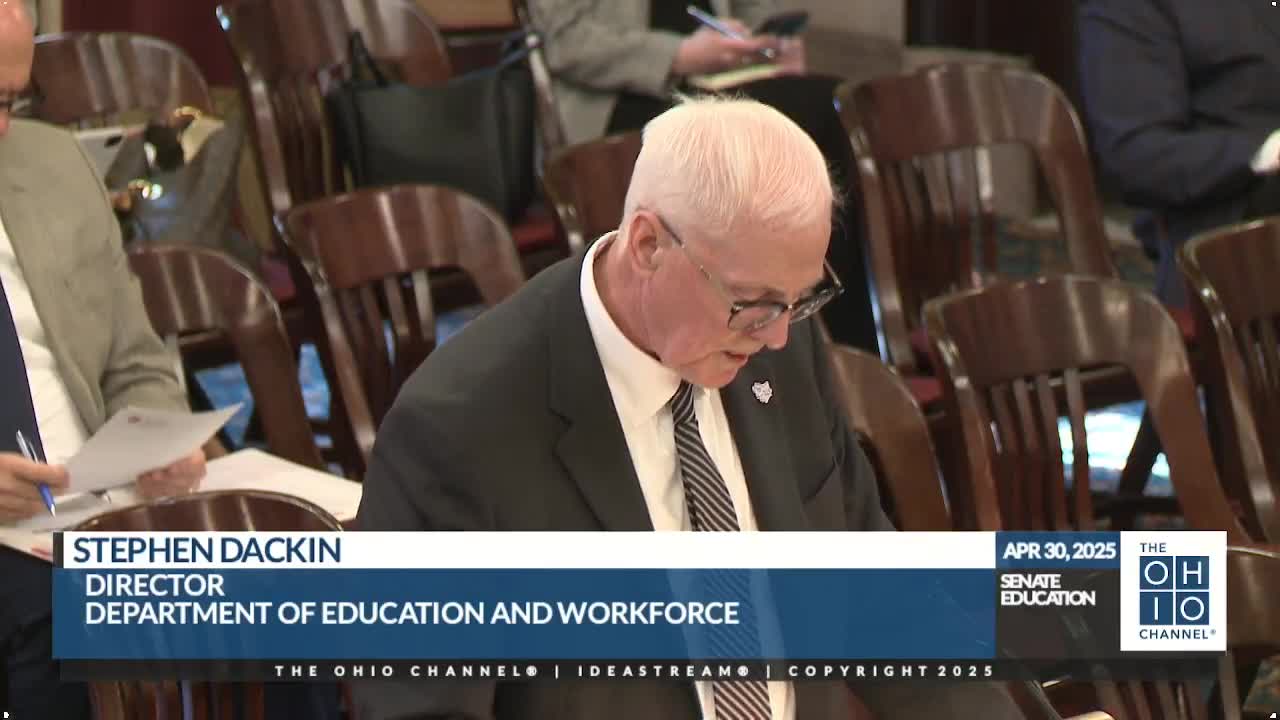
The executive budget would require career planning in high school, eliminate middle‑school career technical education waivers, invest in regional tech‑prep centers, and direct an update of the state industry‑recognized credential list, Director Steve Dakin told the Senate Education Committee.
Steve Dakin, director of the Ohio Department of Education and Workforce, told the Senate Education Committee the executive budget requires high schools to incorporate career planning into students’ graduation plans, and recommends eliminating the waiver that allows some middle schools to avoid offering career technical education (CTE).
Dakin said the department envisions career planning that identifies a student’s career goal and aligns high‑school coursework to meet that goal. “We want kids to stay here,” he said, arguing career planning should connect students with trusted adults who help them navigate post‑secondary options.
To expand access, the executive budget recommends eliminating the middle‑school CTE waiver — which currently is granted to about a third of school districts — so every seventh‑grade student would have access to career awareness. To support regional approaches, the budget proposes up to $7,000,000 per year to reimagine and repurpose regional tech‑prep centers to provide mentoring, career advising and expanded CTE access.
Dakin also proposed directing the department, in collaboration with the Governor's Office of Workforce Transformation and business partners, to update the industry‑recognized credential list used for high‑school graduation, saying the list “has not evolved in 10 years.” He emphasized the importance of ensuring credentials have labor‑market value for students and parents who choose credential pathways.
Committee members asked how funding tied to credentialing would work and whether some credentials would be paid at higher rates. Dakin said the list would be revisited to ensure the market value of credentials is clear and that not all credentials are equal in workforce value.
Ending: Dakin said the recommendations aim to give students earlier access to career knowledge, and to incentivize regional partnerships among schools, employers and higher‑education institutions; no committee action occurred at the hearing.