Get Full Government Meeting Transcripts, Videos, & Alerts Forever!
Get email alerts on the Family Law Parenting topic
No spam. Unsubscribe anytime.
Sponsors say Senate Bill 174 modernizes Ohio family-law language to emphasize co-parenting and best interests of children
Summary
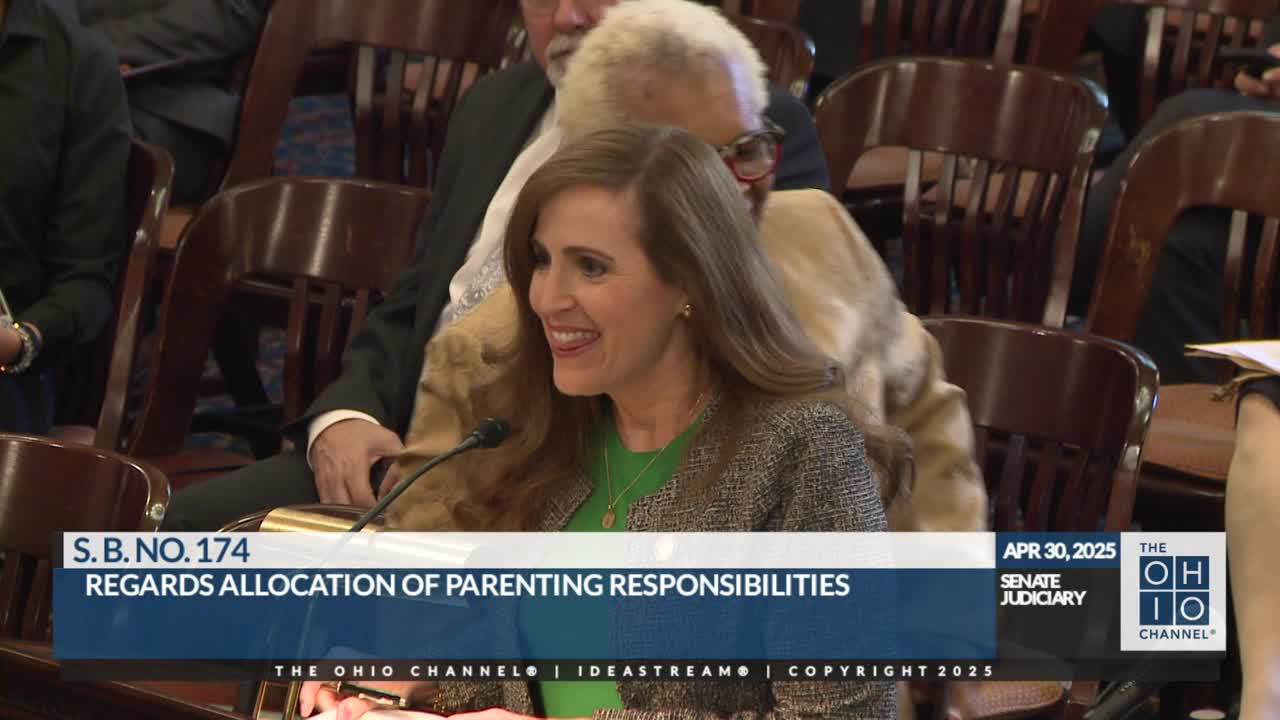
Senate Bill 174 would revise family-law terminology and parenting-plan procedures to emphasize shared parental responsibilities and remove labels like 'custodial parent,' sponsors told the Senate Judiciary Committee.
Senate Bill 174, presented in sponsor testimony to the Senate Judiciary Committee, would revise Ohio family law to emphasize a child-centered, co-parenting approach, sponsors said, removing statutory labels that convey a hierarchical parental role and expanding the factors courts consider when allocating parental responsibilities.
Sponsors framed the measure as the product of long-running work begun under a 2005 Ohio Supreme Court Task Force on Family Law and Children and subsequent advisory committees. "What is in the best interest of a child?" one sponsor asked rhetorically during testimony and said the legislation seeks to make that principle central to allocation of parenting functions.
Major changes described include: discontinuing terms such as "residential parent" and "custodial parent" to reduce adversarial framing; specifying that parenting plans allocate all parenting functions and responsibilities (and may designate a parent for particular functions); expanding best-interest factors to include attempts to mislead the court or cause unnecessary delay; instructing courts to use a single parenting-plan document tailored to a child’s age and development; and requiring written findings if a court denies equal parenting time for safety or other stated reasons.
Sponsors said the bill updates statutory language in response to evolving family structures, including unmarried parents and other guardians, and aims to align the Ohio Revised Code with best practices recommended by family-law experts and the Supreme Court’s advisory groups.
Committee process: Senators Gavarone and Hicks Hudson provided sponsor testimony and asked the committee to schedule proponent testimony. The committee took no final action at the hearing.
Procedural status: The committee recorded the testimony as the first hearing on Senate Bill 174; no vote was taken.