Get Full Government Meeting Transcripts, Videos, & Alerts Forever!
Get email alerts on the Public Art Preservation topic
No spam. Unsubscribe anytime.
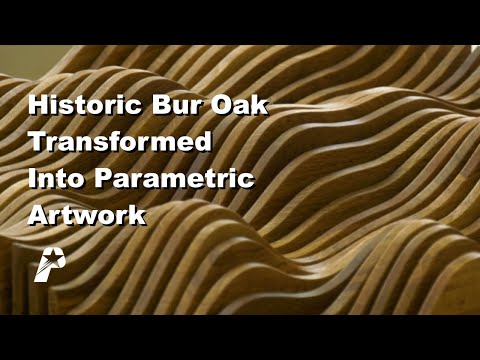
Engineer turns 400-year-old Plano bur oak into parametric wood sculpture
Summary
Engineer Steven Sieg Miller used computer-generated wave simulations and months of woodworking to create a parametric art piece from the quadricentennial bur oak that fell in Plano during a 2023 storm after the city asked artists to preserve the tree's legacy.
Engineer Steven Sieg Miller has created a parametric wood sculpture from the quadricentennial bur oak that fell in Plano during a storm in 2023 after the city of Plano asked artists to preserve the tree’s legacy.
The project converts computer-generated wave patterns into a grid of points that guided precision cutting, sanding and assembly of the burr oak wood, Sieg Miller said. “I started out creating a basic program that simulates the the ripples of a wave,” he said.
The effort began after the tree — described in meeting materials as one of North Texas’ oldest natural landmarks — fell during a powerful storm in 2023. “The mighty Burr Oak fell during a powerful storm in 2023. It had been a symbol of endurance and history,” a meeting narrator said. The city asked artists to preserve the tree’s legacy, prompting the project.
Sieg Miller said his software models interactions between multiple waveforms and outputs a large grid of points that he then transfers to the wood. “My computer program, it is able to compute all the interactions between any different waves that I put on the same art piece. And so then it's able to give me back that design as a large grid of different points, and so I worked out a system for transferring those points to the piece of wood that I'm working on,” he said.
After months of computing, sawing, sanding and precision cutting, the work took shape, the transcript shows. Sieg Miller described a common practical challenge in such projects: “Usually, the biggest mess up is that I've, run out of too much material to work with.”
Sieg Miller said he hopes the piece will serve as a second life for the tree and be appreciated locally. “I'm really excited to be able to work on something that has such a history in Plano and will continue to be appreciated, hopefully, by someone in the city of Plano for a long time coming,” he said.
The project synthesizes engineering, woodworking and local history; the transcript does not specify where or when the finished piece will be displayed, nor does it list funding sources or formal approval steps taken by the city.