Get Full Government Meeting Transcripts, Videos, & Alerts Forever!
Get email alerts on the Capital Master Plan topic
No spam. Unsubscribe anytime.
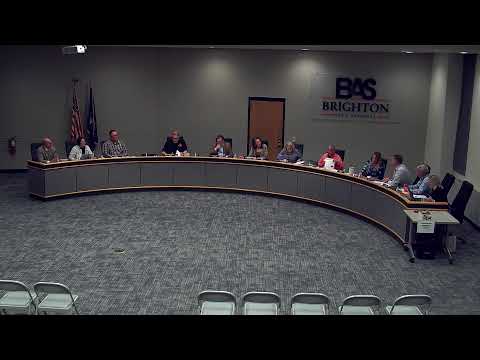
Brighton Area Schools board leans toward bond after facility survey; May vote set to refine scope
Summary
Board members reviewed results from a district facilities survey of nearly 1,400 respondents and discussed whether to place a bond or sinking fund before voters in November 2025. Administrators outlined a working capital master plan, an $8.9 million capital projects fund and deadlines to apply to the state if the board opts for a bond.
Brighton Area Schools board members discussed next steps for a multi-year capital plan after administrators presented results from a facilities survey completed by nearly 1,400 residents.
The presentation, led by Dr. Outlaw, superintendent, and Mr. Jones, a district staff member who oversees the capital master plan work, framed the board’s choice as three options: (1) ask voters to approve a bond in November 2025, (2) place a sinking fund before voters, or (3) take no action. Administrators told the board they must finalize an application to the Michigan Department of Treasury this summer if the district wants to place a bond on the November ballot; the board is expected to take a formal vote at its first May meeting on whether to proceed.
Why it matters: administrators said the survey and the master plan identify immediate and longer-term capital priorities across instructional space, athletics and performance venues. The district has already moved about $8,900,000 into the capital projects fund and administrators proposed assigning near-term items to that balance while reserving large construction projects for a bond.
Key details: the survey asked respondents to prioritize ten identified projects; science classrooms, gymnasium air conditioning at the high school and additional elementary classroom space ranked high, administrators said. Mr. Jones described the master plan as “a working document. It is constantly changing,” and said the district combines a state facilities assessment with local priorities and current square-foot cost estimates to produce project price tags.
Administrators described four funding buckets in the draft plan: (1) the $8.9 million capital projects fund (already partially assigned), (2) a separate bond category for large construction/remodeling projects, (3) food-service capital items funded from the food-service fund balance, and (4) routine capital from the general fund. Mr. Jones said the turf project is currently budgeted at roughly $2,400,000 from the capital projects fund and that, besides that item, no projects have been formally designated for that fund until the board instructs staff to do so.
Board discussion and timeline: the board heard a finance presentation from Baker Tilly at a prior meeting and considered scenarios ranging from smaller packages to much larger multi-series bonds. Administrators said the Baker Tilly work included hypothetical scenarios (one large illustrative scenario cited a $200 million ceiling when projecting millage; another internal exercise showed a $60 million two- or three-series example). The board discussed a two-series or three-series approach to smooth tax-rate impacts across years.
Several trustees said they favored the bond route because sinking-fund receipts would be slower to deliver the scale of work the district now identifies as necessary. Trustees also pressed administrators for more precise cost estimates for several items, notably technology: a line-item of $388,500 in the draft plan for devices and recurring IT costs drew criticism from trustees who said the district’s five-year technology needs are likely several million dollars higher.
Next steps: administrators asked the board for a conceptual signal at the May meeting so staff and consultants can prepare a Department of Treasury application and price missing items. The district expects to return with updated cost estimates and an itemized scope for any bond proposal; the board must formally approve the scope before the district files with the Treasury. No bond measure was placed on the ballot at this meeting; board members agreed to continue due diligence and return to vote in May.
Public comments at the meeting also emphasized arts and performance-space needs, including requests for orchestra-specific rehearsal space and BCPA (Brighton Center for the Performing Arts) improvements, which administrators said are already reflected in the working list of projects.