Get Full Government Meeting Transcripts, Videos, & Alerts Forever!
Get email alerts on the Development Services topic
No spam. Unsubscribe anytime.
Cochise County interim development director outlines budget shortfall, grant wins and enforcement gaps
Summary
Christine McLaughlin, interim director of Development Services, told the Cochise County Board of Supervisors at a May work session that the department is funded primarily by permit and inspection fees, supplemented by grants and an 18% general‑fund subsidy.
Christine McLaughlin, interim director of Development Services, told the Cochise County Board of Supervisors at a May work session that the department is funded primarily by permit and inspection fees, supplemented by grants and an 18% general‑fund subsidy.
McLaughlin said "Approximately 86.5% or a little over a million dollars came from permit and inspection fees last year," and that total revenue for the department (excluding grants) was $1,158,283. She said salary, wages and benefits ran about $1,200,000 and that the department has 12.5 full‑time employees, a staffing level she described as low compared with similar Arizona counties.
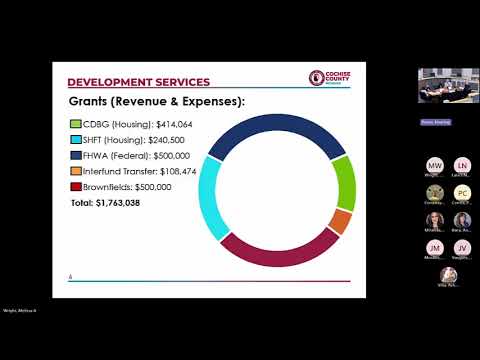
The presentation grouped the department's work into planning/building services, facility management, economic development and real estate. McLaughlin reviewed several grant programs the county has used: Community Development Block Grant (CDBG) funds and SHIFT housing funds administered by the Arizona Department of Housing; Federal Highway Administration grants that funded electric vehicle (EV) chargers at county facilities in Bisbee, Wilcox and Sierra Vista; and multiple U.S. Environmental Protection Agency (EPA) brownfield grants. "For every dollar spent on brownfield cleanup, there's an estimated return of $20 in economic investment," she said, describing brownfield assessment and a revolving loan grant the county has secured since 2019 that together total about $2,100,000.
On housing, McLaughlin described planned work on an affordable housing strategy and said the county will present a six‑month housing study to supervisors next week. She said available approaches include rent assistance, rehabilitation programs funded through HOME and CDBG, and encouraging development on consolidated parcels where utilities are feasible.
Supervisors pressed McLaughlin and staff about code enforcement, collection of fines and whether enforcement has been truly proactive or mostly complaint‑driven. Board members said some long‑running code violations — including multiple recreational vehicles on properties and an apparent unpermitted guest‑ranch operation — have not resulted in fines, and asked whether modest fines or more code‑enforcement staffing would deter repeat violations. McLaughlin said fines depend on code enforcement activity and that the department seeks programmatic and funding options to address housing and blight but did not report a new, formal enforcement policy or approved staffing increase at the meeting.
On antiquated subdivisions and tax‑lien parcels, McLaughlin described staff work targeting clusters of small, contiguous parcels — especially near Douglas’ Port of Entry and north of the new Port of Entry adjacent to Cochise College — for potential consolidation through the assessor's office and for rezoning options. She said staff plan a Planning and Zoning Commission work session on May 14 to consider a zoning text amendment to allow increased accessory heights in antiquated subdivisions (zoning district SR‑174) and other special‑area provisions intended to make small parcels more usable.
The meeting included discussion of the county’s EV charger installations. Supervisors noted the chargers are being placed at county facilities and city locations, and asked about usage, payments and local economic benefit. McLaughlin said chargers will permit drivers to recharge at county buildings, and that charging fees are per kilowatt‑hour; she said ribbon‑cutting events were being scheduled.
McLaughlin also said the county intends to pursue another brownfield assessment grant (she mentioned seeking a $1,000,000 assessment grant this year) and that staff will continue to look for available housing rehabilitation and emergency assistance programs. No motions or votes were taken at the work session; the presentation and subsequent board comments were discussion and direction for staff.
The Board scheduled follow‑up work sessions and said it wants staff to return with recommendations on the Planning and Zoning text amendment, housing study results, grant applications and options for strengthening code enforcement.