Get Full Government Meeting Transcripts, Videos, & Alerts Forever!
Get email alerts on the Homelessness topic
No spam. Unsubscribe anytime.
Baltimore officials say more permanent supportive housing and services needed as homelessness rises
Summary
City and state officials told a Baltimore City Council committee the number of people entering homelessness rose in 2024–25, that permanent supportive housing and case management are critical, and that funding gaps — especially for services — limit the city’s ability to house and keep its most vulnerable residents.
The Baltimore City Council’s Housing & Community Development Committee heard a report Tuesday from Ernestina Simmons, director of the mayor’s Office of Homeless Services (MOHS), saying the city served more people in 2024 and that the number of residents experiencing homelessness for the first time rose sharply.
"Our mission is to make homelessness rare and brief," Simmons told the committee, then outlined program counts and system measures. MOHS reported serving 21,306 clients in 2024 through supportive services, shelters and housing programs; enrolling 6,609 clients in the coordinated entry system; and providing permanent supportive housing to 4,249 clients. Simmons said the city exited 1,044 clients to permanent housing and that outreach teams served 3,106 people, delivering 63,261 services.
Why it matters: City and nonprofit leaders said permanent supportive housing (PSH) — housing linked to on-going case management, health care and substance-use treatment — is the most effective intervention for people with chronic needs. But they warned that funding for supportive services is sparse, restricting how many units can include the services that sustain tenancy.
Simmons told council members the city lags national trends for moving people from unsheltered situations into permanent housing. She said MOHS’s 2025 unsheltered point-in-time count recorded 188 people on the street the survey night and that among those unsheltered, self-reported substance-use disorder rose from 23% in 2023 to 76% in 2025.
Dan McCarthy, of Episcopal Housing Corporation, and Kevin Lindemood, CEO of Healthcare for the Homeless, described a planned conversion of two city‑owned hotels on Fallsway into PSH. McCarthy said the proposal would renovate the former Holiday Inn and demolish the adjoining Sleep Inn to build a new structure, combining the sites into roughly 170 units. He said the sponsors planned to apply for Maryland tax-credit financing in mid‑May and expected an award decision by August; construction would begin roughly 12 months after financing, with phased occupancy starting about a year after that.
McCarthy and Simmons confirmed the hotel sites are currently used for noncongregate shelter and that the city intends to secure replacement shelter capacity while proceeding with the conversion. Simmons emphasized that residents currently using shelter beds are not guaranteed tenancy in the new PSH projects; referrals into the finished development would follow the coordinated entry process.
Healthcare for the Homeless, which provides clinical and supportive services, said it now operates approximately 550 PSH units and that its integrated care model — clinics, mobile units and shelter-based services — is designed to improve housing stability once people are housed. "For every $100 increase in median rental costs, homelessness goes up by 9%," Lindemood told the committee, citing research from Pew and the National Alliance to End Homelessness.
State and federal programs: Danielle Meister, assistant secretary at Maryland DHCD’s Division of Homeless Solutions, told the committee the state provided about $7 million to homeless-specific programs in the last fiscal year and has expanded a Medicaid housing case-management waiver (described in testimony as the Access to Community Integration Services or "ACES" waiver). Meister said the state received federal approval to expand slots from 900 to 2,100 statewide and that the state will cover the non‑federal match going forward, which she said should increase local capacity to provide long-term supportive services.
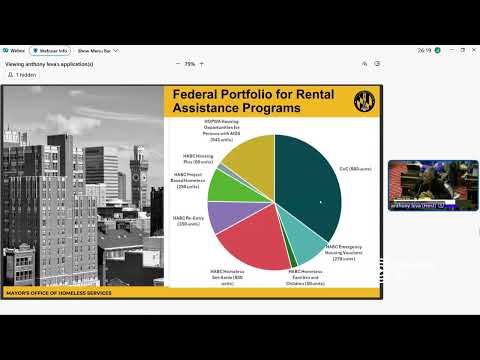
Funding gaps and service costs: All presenters said the principal shortfall is supportive services funding. Simmons and partners showed that while capital subsidies and rental assistance fund many housing units, the annual cost of intensive case management and wraparound services is not consistently underwritten. Simmons cited a Medicaid pilot that provides roughly $2.685 million to fund 300 case-management slots; she said that leaves many PSH units without matched services. In committee discussion, Lindemood and a COC representative said an "ideal" case-manager-to-client ratio for intensive PSH ranges from 1:14 (best-case) to 1:20 or 1:25, and that services costs are roughly $8,000 per person per year — less than average unit costs but difficult to finance sustainably.
Prevention and eviction-related questions: Council members asked whether reductions in eviction-prevention dollars explain the rise in first-time homelessness. Simmons said MOHS does not track eviction filings and does not collect a client's reason for entering the system, but she and the committee discussed coordinating with the mayor’s Office of Children & Family Success and state partners to get eviction-prevention spending and eviction-filing data. Simmons said in 2024 the city used flex funds for shelter diversion and diverted 1,599 clients; with those funds largely exhausted, the city now sees more first-time shelter entrants.
System performance and next steps: Speakers stressed three fronts: (1) add more PSH units, (2) secure sustainable funding for supportive services, and (3) maintain accessible, decent shelter for people entering the system. The committee’s vice chair said the committee will hold quarterly follow-up hearings and requested MOHS provide data and a plan for prioritizing scarce resources if federal funding declines.
Ending note: Officials said the city has ramped up interagency coordination among MOHS, DHCD, the Housing Authority of Baltimore City and nonprofit providers and that the expanded Medicaid waiver and recent state tax-credit policy changes may accelerate PSH capacity, but that service funding remains the limiting factor to reduce chronic and unsheltered homelessness.