Get Full Government Meeting Transcripts, Videos, & Alerts Forever!
Get email alerts on the Lead Remediation topic
No spam. Unsubscribe anytime.
Milwaukee board reviews lead action plan, outlines inspections, relocations and timelines
Summary
Milwaukee Public Schools presented a districtwide lead action plan April 30 that prioritizes inspections, hiring certified assessors, specialized cleaning, targeted relocations and public screenings; the item was informational and no vote was taken.
The Milwaukee Board of School Directors on April 30 received an update on the district's lead action plan, a multi-pronged effort the administration developed with the Milwaukee Health Department to inspect, stabilize and communicate about lead hazards in school buildings.
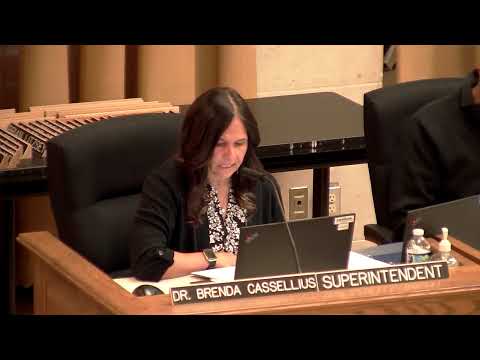
The plan focuses on expanding inspection capacity, partnering with external contractors and agencies, and identifying certified personnel to perform lead stabilization. Superintendent Brenda Cassellius told the board the district will "expand the capacity for the inspections of all of our buildings" and that the work "will be guided by our five priorities for success and aligned to our strategic plan." Michael Harris, interim chief school administration officer, led the presentation.
Why it matters: Board members and public speakers said the issue affects students citywide and raised questions about timelines, accountability, water testing and funding. The district presented action benchmarks and provisional timelines for remediation and said it will seek grants and use district reserves to fund work rather than asking individual schools to pay.
The presentation listed five program priorities: hire certified lead risk assessors and inspectors, update lead-hazard protocols with annual reviews, strengthen cleaning and documentation, train staff, and pursue additional funding. The administration described a prioritization strategy that gives highest attention to buildings built before 1978 that serve young children and to spaces where conditions or severity indicate higher risk. Michael Harris said the district will use internal and external resources to meet targets.
Key details provided by the district and during public comment - Scope and timing: The district identified 106 schools built before 1978 that will require some remediation (described to the board as 54 buildings in the oldest cohort and 52 in the 1950'1978 cohort). The district set a goal to complete stabilization in schools built before 1950 "by the end of summer" and to complete stabilization of schools built between 1950 and 1978 by the end of the calendar year. Harris said 54 buildings are under the earliest cohort and that 7 of those have been cleared or are close to clearance. - Cost and spending: Administration reported about $2,000,000 has been spent so far; final cost estimates are still being calculated as inspections continue. - Staffing and program changes: The lead action plan proposes the addition of lead risk assessors (the administration described two FTEs as part of the plan), additional cleaning staff and a field assistant, plus a permanent lead expert to provide ongoing oversight. - Relocation thresholds: The plan sets benchmarks for temporary relocations: full relocation when 50% or more of surfaces are deteriorated; partial relocation for 10% to 50% deterioration. The district said it will prioritize minimizing instructional disruption and will communicate directly with affected school communities. - Screening and communication: The district plans at least two blood-lead screening events during June'August and additional community town halls and virtual tours. Administration said a clinic will be held May 7 at North Division at 2 p.m. The district encouraged parents and staff to report concerns first to the school principal and building engineer and provided an email for concerns: led@milwaukee.k12.wi.us.
Public comments and concerns: Dozens of speakers urged faster action and stronger accountability. Kristin Payne, a public commenter, said the plan "does not match the urgency that the lead crisis deserves," asked the district to leverage state agencies and called for stronger water limits, noting that the American Academy of Pediatrics recommends a school-water recommendation of 1 part per billion. Ingrid Walker Henry, president of the Milwaukee Teachers Education Association, called on the state to increase special-education reimbursement and urged careful choices about abatement methods. A number of parents, teachers and community advocates asked for transparent, comprehensive water testing data, routine filter maintenance records and fuller disclosure of test results.
Board members'questions and next steps: Several directors pressed administration for budget detail and timing. Director O'Halloran said a resolution being drafted would seek water-filtration maintenance data and inspection and surveillance results; the administration said budget details and specific facility investments would be presented as part of the FY26 budget process and that a budget timeline includes an initial presentation on June 2. Administration said the remediation work will be centrally funded from district reserves, not taken from individual school operating budgets.
The district emphasized a mix of short-term contracts with outside vendors for immediate stabilization and long-term, permanent positions for ongoing oversight, cleaning and maintenance. Officials said the long-range facilities master plan will be adjusted to incorporate lead remediation costs and that potential consolidations or rebuilds will be decided with community input.
This item was noticed for possible action but presented as informational; the board took no formal vote on the lead action plan at the April 30 special meeting.