Get Full Government Meeting Transcripts, Videos, & Alerts Forever!
Get email alerts on the Indigent Defense Budget topic
No spam. Unsubscribe anytime.
Cochise County public defender, legal advocate outline staffing, expert-fee and training needs ahead of budget cycle
Summary
At a Board of Supervisors work session, Cochise County public defender and the legal advocate described staffing shortages, rising expert and evidence‑review costs, and requested funding adjustments including a proposed $15,000 professional‑services fund and a training increase.
Cochise County public defender Charles (Public Defender) and Andrew Marcy, director of the Legal Advocate, told the Board of Supervisors at a work session that staffing vacancies, rising expert‑witness and evidence‑review costs, and training needs will drive budget requests for the next fiscal year.
The presentations focused on three immediate budget pressures: judicial‑related professional fees for experts and accident reconstruction, a proposed $15,000 professional‑services fund to pre‑screen voluminous digital and medical records, and an increase to training funds to send newer attorneys to multi‑day trial and database trainings.
Charles said his office currently includes five criminal felony attorneys (two part time), a title‑36 mental‑health attorney, four dependency/misdemeanor/delinquency attorneys (three part time, one full time), one legal‑secretary supervisor, six legal secretaries and one defense investigator. He said his dependency attorney will retire in June and the office plans to move three part‑time legal defender positions under the public defender umbrella; the three part‑time roles now work roughly 21 hours and the office is proposing increasing them to 30 hours per week to cover most of the retiring attorney’s work.
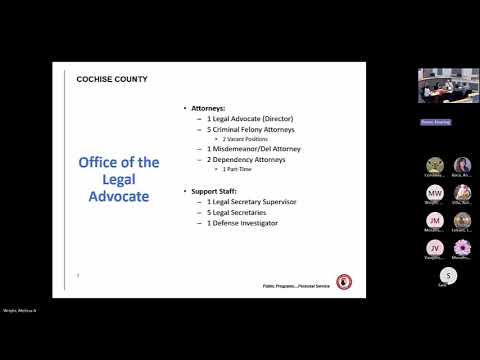
Andrew Marcy said the Legal Advocate has five criminal attorney positions but two were vacant at the time of the meeting. He said many of his attorneys are relatively new and need more training before handling serious cases. “I have 5 criminal attorney positions in the office, but 2 of them are currently vacant,” Marcy said.
Both offices described shifting case mixes and operational strain: Charles reported about 130 title‑36 mental‑health cases year to date and said conflicts referred to contract counsel have fallen from approximately 74 a year and a half ago to about 15 recently. He and Marcy also described reliance on contract attorneys for misdemeanors and overflow work; one contract arrangement cited in the presentation pays $200 per misdemeanor case regardless of trial or plea outcome.
Charles and staff reviewed recent and projected expert costs. Examples cited included approximately $14,833 for an expert in one arson matter and about $7,500 for another consultant in the same case (totaling about $22,000), $1,600 for an accident reconstruction consultant and $250 for blood‑alcohol testing in a DUI matter. Fiscal‑year to date, the offices reported spending about $46,558 against a $23,000 budget line for expert and related judicial expenses.
To address the growing volume of digital evidence, Charles requested establishing a $15,000 professional‑services fund to pre‑screen Cellebrite phone dumps, accounting records and other voluminous materials at lower hourly rates (example cited: $20/hour for screening) before deciding whether to escalate to higher‑cost experts. He said pre‑screening could reduce the county’s variable expert expenditures by catching cases that do not require costly expert analysis.
Both offices asked for a modest increase to training funds (Charles requested a $5,000 increase) to support specialized, multi‑day training for newer attorneys and for staff who maintain and use the defense case database referenced as CARPEL/CARPEL‑type software. Charles described sending staff to St. Louis for database training and noted the benefit of having vendor developers present at the training to implement requested features.
Board members and presenters discussed operational impacts of the county’s early resolution/settlement process (referred to in the meeting as ERC or EDC) on workload and trial demand. Presenters said that without plea resolutions the defense workload would be many times larger and that the county’s limited pool of experienced defense attorneys and the court calendar constrain trial scheduling.
No formal action or vote was taken at the work session; the presentation was informational and intended to inform supervisors as the county prepares the budget. Supervisors asked questions about pay competitiveness, part‑time to full‑time staffing conversions, contract‑counsel rates, and potential savings if more cases can be kept in‑house.
Officials said any unspent funds would revert to the general fund and noted that increasing allocated professional and training resources could keep more work in fixed‑cost county staff rather than incurring larger variable contract and expert costs.
The board moved on to a scheduled finance item following the discussion; budget requests and appropriation decisions will be considered in the county’s formal budget process.