Get Full Government Meeting Transcripts, Videos, & Alerts Forever!
Get email alerts on the Municipal Budget topic
No spam. Unsubscribe anytime.
Lompoc council reviews 10-year general fund forecast, hears warning about Measure I sunset and pension costs
Summary
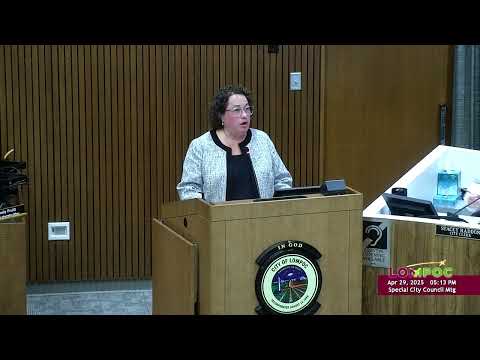
LOMPOC, Calif. — City leaders and staff on April 29 reviewed a status‑quo draft of the proposed 2026–27 biennial budget and a 10‑year general fund forecast that flagged rising insurance and pension costs, uncertain revenue trends and a significant revenue timing risk tied to the scheduled expiration of Measure I.
LOMPOC, Calif. — City leaders and staff on April 29 reviewed a status‑quo draft of the proposed 2026–27 biennial budget and a 10‑year general fund forecast that flagged rising insurance and pension costs, uncertain revenue trends and a significant revenue timing risk tied to the scheduled expiration of Measure I.
Management Services Director Christy Donlin opened the workshop by telling the council that "this is a status quo" budget, meaning staff built the draft mostly by carrying current service levels forward while adjusting for known nondiscretionary increases. Donlin said finance and departments have worked through thousands of line items; staff expect to deliver a draft budget and CIP book in mid‑May and to present the package to council on June 3, with final adoption possible June 17.
The city’s consultant, Jim Morris of Urban Futures, walked the council through a baseline forecast and a recession scenario. "It is a projection based upon the best information we have today of what your finances look like over 10 years," Morris said, describing the model’s assumptions: salary growth at 2.85% (the CalPERS assumption), a roughly 10% historical vacancy factor, and Moody’s Analytics economic inputs tailored to the Santa Barbara region.
Nut graf: The forecast shows modest annual operating surpluses under the baseline, but it calls attention to two timing issues that could sharply change the city’s outlook: (1) CalPERS unfunded actuarial liability (UAL) payments that peak in the next few years before dropping in FY 2036 because of a prior “fresh start” payoff, and (2) the scheduled expiration of Measure I (the local sales tax) in the third quarter of FY 2036. Morris said the two events together could create a near‑term fiscal bridge the council will need to plan for.
Key findings and numbers - Insurance and other nondiscretionary costs are rising: Morris and Donlin highlighted sharp increases in liability, workers’ compensation and property insurance in recent years; Donlin noted an 82% jump in liability insurance between 2021 and 2022 and a 24% rise in 2024. Staff cited a projected 28% increase for the coming year (noted as FY26) and a further 20% the following year from the city’s insurance provider/JPA. - Credit‑card processing: Donlin said staff renegotiated processing fees in April and now estimate a recurring annual savings of at least $918,000 compared with prior projections (staff estimated processing charges would fall from roughly $1.6 million to about $650,000 in the coming year after negotiations, with a range of savings depending on interchange fees). - CalPERS UAL and Measure I timing: Morris said miscellaneous UAL increases about 19% starting in 2026 and that, because of the city’s earlier fresh‑start payoff, UAL payments will fall by roughly $8.5 million in FY 2036. He also said Measure I is scheduled to expire in FY 2036 and that expiration would reduce revenues by about $11.8 million that year — a net revenue swing of roughly $3.3 million compared with the UAL reduction. - Major revenue lines: Staff projected TOT at about $2.5 million for the year and cannabis revenues near $1.5 million; Bradley‑Burns (local sales tax pool) receipts were below budget for FY25 and were projected to partially recover in FY26–27 but remain modest. - Budget construction: Donlin described a status‑quo baseline built from FY25 with adjustments for contracts, benefits and division requests. She said finance reviewed roughly 5,400 nondiscretionary lines and that divisions produced about 2,400 line‑item requests as part of an overall dataset exceeding 17,000 lines.
Scenario testing and reserves Morris emphasized the model’s value as a planning tool to answer “what if” questions rather than to predict exact dollar amounts. He showed a mild recession scenario (a roughly 1% revenue contraction in FY27) that produced two years of operating deficits and a noticeable dip in the city’s fund balance compared with the baseline. Under the baseline, the forecast projects modest operating surpluses but not enough to reach a two‑months‑of‑operations reserve target or an aspirational 25% reserve target; Morris recommended using the model to build a “bridge” toward the FY36 change in UAL and Measure I.
Council discussion, public comment and staff directions Councilors pressed staff and the consultant on assumptions and sensitivity. Council Member (unnamed in the transcript) said the expense growth rates in the forecast chart "scare me," questioning why several expense categories now assume long‑term growth near 3% versus historical rates nearer 6%.
Multiple councilors asked staff for follow‑ups and additional detail, including: - A mid‑May delivery target for the draft budget and CIP book and a scheduled presentation June 3, with June 10 as a possible supplemental workshop and June 17 as the adoption date. - Staff to run additional "what if" scenarios (for example, higher expense growth or alternate labor assumptions) and bring the results back to council. - Detailed breakdowns of enterprise reimbursements, transfers‑in (the electric utility transfer was cited as a large historical transfer), the cost‑allocation plan and the enterprise reimbursement methodology; several councilors requested five‑year trend data for those items. - A review of the cost‑allocation entries that support economic development funding (including the city’s chamber contract) and any items that might require Prop 218 analysis. - Street maintenance: councilors and a public commenter asked staff to respond to deteriorating street conditions (the speaker noted blocks with PCI scores in the red and requested consideration of adding three street worker positions as a near‑term mitigation). - Cash reports and financial system status: a councilor asked staff to address an apparent backlog of cash reports and whether system fixes or patches are needed to deliver timely financial statements.
Public comment during the workshop raised the same follow‑up requests for transparency on transfers and the chamber/economic development funding; the chamber contract was noted as expected to return to council in May.
Formal actions No motions or votes were taken at the special meeting. The council provided direction to staff to prepare the draft budget and related follow‑up analyses, to run sensitivity scenarios in the forecast model, to return with enterprise reimbursement and cost‑allocation detail, and to present the budget and forecast at the June 3 meeting (with workshops or adoption dates to follow as needed).
Why this matters The workshop gave council an early view of a 10‑year fiscal path that looks balanced under the baseline but depends heavily on projections for key revenue streams and on managing labor, insurance and pension costs. The scheduled FY36 coincidence of a large reduction in UAL payments and the expiration of Measure I creates a multi‑year planning challenge: without deliberate policy and fiscal choices, the city could face a sizable revenue gap at that point.
What’s next Staff committed to deliver the draft budget and CIP to council staff by mid‑May, present the draft on June 3, and return with additional “what if” scenarios and line‑item detail requested by councilors — including enterprise reimbursements, cost allocation, chamber contract terms and streets maintenance options. There were no formal votes at the workshop.
Ending note: The workshop concluded with the council closing the meeting and setting follow‑up deadlines in advance of the June budget cycle.