Get Full Government Meeting Transcripts, Videos, & Alerts Forever!
Get email alerts on the Community Services Block Grant topic
No spam. Unsubscribe anytime.
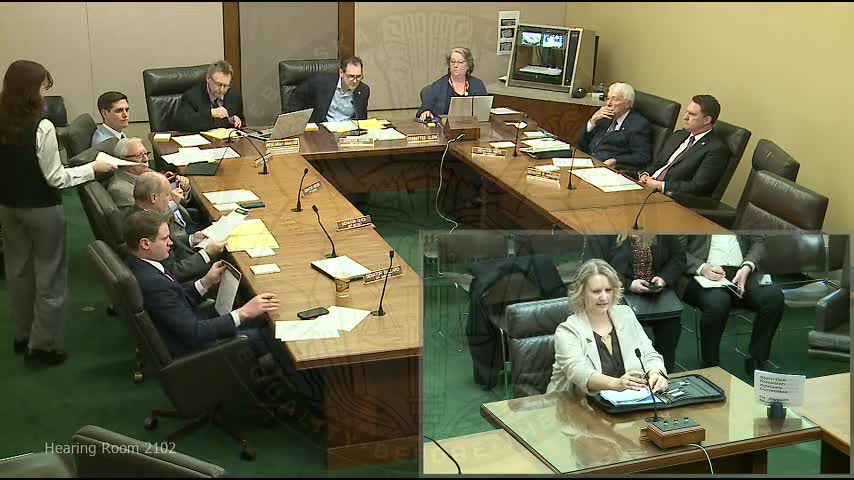
Nebraska HHS Committee reviews CSBG state plan, hears local community action agencies describe services and needs
Summary
At a public hearing of the Nebraska Legislature Health and Human Services Committee, state and local officials reviewed the federal Community Services Block Grant (CSBG) state-plan process, described how CSBG funds are used across nine community action agencies, and highlighted local pilot programs and funding pressures.
At a public hearing of the Nebraska Legislature’s Health and Human Services Committee, senators heard federal and local officials describe how the Community Services Block Grant, or CSBG, supports Nebraska’s nine community action agencies and the state’s plan development for federal fiscal years 2027–28.
The discussion matters because CSBG is the core federal funding stream that underpins Nebraska’s Community Action Network. Shannon Goetrien, director of the Office of Economic Assistance at the Nebraska Department of Health and Human Services, told the committee the department is drafting the state plan that must be submitted by Sept. 1, 2026, and summarized program oversight, eligibility and reporting requirements tied to the federal CSBG Act.
"The purpose of the Community Services Block Grant is to provide assistance to states and local communities ... for the reduction of poverty, the revitalization of low-income communities, and the empowerment of low-income families and individuals to become fully self-sufficient," Goetrien said. She told senators the department distributes CSBG funds to nine community action agencies in Nebraska using a population-based formula and monitors agencies for federal and state compliance.
Goetrien briefed the committee on recent program totals for federal fiscal year 2024, saying Nebraska received $5,300,000 in CSBG funding; community action agencies provided services to more than 32,000 low-income individuals from roughly 16,500 families. Goetrien also said about 11,000 of those individuals were children, more than 6,500 were senior citizens, and 80.4% of the families served were at or below 125% of the federal poverty level.
Statewide advocates and agency leaders described how CSBG funding is used on the ground. Tina Rockenbach, executive director of Community Action of Nebraska, said the grants are foundational and allow local agencies to leverage additional federal, state and private funds. "CSBG has served as the founding legislation and federal source that creates the Community Action Network nationwide," Rockenbach said, adding that Nebraska’s nine agencies provide roughly 1,500 jobs and a wide range of services from early childhood interventions to weatherization and emergency assistance.
Aaron Bowen, executive director of Eastern Nebraska Community Action Partnership (NCAP), described a local matched-savings pilot his agency began to build household financial capacity. Bowen said the pilot requires monthly deposits, is matched with private foundation funds, and includes financial coaching and case management so participants build a habit of saving rather than relying repeatedly on emergency assistance. Bowen said the pilot began in February with 15 households, including five seniors on fixed incomes.
Bowen summarized the match structure as presented to the committee: participants contribute a minimum monthly deposit, the program matches savings up to $600 at a 2-to-1 rate after the first six months, and if participants remain for a second six-month period Sherwood Foundation funds provide an additional 3-to-1 match; Bowen said the structure could allow participants to leave the program with substantially increased savings. He and other speakers emphasized program reporting, outcome measurement and partnership with banks and local nonprofits.
Mary Spurgeon, who said she serves on NCAP's board and on the Omaha Public Power District board, described NCAP’s Bellevue food pantry and the agency’s geographic reach across Douglas and Sarpy counties. Spurgeon said the Bellevue pantry supplies meal-based distributions and delivers food to households that are homebound.
Committee members asked staff and witnesses about monitoring, performance benchmarks, and how CSBG-funded agencies coordinate with local pilot programs such as proposed poverty-elimination or youth-center efforts. Goetrien and Rockenbach described the community needs assessment and planning cycle that agencies use (every two to three years) and explained that agencies submit action plans and end-of-year reports tied to federal work standards.
No bills or motions were taken during the hearing; the committee concluded public testimony and moved to executive session.
Votes at a glance: none — this hearing consisted of public testimony and informational briefings only.