Get Full Government Meeting Transcripts, Videos, & Alerts Forever!
Get email alerts on the Inheritance Tax Reform topic
No spam. Unsubscribe anytime.
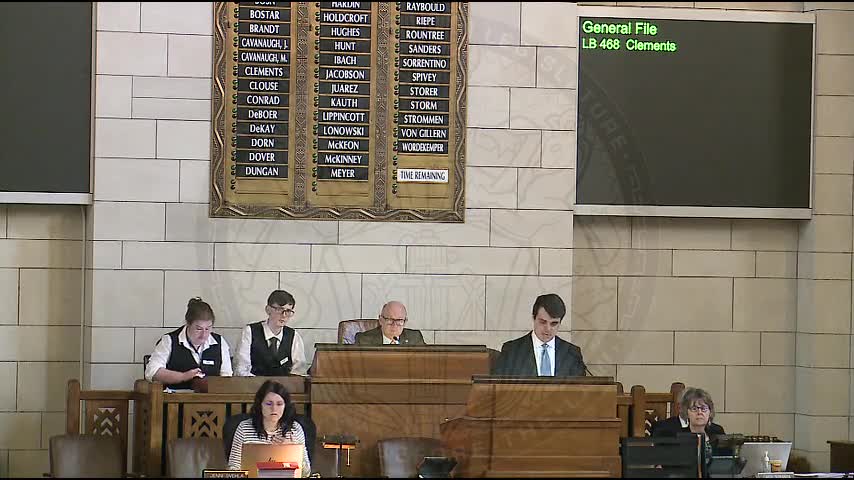
Senate hears bill to cut county inheritance tax while replacing revenue; debate centers on tradeoffs
Summary
Sen. Dan Clements proposed LB468 to lower county inheritance tax rates and raise exemptions while replacing county revenue with a set of state‑level and county fee changes; the floor heard technical debate over the tradeoffs of the replacement package.
Senator Dan Clements brought LB468 to the floor as a priority bill proposing a substantial rewrite of how Nebraska funds county services paid today in part by a county inheritance tax.
Lede: The proposal would reduce beneficiary exposure to the county inheritance tax while replacing that local revenue through a mix of county fee increases, reallocated state taxes and adjustments to several industry‑specific levies. Lawmakers spent the evening weighing whether the proposed revenue swaps would create fair, stable county funding and whether specific changes—particularly to energy tax rules and to a site‑and‑building economic development fund—were desirable.
Nut graf: The Clements bill reduces the top inheritance‑tax rates and raises exemptions for heirs while attempting to offset county revenue losses with increased county shares of certain state tax streams (for example motor‑vehicle administrative fees, a larger county share of insurance premium taxes, reallocations from a documentary stamp fund), modest fee increases and a rise in the nameplate capacity tax used for renewables. The Judiciary/Revenue committee amendment (AM874) refines those technical revenue items; the bill remained under debate at adjournment with multiple senators expressing either conditional support or continued concerns.
What the proposal does: LB468 would cut the county inheritance tax burden by raising exemptions and lowering rates across beneficiary classes. The proposal replaces most of the counties’ lost revenue through ten revenue adjustments listed in the sponsor’s packet: an increase in the county portion of the motor vehicle tax administration fee (from 1% to 2%), a shift in insurance premium tax shares (reducing the state share and increasing counties’ share), a reallocation of documentary stamp revenue, creation of additional county‑dedicated revenue from the nameplate capacity tax (renewables), and modest increases to county fees such as marriage licenses and advertising of delinquent tax sales. The committee amendment (AM874) bundles those changes and provides a county‑by‑county estimate showing most counties would be roughly made whole.
Why supporters back it: Senator Clements and several colleagues said Nebraska’s inheritance tax is increasingly out of step with peer states and raises difficult liquidity problems for families stretching to pay taxes on farms, small businesses or parcels they otherwise wish to keep in a family. “People without children can lose more than 11% of their life savings to this tax,” Clements said in opening. Supporters argued that a carefully designed replacement package is preferable to an unfunded repeal because counties depend on the revenue for one‑time capital projects and public‑safety investments.
Why opponents are wary: Critics—including several former county commissioners in the chamber—warned that proposed replacement revenue streams could be regressive, could shift tax burdens to ordinary residents (via higher fees or property‑tax pressure) and could chill certain industries (notably renewables) if the nameplate‑capacity tax is substantially increased. Several senators asked for more time and more technical detail: how will the nameplate capacity increase affect purchase‑power agreements and local landowners, and what will be the net state general‑fund impact if credits and exemptions in other bills are counted against the offsets in LB468?
Committee discussion and next steps: Revenue committee staff and county officials (NACO) worked with the sponsor in interim meetings to find offsets that counties would accept; NACO formally supported the effort to replace county revenue rather than an unfunded repeal. During floor discussion, Senator Tim Bostar proposed an alternative amendment (AM1069) that would phase out the inheritance tax across 10 years without replacement revenue; the sponsor and NACO opposed that approach as fiscally irresponsible for counties. The bill required additional time for select‑file work and technical changes; a roll call on AM874 and further amendments had not concluded when the chamber recessed.
Clarifying figures and fiscal notes: Clements’ packet estimated replacement revenue of roughly $34.8 million statewide against an estimated $34.3 million reduction in county inheritance collections under the proposed rate/exemption changes (figures are county‑level estimates in the sponsor’s handout). Several line items in the replacement package were called out on the floor: a proposed reallocation of documentary stamp funds (roughly $4.1M to counties in the sponsor’s plan); use of a portion of the Securities Act cash fund (the bill would allocate $5M of that fund to counties); and indexing the nameplate capacity tax (a renewable‑industry in‑lieu tax) to property‑tax growth, which sponsor materials estimate could add $2.5M to counties and $8.5M to schools under current projects and assumptions.
Outstanding questions: Senators asked for clearer analysis of how the changes would affect individual counties (several smaller counties rely more heavily on inheritance tax), how fee increases for marriage licenses and other administrative fees would impact constituents, and whether the measure’s transfers would reduce funds available for economic‑development programs (the bill reallocates documentary stamp dollars used for the site‑and‑building development fund).
Ending note: LB468 represents one of the legislature’s larger tax‑structure attempts this session—an effort to reduce a tax many Nebraskans dislike while keeping counties fiscally whole. Floor debate showed cross‑cutting concerns about fairness, local control and the tradeoffs of funding swaps that lawmakers signaled would need select‑file work and likely technical fixes.