Get Full Government Meeting Transcripts, Videos, & Alerts Forever!
Get email alerts on the Hemp Consumables Delta8 topic
No spam. Unsubscribe anytime.
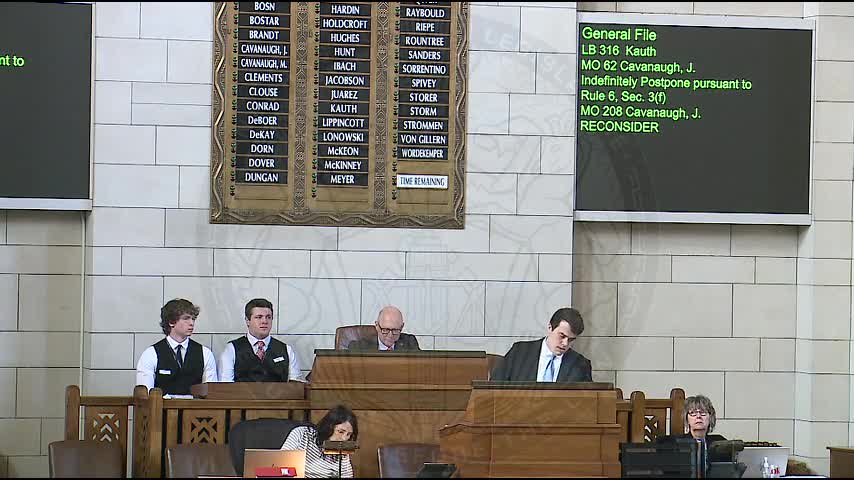
Senate advances bill that sharply restricts consumable hemp products after hours of debate
Summary
The Nebraska Senate voted to adopt a Judiciary Committee amendment and advance LB316 after extended floor debate over whether to restrict or regulate hemp‑derived consumables such as delta‑8 THC products.
The Nebraska Legislature spent most of an afternoon and evening debating LB316, a bill that would sharply narrow which hemp‑derived consumable products are legal in the state and create a new enforcement and tax framework for cannabidiol goods.
The measure, introduced as LB316 and discussed under a Judiciary Committee amendment (AM094), passed the amendment on a 33‑7 roll call and was advanced from general file to enrollment and review 33‑13. Debate ranged from public‑safety accounts and poison‑control statistics to questions about the bill's effect on farmers, processors and small retailers.
Why it matters: Supporters say LB316 closes a legal loophole allowing intoxicating hemp products such as high‑dosage delta‑8 to be sold without testing or child‑safe packaging; opponents say the bill will criminalize lawful businesses and some currently legal hemp products, cut state and local tax revenue and should be regulated rather than banned.
The committee amendment retains most of the bill's stricter hemp definition and adds three elements that shaped votes on the floor. First, it narrows allowable consumable hemp (called “cannabidiol products” in the amendment) so products cannot contain cannabinoids “created through chemical conversion, modification, or synthesis.” Second, it sets a THC limit for processed consumables equal to the lesser of 0.3% total THC on a total weight basis or 10 milligrams of total THC per package. Third, it adds a consumer safe‑harbor period beginning on the bill’s effective date and ending Dec. 31, 2025, during which consumers may surrender non‑compliant products without prosecution; the amendment also directs the Attorney General to coordinate drop‑off locations during that period.
Proponents framed the measure as a public‑health intervention. Senator Julie Kautz, sponsor of LB316, said the bill targets “synthetic” or synthetically enhanced cannabinoid products that are being sold in brightly‑marketed retail stores without robust testing or child‑proof packaging. She cited a series of purchases and investigations by the Attorney General’s Office and local law enforcement that found mislabeled products and some items with delta‑9 concentrations above federal limits. Senator Jared Storm, who spoke frequently for proponents, read letters and poison‑control data documenting hospitalizations and psychotic episodes after use of some hemp‑derived consumables.
Opponents said the bill is too broad and will sweep legitimate hemp uses and small businesses into criminal penalties or destroy markets that already are taxed and regulated at the state level. Senator John Kavanaugh, who has offered an alternative regulatory plan this year, urged a regulatory approach that would require testing, labeling, distance limits from schools, and licensing rather than a near‑ban. “If we pass this, we’ll be banning products based on cumulative THC rather than addressing the manufacturing and labeling problems,” Kavanaugh said. Senator Machaela Kavanaugh and several other senators noted that the federal 2018 farm bill and the Nebraska Hemp Farming Act created a legal hemp market and that change should be narrowly targeted.
Key text and thresholds: Under the amendment, consumable hemp products would be legal only if they are derived from hemp, contain no chemically synthesized cannabinoids, and remain below 0.3% total THC on a total weight basis or 10 mg total THC per package. The amendment also establishes a 10% excise tax on retail sales of allowed cannabidiol products beginning Jan. 1, 2026, to be collected by the Department of Revenue.
Evidence and enforcement: Committee and floor debate cited several data points used by proponents: an estimated 300 storefront “vape/THC” shops statewide that sell products marketed as hemp; Attorney General enforcement actions (the AG has filed about 15 lawsuits and issued cease‑and‑desist letters to more than 100 Omaha‑area stores); and poison‑control and FDA reporting showing thousands of delta‑8 exposures and dozens of adverse events in national data cited at the hearing. Opponents said much of the national data conflates artificially created synthetic cannabinoids (for example products known as K2 or “spice,” which state statute already bans) with hemp‑derived isomers such as delta‑8 that occur in plants or can be concentrated through chemical processes.
Votes and formal actions: The Senate first defeated a motion to reconsider an earlier procedural vote (13‑33). Later, after a successful motion to invoke cloture, the chamber voted to adopt the Judiciary Committee amendment AM094 to LB316 (33‑7). The bill then advanced to enrollment and review 33‑13. The committee amendment includes the consumer safe‑harbor (through Dec. 31, 2025), the THC limits described above, and the 10% retail excise tax on allowed cannabidiol products beginning Jan. 1, 2026.
Outstanding questions and next steps: The measure's opponents urged additional hearings or a regulatory alternative; proponents said immediate action was necessary to stop harms being reported to hospitals and schools. Lawmakers flagged implementation questions—how the state will test and verify THC totals in complex edible or beverage packages, how cumulative thresholds will be calculated for multi‑ingredient consumables, and how the new consumer excise tax and Pure Food Act enforcement will be resourced. The amendment directs the Department of Revenue and the AG to administer parts of the law, but several senators said they expect select‑file technical amendments to refine definitions and the operation of the safe harbor and excise collection.
Ending note: The debate reflected a long‑running national policy split: whether to treat emerging hemp‑derived cannabinoids as an enforceable public‑safety threat best cured by prohibition, or as a consumer product best managed by licensing, testing and labeling. LB316’s committee amendment narrowed the statutory definition, created a transition period for consumers, and added a tax and enforcement pathway; supporters hailed it as a necessary clampdown, while opponents said it will break businesses and push activity underground.