Get Full Government Meeting Transcripts, Videos, & Alerts Forever!
Get email alerts on the Treasurer Incompatibility And Appointment topic
No spam. Unsubscribe anytime.
Adams County board appoints treasurer after legal dispute over compatibility of offices
Summary
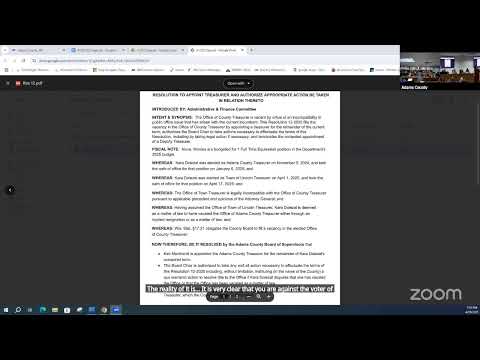
At a special April 2025 meeting, the Adams County Board adopted Resolution 12 to appoint Kim Meinhardt as county treasurer following attorneys' advice that the incumbent vacated the office by accepting a town treasurer role; the meeting included heated debate over notice, legal interpretations and public calls for due process.
Adams County supervisors voted 14-6 at a special meeting in April 2025 to adopt Resolution 12 appointing Kim Meinhardt as county treasurer after outside and county attorneys advised the board that the county treasurer had vacated the office by accepting a town treasurer position.
The question of vacancy and the authority to appoint a replacement was the focus of more than two hours of debate, public comment and procedural objections. County corporation counsel told the board the county’s legal analysis and attorney opinions indicate the county treasurer’s “position was vacated on April 17.” Attorney Matt Tom of the Tullus Law Firm told supervisors, “if you accept an office that is incompatible with the duties of the office you are currently holding, you vacate the office that you're holding. It's pretty cut and dry.”
Why it matters: the board acted on a memo from outside counsel that concluded duties of a town treasurer and county treasurer create a conflict under common-law incompatibility doctrine and historic attorney-general opinions. The move to appoint Meinhardt followed failed motions to adjourn the meeting and a failed amendment that would have kept the incumbent in office while giving her the option to resign the town post.
Board procedure and notice were repeatedly contested. Supervisor Podolski argued the session was improperly noticed as a special meeting because board rules require 48 hours for most special meetings: “The 16 A says that a special meeting requires 48 hours notice,” he said. Corporation counsel countered that the meeting qualified as an emergency special meeting and therefore complied with the alternate 24-hour notice provision, telling the board the emergency was that “there is no treasurer right now. The position has been vacated as of April 17.” A motion to adjourn on notice grounds was put to a roll call and failed 6-14.
Public commenters urged the board to follow statutory removal procedures or allow the elected official to choose which office to keep. Scott Krug, who identified himself as speaking for many northern-county constituents, cited statute in urging supervisors to reject the appointment: “There is a very clear state statute on what the process you have to go through to remove an elected individual from a county wide office. That state statute is statute 17 oh 9.” Other residents raised similar due-process concerns and warned of litigation costs.
The board considered, and rejected, an amendment that would have left the incumbent in the county treasurer position while allowing her to resign the Town of Lincoln post; that amendment failed 9-11. After additional discussion and questions of counsel, the full Resolution 12 — introduced by the Admin and Finance Committee and moved by Supervisor Paylor with a second by Supervisor Grabarski — was adopted on a 14-6 roll call. The clerk recorded the vote; the resolution instructs the county to appoint and take “appropriate action” to fill the treasurer vacancy.
Corporation counsel and outside counsel described the board’s options if the incumbent does not accept the legal conclusion of vacancy: the county can seek a judge’s determination through a quo warranto action to resolve entitlement to the office. Counsel told the board that a lawsuit would be the standard method for a court to rule on whether a vacancy exists and on the validity of any appointment the board makes.
Meeting context: the session included extended public participation (several dozen speakers) and sustained debate among supervisors about process, the timing of legal advice and whether the county had adequately warned the incumbent. Some speakers and supervisors raised the practical point that, if the incumbent resigned the town post, the board could lawfully appoint her to the county office, and that option was discussed but not adopted.
The board adjourned after adopting Resolution 12. Counsel said litigation could follow if the incumbent contests the board’s action; supervisors and residents warned of potential legal costs either way.