Get Full Government Meeting Transcripts, Videos, & Alerts Forever!
Get email alerts on the School Finance Bond Defeasance topic
No spam. Unsubscribe anytime.
McAllen ISD advisers: pending state bills could force fast choice on defeasance and a possible $290 million bond election
Summary
Financial advisers and district staff told the McAllen ISD Board of Trustees that proposed state limits in House Bill 19 and funding changes in House Bill 2 could make November 2025 the most advantageous date to seek voter approval for bonds while retaining the district's current interest-and-sinking tax rate; no board vote was taken.
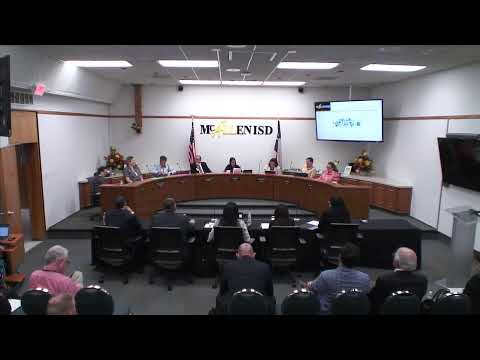
McAllen, Texas — Financial advisers and district staff told the McAllen Independent School District Board of Trustees on April 29 that new proposals in the Texas Legislature could force the district to choose quickly whether to pursue a defeasance and a voter-approved bond election that advisers estimate could provide roughly $290 million without increasing the district's interest-and-sinking (I&S) tax rate.
Miguel de los Santos, a financial adviser with Estrada y Nohosa, told trustees that if the board authorizes a defeasance and the related legislation (he discussed House Bill 2 and House Bill 19 as the legislative assumptions) remains intact, “you could access approximately $290,000,000 with no increase in the I&S tax rate.” De los Santos advised the board that the window for a November 2025 election is time-sensitive if the legislature enacts limits now under HB19.
The proposals discussed would change how districts calculate borrowing capacity and the timing of financing elections. De los Santos said one HB19 provision under consideration would cap the amount of property-tax collections a district can use for new debt by averaging the last three years of local property-tax collections and taking 20 percent of that average; using McAllen ISD’s current three-year average collections of about $91,900,000, that 20 percent figure would be about $18,895,000 in annual debt service capacity. Under the assumptions in the advisers’ analyses, that capacity could support a roughly $290 million project fund while keeping the district’s current I&S rate at 16.16 cents (0.1616).
Joel Garcia of district finance staff said the district has prepared two budget scenarios — one under current law and one using House Bill 2’s preliminary template — and that HB2, as currently modeled, would add about $10.6 million in state funding to the district’s budget. Garcia also reported that current-year projections show the district’s net fund balance could increase by about $11.6 million by fiscal-year end, pending final audit numbers.
Advisers and staff outlined trade-offs and risks. De los Santos said defeasance — using available I&S capacity to retire outstanding bonds early so the district remains at the 16.16-cent I&S level — could free capacity for larger future voter-approved debt, but House Bill 2 contains a provision that would reduce state aid following a defeasance. De los Santos gave a defeasance example presented to the board: a recent defeasance removed about $8,058,400 of debt from the district’s books, was funded with roughly $7,363,000 of local collections and produced interest savings of about $694,000; however, the HB2 draft language he cited would reduce state aid by roughly $991,803 as an offset to that local action.
Advisers warned of other constraints in HB19 as written in committee: it would restrict financing elections to November and apply a 20 percent limitation on average collections to set annual debt service capacity. De los Santos said that if the district did not pursue a defeasance, its I&S rate would likely fall — in the advisers’ scenario to roughly 6.5 cents — and the district’s borrowing capacity at that lower rate would drop to about $100 million under the same market assumptions.
Superintendent Dr. Gutierrez told the board the district already has a facilities needs assessment under way and emphasized that a facilities plan must be ready before any bond election. “When we go out to the voters, we have to tell the voters ... we qualify for this $290,000,000, but we have to itemize to the voters where are we gonna spend those $290,000,000 so that when they go out, they're gonna vote on it, they're gonna know what they're voting for,” Gutierrez said.
District staff outlined a fast-moving timeline if trustees decide to pursue a November 2025 election: rapid completion of the MGT facilities assessment, committee and community meetings through July, and an August board action window to call an election for November. Staff and advisers repeatedly cautioned that the legislative picture remains fluid; advisers said HB19 was in committee and could die or be amended, but also could be attached to another bill and move forward.
The board did not take a formal vote to order a defeasance or to call an election during the workshop. Trustees asked for additional comparisons, community engagement plans and more detail on project prioritization and on stipend and compensation trade-offs that would affect the operating budget.
Other budget particulars discussed at the workshop included a proposed 0.9966 total tax rate (0.835 M&O and 0.1616 I&S) presented by staff, an estimated $4.6 million reduction in local tax collections this year, a budgeted fund-balance contribution of $4.5 million to balance 2024–25, and a planned employer health-insurance contribution increase proposal of $55 per subscriber per month (about $2 million annually) to address projected shortfalls. Staff also said the district would need a budget amendment to cover a large medical claim and estimated a roughly $1 million transfer to the health plan this year.
The workshop closed without further board action on the bond question; trustees and staff agreed to continue work on the facilities assessment, community engagement and budget scenarios so the board could decide whether to proceed, delay to November 2026 under changed capacity assumptions, or pursue other funding strategies.