Get Full Government Meeting Transcripts, Videos, & Alerts Forever!
Get email alerts on the Data Center Residential Impacts topic
No spam. Unsubscribe anytime.
Planning commission recommends approval of two data‑center rezones and special exceptions despite strong public concern about water, power and long‑term impacts
Summary
The planning commission recommended approval of two rezoning and two special‑exception applications to allow a data‑center campus adjacent to the planned airport, subject to extensive staff conditions including DRI mitigation, airport‑overlay height limits, and a decommissioning plan.
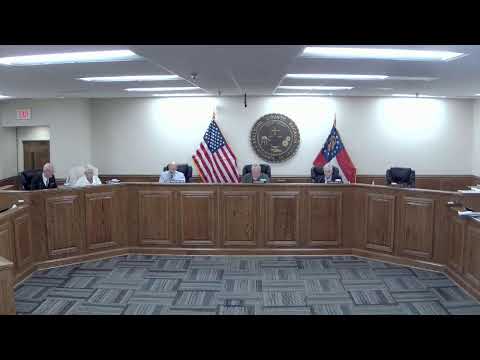
Spalding County’s Planning Commission recommended approval of two rezoning applications (2513Z and 2514Z) and the accompanying special‑exception applications (2503S and 2504S) for a proposed data‑center campus on two adjacent parcels fronting High Falls Road and adjacent to the planned airport site.
The applicant and counsel described a campus concept that places the data‑center buildings largely behind existing transmission corridors and retains tree cover along High Falls Road, with an office/operations building set near the road. The concept presented roughly 2,000,000 square feet of data‑center floor area divided among multiple buildings, estimated build‑out value of approximately $1.87 billion, projected annual ad‑valorem taxes in Spalding County of about $26.8 million, and a projected operations workforce of roughly 100 employees. Staff and applicant representatives stated the project would use closed‑loop cooling with low daily potable water demand (applicant cited about 16,500 gallons per day) and that sewer/outfall could be addressed with on‑site treatment or by connection to a nearby lift station; power providers (MEAG and Georgia Power) told the applicant they will serve entitled projects and typically allocate power after projects are entitled, then scale generation as needed.
The county conducted a Development of Regional Impact (DRI) review through the Three Rivers Regional Commission; public works and the Georgia Department of Transportation provided comments focused on construction‑era traffic impacts and recommended mitigation measures, which staff incorporated into conditions. Staff recommended conditions including adherence to AKB/airport overlay height restrictions, compliance with county data‑center standards (including detailed decommissioning requirements), implementation of all DRI‑required measures, and county review of final civil/landscape plans prior to permitting. The applicant told the commission it consents to staff’s recommended conditions.
Public comment was substantial and uniformly cautious: speakers asked for town meetings, independent studies, transparency in negotiations, and stronger public disclosure about tax abatements or incentive terms. Concerns included power availability and whether entitlements would require Georgia Power or MEAG to build new generation (applicant representatives said providers allocate and build capacity following entitlement and reverse RFP processes), water consumption (speakers compared other sites that used large amounts of water and raised concern about reservoir levels), noise and visual impact near existing neighborhoods, and the long‑term risk of large vacant data‑center campuses if technology or markets shift. One speaker called for outside consultants and town meetings; another cited an open‑records request he had filed and said the county’s responses had been delayed.
After extended discussion, commissioners voted to recommend approval of both rezoning applications and both special‑exception applications, subject to staff’s written conditions (including the decommissioning process and DRI mitigation measures). Several commissioners and the chair stressed these recommendations are advisory; the Board of Commissioners will take final action on May 22. A small number of commissioners registered abstentions on one or more votes but the majority favored recommendation.
Staff and applicant representatives said MEAG and Georgia Power confirmed they will coordinate service for entitled projects and that water/sewer options had been preliminarily evaluated; the record notes those technical details will be resolved in engineering and permitting if the county and Board approve the rezoning and special exceptions.