Get Full Government Meeting Transcripts, Videos, & Alerts Forever!
Get email alerts on the Higher Education Funding topic
No spam. Unsubscribe anytime.
Public universities, students and staff urge $1.275 billion for core operations and expanded grants at SB 5525 hearing
Summary
Dr. Jesse Peters, president of Western Oregon University, told the Joint Committee on Ways and Means Subcommittee on Education on April 30 that "we cannot build a stronger Oregon if our students can't afford to enroll in college, or don't have the resources to succeed once they get there."
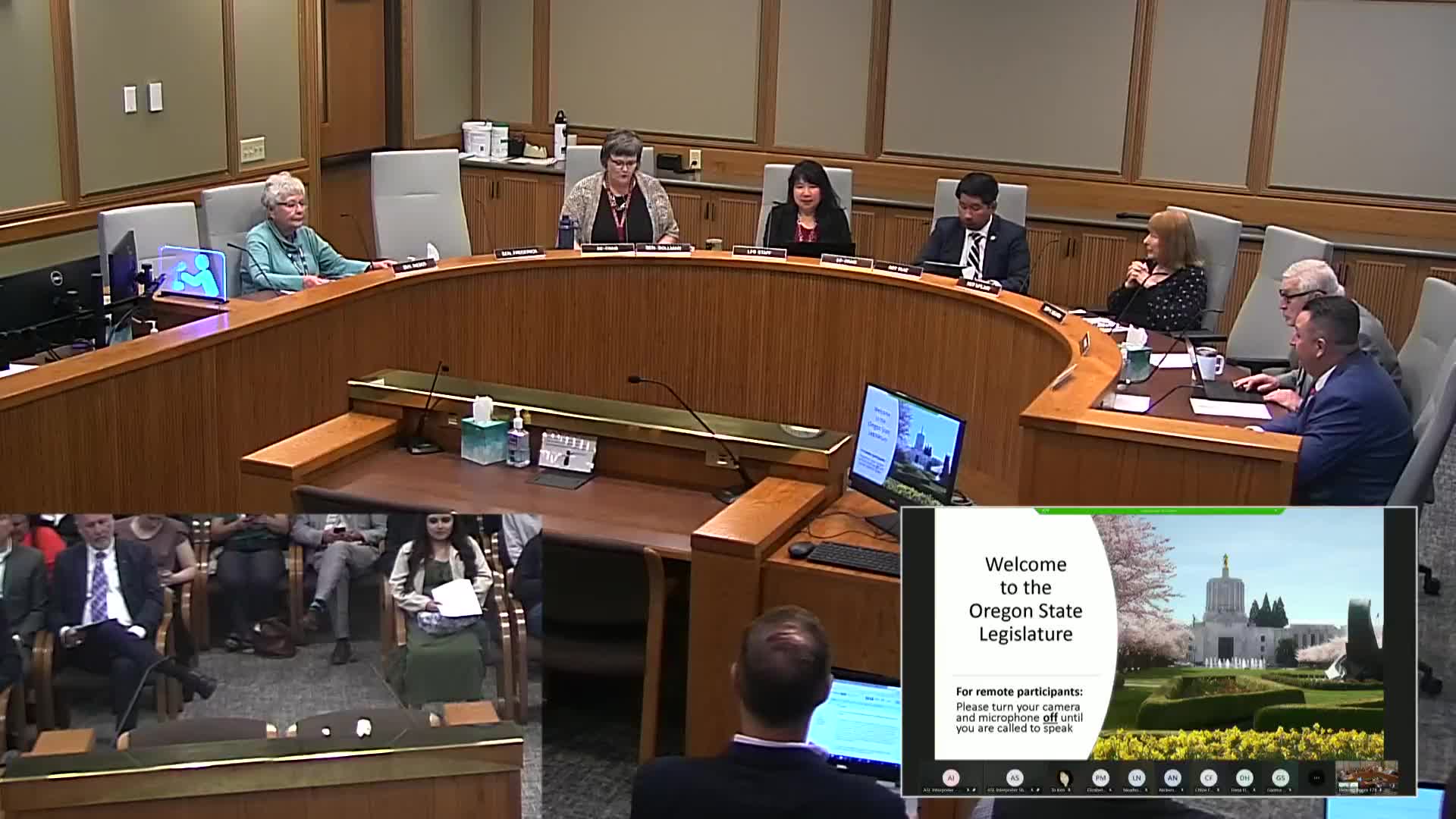
Dr. Jesse Peters, president of Western Oregon University, told the Joint Committee on Ways and Means Subcommittee on Education on April 30 that "we cannot build a stronger Oregon if our students can't afford to enroll in college, or don't have the resources to succeed once they get there." The informational meeting and public hearing on Senate Bill 5525 brought presidents of Oregon's seven public universities, students, classified staff and campus service providers to testify in favor of increasing state investments in higher education.
The core ask at the hearing was twofold: fully fund the Public University Support Fund (PUSF) at $1,275,000,000 for the 2025–27 biennium and increase the Oregon Opportunity Grant (OOG) by roughly $150,000,000. University leaders and enrollment officials said those increases would lower net costs for low‑ and middle‑income students, allow campuses to expand need‑based awards and preserve services that support retention and graduation.
Nut graf: Speakers said Oregon funds public universities at a lower rate than peer states, shifting costs to students and families. Witnesses tied those funding shortfalls to higher tuition and to cuts or gaps in campus services that help students persist, including financial aid, basic‑needs supports, early‑college transition programs and campus childcare.
Details and testimony
Dr. Chuck Nefley, vice president for enrollment management at Portland State University, outlined the financial aid landscape and said Oregon public universities collectively provided more than $229 million in fee remissions last year. He described the Oregon Opportunity Grant as one of three major funding sources for resident students and noted that increasing state aid would let institutional dollars ‘‘reach further’’ to lower students' out‑of‑pocket costs. Nefley said a targeted increase in the OOG would also hedge against federal funding uncertainty.
Students from multiple campuses gave personal testimony about how grants and targeted programs affected their ability to enroll, persist and graduate. Karima Sharma, a senior at Southern Oregon University, and Quinn Conklin, a recent Portland State University graduate and OOG recipient, asked legislators to expand eligibility and award amounts so the program reaches more low‑ and middle‑income families. Several speakers used a $450,000,000–$458,000,000 figure for the total OOG ask; presenters varied between a round $450 million and a specific $458 million total for the program in the next biennium.
Campus supports and basic needs
Witnesses described multiple student success investments that they said rely on stable state funding. Maria Barrera, basic needs coordinator at Western Oregon University and a benefits navigator, said the navigator program—first funded in 2021—has helped students access food, housing and insurance, and that she personally met with 639 students since starting in January 2022. "If this funding doesn't continue, it puts at risk thousands of students' lives who can't... continue to struggle with having their basic needs met," Barrera said.
Students and program staff urged continued support for Strong Start (first‑year transition programs) and a proposed $22,000,000 basic needs and workforce stabilization package. Chloe Fivish, a Southern Oregon University senior who analyzed retention outcomes for her campus, said nearly 70% of Strong Start participants from fall 2023 were retained the following year compared with 33% retention for at‑risk students who did not participate; she also reported average GPAs of 3.2 for Strong Start participants versus 2.5 for comparable nonparticipants (SOU analysis, as presented to the committee).
Athletics, campus childcare and other targeted requests
Tom Thaik, a student‑athlete at Portland State, urged continued allocation of 1% of the state lottery to the sports lottery program and quantified an ask of about $19,700,000 for scholarships and services that support student athletes and compliance with Title IX. Dana Hepper of the Children's Institute requested $5,000,000 in House Bill 3011 to stabilize and expand on‑campus childcare centers, noting that approximately 20% of Oregon undergraduates are parents or guardians.
Research, extension and veterinary testing
Representatives of industry and conservation groups testified in support of targeted investments at Oregon State University. Michael Ison, representing the Oregon Forest Industries Council and the Rocky Mountain Elk Foundation, supported sustained funding for OSU's statewide public service programs—the Agricultural Experiment Station, OSU Extension and the Forest Research Laboratory—and backed expanded funding for the Oregon Veterinary Diagnostic Laboratory to support chronic wasting disease testing and management.
Process and next steps
Committee staff opened the informational meeting, then transitioned the group into a public hearing on SB 5525. No formal votes were taken during the session. Committee leadership reminded witnesses that the written record would remain open for 48 hours from April 30 for additional written testimony. A committee staff note asked members to forward topics they want addressed in phase two of the budget presentations.
Ending: The hearing brought a cross‑section of campus leaders, students, classified staff and community partners to the microphone to link specific funding line items in SB 5525 to student aid, retention programs and campus operations. Legislators and staff acknowledged tough budget choices ahead and said they would review testimony as they finalize recommendations in the coming budget phases.