Get Full Government Meeting Transcripts, Videos, & Alerts Forever!
Get email alerts on the Elections And Audits topic
No spam. Unsubscribe anytime.
Secretary of State staff outline audits, elections priorities and motor-voter controls
Summary
Deputy Secretary Michael Kaplan and division directors briefed the Senate Committee on Rules on April 30 about audit reforms, election-system projects and new controls on the motor‑voter process.
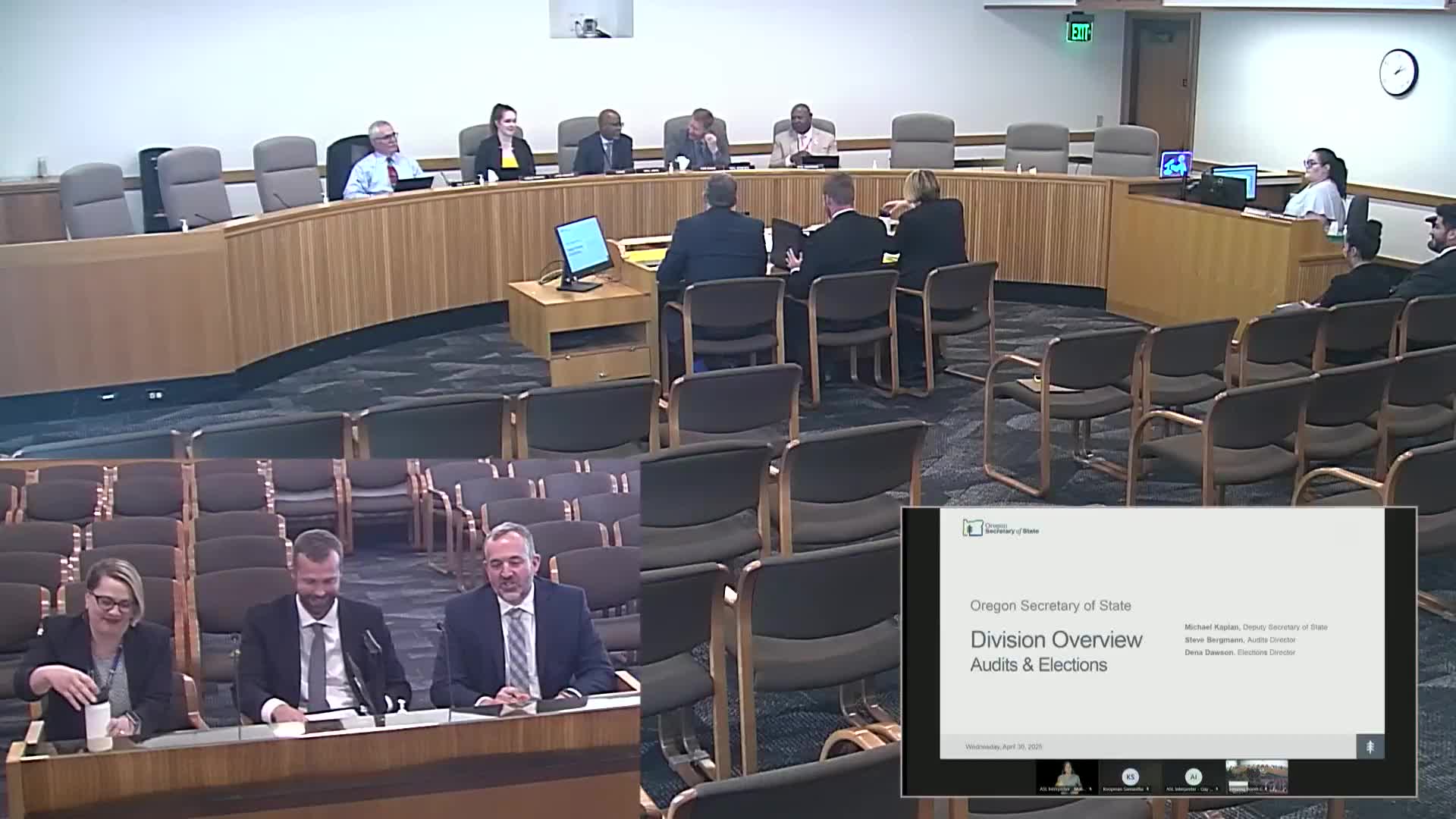
Deputy Secretary of State Michael Kaplan and the directors of the audits and elections divisions presented an overview of their offices to the Senate Committee on Rules on April 30, emphasizing a management plan organized around "integrity, accountability, and competence," and outlining steps to improve audit selection, election security and the Oregon motor-voter process.
Kaplan said the secretary has prioritized three guiding principles and asked the committee to view the briefing as "a foundational look" at division programs, challenges and near-term outlooks. He introduced Steve Bergman, director of the Audits Division, and Dina Dawson, director of Elections, who each described their offices' responsibilities and current projects.
Audits: Bergman said the Audits Division conducts financial audits, federal compliance audits, performance audits and IT security audits. He told the committee the division operates on a 2023–25 biennium budget of $28,500,000 and employs 72 full-time staff; more than half of the auditors hold professional certifications such as CPA, certified fraud examiner or CISA. Bergman said the division is transitioning to a risk-based audit selection model that will aggregate indicators of risk to prioritize work and is seeking input from legislators and the public.
Responding to a question from a senator about scope, Bergman said the audits office "does have authority to review more than just state agencies" and can examine pass-through funding, subrecipients, municipalities and school districts.
Hotline and budget: Committee members asked about the government's hotline for reporting fraud, waste and abuse. Officials said the hotline is primarily targeted to state employees reporting anonymously, but is open to the public; the office currently staffs two hotline positions and the majority of performance-audit staff are assigned to the broader performance work.
Elections: Director Dina Dawson described the Elections Division's role as the state's chief elections officer under the Secretary of State, its responsibility to interpret and apply elections law, and to support counties. Dawson said the division has 35 full-time staff and has added 15 positions since 2023. She listed top priorities: modernizing the centralized voter registration and election management systems, implementing the requirements of House Bill 4024 (a new web-based campaign finance tracking system), strengthening election security and addressing backlog and staffing pressures.
Motor-voter controls and coordination: Committee members pressed officials on recent errors in the motor-voter process that produced incorrect registrations. Kaplan and Dawson described three controls the office has put in place since the secretary took office: (1) random sampling of automatic voter registration files sent from DMV to confirm correct handling, (2) a daily control file reconciliation so the agency confirms nightly file counts, and (3) a proposed annual DMV review panel that would include Secretary of State staff, internal audit, IT and county clerks (contingent on budget approval).
Officials said the bulk of public communication about recent motor-voter issues is being handled by the Department of Motor Vehicles and the Oregon Department of Transportation, but the Secretary of State's office is coordinating reports and said it will continue to seek ways to rebuild public trust.
Next steps: Officials told the committee they have proposed a modest budget for the near term, will return with more substantial proposals in 2026, and are developing a risk-based audit model and projects to modernize election management and voter registration systems.