Get Full Government Meeting Transcripts, Videos, & Alerts Forever!
Get email alerts on the Infrastructure Sewer Bonds topic
No spam. Unsubscribe anytime.
Spalding County authority accepts bond documents to advance High Falls sewer project amid questions about customers and costs
Summary
The Spalding County Water and Sewage Facilities Authority voted April 30 to accept bond documents that enable issuance of bonds to fund a new sewer system and treatment plant, but board members raised concerns about prospective customers, schedule risk and potential rate increases.
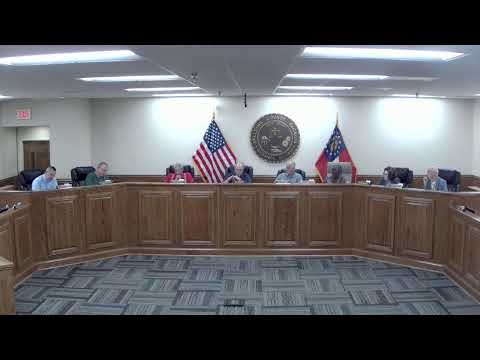
The Spalding County Water and Sewage Facilities Authority on April 30 voted to accept bond documents that allow the authority to issue bonds to finance a new sewer project serving the High Falls industrial site and surrounding areas.
The board voted after a motion to accept the bond documents; the motion to accept was placed on the floor during the meeting and the board completed a roll-call-style vote. Joseph, the authority general manager, told the board the guaranteed maximum price (GMP) contract from the progressive design‑build team totals “approximately $19,400,000 all in.” He said signing would be anticipated in June with construction starting soon after and plant testing scheduled for late second quarter 2026 if schedules hold.
Board members pressed staff on what customers existed to support the plant. One member warned the authority was assembling a large project without firm customer commitments and cited an amount stated in the meeting transcript as “$2,526,000,000,” expressing concern about scale and risk. Joseph and other staff said the authority currently has one primary developer prospect at the High Falls Industrial Site that is actively grading pads, and two other landowners with interest. Joseph said a previously discussed primary site may be delayed into 2027, creating timing uncertainty.
The general manager told the board the plant capacity under discussion is roughly a 200,000‑gallon‑per‑day facility and that the authority would need about 17,000 gallons per day of typical domestic wastewater to properly test and operate the plant. He emphasized that some industrial flows (for example, large wash operations) are not the type of wastewater the plant needs to reach commissioning thresholds: “We’re looking for toilets and sinks and garbage disposals, so typical waste streams,” he said.
Board members raised questions about who would pay if bond payments increase. One member noted a projected increase in annual debt service versus the current payment and said the authority’s existing cash flow does not cover the higher payment; another calculated the increase could amount to roughly a half‑million dollars a year. Board members and staff referenced a county commitment of $500,000 per year for the next three years and discussed the authority’s FY26 budgeted cash outlay, plus the ability to reimburse pre‑issuance expenses from bond proceeds if the bonds are issued within the reimbursable window.
Members also highlighted schedule and supply‑chain risk. Staff said major equipment lead times are long: motor control centers (MCCs) and generators have multi‑month delivery windows (generators estimated at 14–15 months), and pipe and other long‑lead items were not yet received; one board member warned that survey, clearing and initial work often reveal new delays.
The board discussed nearby infrastructure and potential interim arrangements. Joseph said the authority is working with a company called P and K on routing sewer and with the City of Griffin on an intergovernmental agreement that could allow P and K to discharge temporarily into the Lakes of Green Valley system while the authority builds out a lift station and force main to divert flow to the new High Falls system. He said easements and lift‑station construction would be required for that route.
After discussion, the authority moved and seconded the acceptance of the bond documents and approved the item. The board was told the approval launches the next steps in the bond process, including required publication and a court hearing scheduled for May at 3 p.m.
Why it matters: the bonds would finance a major sewer extension and treatment facility that the authority and county hope will support industrial development and jobs at High Falls; however, board members repeatedly warned that schedule slippage, uncertain customer commitments and increased debt service could require higher water and sewer rates or county support.
The authority also approved several related contracts and purchases during the same meeting (water‑modeling work with Griffin, acquisition services concept for easements, a large equipment purchase order and a small real‑estate easement purchase). Those votes are covered in a separate article.