
Somerville Board hears proposed 2025-26 budget as state equalization aid drops
Get AI-powered insights, summaries, and transcripts
Sign Up Free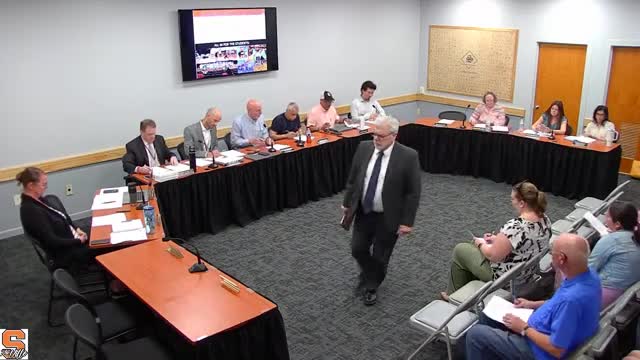
Summary
Somerville Board of Education administrators presented the proposed 2025-26 budget at the April 29 public hearing, saying the plan preserves current programs and staff while responding to a drop in state equalization aid that lowered anticipated revenue.
Somerville Board of Education administrators presented the proposed 2025-26 budget at the board’s April 29 meeting, saying the plan holds current programs and staffing while responding to a sharp reduction in state equalization aid.
“I don't want to be repetitive ... but do understand that this was a very deliberate process in which we look at everything,” Superintendent JR said as he introduced curriculum and facility priorities during the public hearing on the budget. Business staff member Brian Boyce laid out the district’s revenue and expense assumptions, including use of reserves and grant projections.
The nut of the budget presentation is that equalization aid — the portion of state school funding that fills the gap between state-calculated adequacy and a district’s local fair share — declined for the district. Boyce told the board the drop in equalization aid was about $569,000 and that the district relied on a mix of local levy growth, limited use of bank cap, fund balance and reserves to balance the budget. He said the district used $12,104 of bank cap and is leaving roughly $400,000 available for future years, and that the district will rely on $1.5 million of fund balance for operating costs.
Administrators said a capital reserve withdrawal of $750,000 is earmarked for next year’s projects, and that special revenue (federal and grant-based) will decline because COVID-related grants have expired and the state is advising districts to assume 70% (rather than a prior 85%) of federal entitlement grant levels for budgeting. The district also noted a debt-service increase tied to a March 2025 referendum.
Board members and staff ran through affordability details: the district’s calculated adequacy budget for 2024-25 was stated as about $30.6 million, with equalization aid near $7.7 million; administrators said the 2025-26 adequacy figure rose but the state’s calculation of the local fair share rose faster, reducing the state aid the district receives. Boyce also walked through the conversion of tax rates to calendar-year impacts, saying the calculated new school tax rate would be about 2.388 and that the average assessed residential property used in the presentation was $276,200; administrators said the average increase in school tax would be about $218.
Administrators emphasized that, despite the reduction in aid, the budget does not cut core programming or reduce after-school offerings. “We still make intervention support at all three schools a primary focus,” JR said, describing targeted interventions, math and ELA labs at the high school, and expanded summer and after-school opportunities. Staff said some cost savings were achieved through attrition, reorganization and scheduling efficiencies rather than layoffs.
Parents and community members asked clarifying questions during the public-comment portion of the hearing. Resident Dennis Sullivan asked for enrollment details and for the board to tell taxpayers how much of the tax increase is due to reduced state and federal aid rather than new spending. Boyce replied with current and projected enrollment figures (Vanderveer ~640 to 644; grades 6–8 roughly 328 to 324; self-contained special-education placements projected from 72 to 82) and restated that the board is limiting levy growth and using one-time reserves to maintain programs.
Members of a newly formed Special Education Parent Advisory Group (CPAG) spoke during public comment to introduce themselves and describe their work advising the district. Marian Altadonna, a CPAG representative, said the group gathers parent input, runs surveys and hosts workshops for families. CPAG speakers described three workshops held this year on eligibility and services, understanding behavior, and lived experience of disability; they also announced a May workshop on anxiety and school phobia. CPAG members credited the district with including an ADA-compliant replacement for the Vanderveer playground in the capital plan and said the group had worked with staff to make past events and facilities more accessible.
Administrators described several capital and facility priorities that appear in the capital portion of the proposed budget: continuation of the next phase of HVAC upgrades (partly tied to a grant), replacement of an aging burglar alarm system, intercom and bell-system updates, structural repairs to a ramp at the high school identified by an engineer, district-wide security camera updates, and the Vanderveer playground replacement, which the administrators said will be ADA-compliant and will be supported in part by a grant.
The board held the required public hearing; the presentation generated questions and requests for clear communication to taxpayers about the causes of the tax change. No formal vote on the budget occurred at the hearing; the board will take formal action consistent with the district’s budget-adoption calendar and state requirements.
Ending: The board closed the public hearing and proceeded with routine agenda items, including approvals of personnel and committee appointments. Administrators said they will continue to monitor state aid developments and keep the community informed about final budget decisions and timelines.