Get Full Government Meeting Transcripts, Videos, & Alerts Forever!
Get email alerts on the Transportation Mobility topic
No spam. Unsubscribe anytime.
Council amends and adopts dockless vehicle ordinance after debate on rates and removal timelines
Summary
The governing body debated a substitute and several amendments to the dockless vehicle ordinance (electric scooters and e-bikes), ultimately adopting the ordinance as amended; two members voted no. The council discussed rate-reduction programs, startup timelines and the period companies have to remove equipment after a license expires.
The City of Cheyenne governing body debated and then adopted changes to the city’s dockless vehicle ordinance (chapter 10.82) at third and final reading April 28 after several amendments and public discussion.
Councilmember John Layborn presented the finance committee recommendation to approve the ordinance on third reading. Councilmember Michael Moody moved a substitute that would remove certain program requirements, arguing it would make the process accessible to smaller operators. "I'm deleting the programs to reduce rates to allow for other companies," Moody said while explaining the substitute.
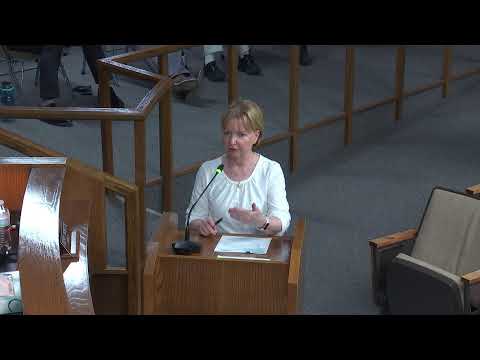
Councilmember Dr. Aldridge objected to removing reduced-rate programs, saying rate reduction could help marginalized residents who rely on scooters for transportation. "In order for companies to be able to compete ... they need to be able to offer reduced rates, especially for people that may be marginalized," Dr. Aldridge said. She moved to amend the amendment to add back the reduced-rates item; the amendment passed.
The council also debated how long a company would have to remove vehicles from city rights-of-way after its license expired. Councilmember Dr. Aldridge proposed changing a 40-day removal period to 14 days; that motion was adopted initially. Councilmember Seagrave subsequently moved to delete the section and replace it with language that would: (1) prevent renewals of existing licenses upon the ordinance's effective date; (2) require written notice to licensees that they would have up to 40 days from license expiration to remove property; and (3) allow the city to deem property abandoned and remove it after that period. Seagrave said the replacement language would prevent a lapse of service while the city issues a new operating agreement: "What this does is it just says that, we will pass this ordinance and then once the RFP is...awarded, then that would trigger everybody else to get their stuff off the street," he said.
City purchasing manager T.J. Bartlebort explained timing for requests for proposals and contract terms: "Typically, they're at least for a year, and we have done options where we can extend it on to 2 to 3 years, and we typically try to resolicit those services about annually or between annually and 3 years," he said, describing the city's typical RFP terms.
After debate and multiple amendment votes, the ordinance passed on third and final reading as amended. The final roll call recorded affirmative votes from Councilmembers Reubel, Seagrave, White, Dr. Aldrich, Mayor Collins, Dr. Emmons and Escobel; Councilmembers Layborn and Moody voted no. The ordinance as adopted includes amended provisions about procurement and the city's planned transition to an RFP-based operating agreement.
Why it matters: the ordinance governs dockless scooters, e-bikes and similar micro-mobility devices and sets rules for companies operating within Cheyenne, including procurement processes, program requirements for rate reductions and timelines for equipment removal after license expiration.
Details and limits: the council debated but did not agree on a single removal period—an earlier 14-day proposal was replaced by the Seagrave language specifying a 40-day removal period after license expiration once notice is given. Councilmembers expressed competing concerns about continuity of service, support for marginalized riders, and barriers for smaller operators.
Next steps: the ordinance is effective according to the city's ordinance rules and will be implemented under the procurement process and operating agreements described in the ordinance; the city will issue an RFP for dockless services as described in the ordinance.