Get Full Government Meeting Transcripts, Videos, & Alerts Forever!
Get email alerts on the Transit Light Rail Permitting topic
No spam. Unsubscribe anytime.
Committee hears briefing on code amendments to streamline permitting for Ballard and West Seattle light rail
Summary
City staff and Sound Transit representatives briefed the Land Use Committee about proposed code amendments to streamline permitting and set design standards for Ballard and West Seattle light-rail projects; the April 30 presentation was informational and no committee vote occurred.
City of Seattle staff and Sound Transit representatives briefed the Land Use Committee on April 30 on Council Bill 120,975, a package of land-use and environmental-code amendments intended to streamline permitting and set design standards for Sound Transit’s ST3 projects, including the Ballard Link Extension and West Seattle Link Extension. The briefing was informational; the committee did not vote on the bill at the April 30 meeting.
Why it matters: The Ballard and West Seattle extensions are among the largest infrastructure projects in Seattle’s history. City staff said the code amendments aim to remove code conflicts, consolidate review where appropriate, and set consistent design expectations for linear transit facilities that cross multiple zoning districts.
City staff described two broad themes for the proposed code package: process improvements and design standards. Process changes include batching and simplifying master use permit (MUP) review, integrating a preliminary construction management plan (PCMP) into the MUP application, and requiring a project-level tree and vegetation management plan (TVMP) that would cover each extension comprehensively rather than resolving tree impacts permit by permit. Lindsay King of the Seattle Department of Construction and Inspections said the city expects roughly 59 MUPs for the West Seattle extension and many more for Ballard; staff said a project-level TVMP and PCMP would reduce repetitive, permit-by-permit analysis across hundreds of anticipated permits.
Staff explained the changes to appeals and timing. Under the proposed approach, MUPs would be appealable once (via land use petition act procedures) instead of twice (first to the city Hearing Examiner and then through state petition as currently common), which staff said would reduce the number of appeal filings and shorten overall timelines. SDCI staff said the program’s operational target—based on the 2018 partnering agreement—would be to issue MUP decisions within 120 days of acceptance; staff reported that earlier permitting for Sound Transit averaged roughly 240 days and that removing a second appeal opportunity could shave months from permit timelines.
On trees and vegetation, the proposal would require a project-level TVMP for each major extension, document tree removal and replacement strategies, and set a minimum mitigation ratio. Staff said the city expects Sound Transit to replace trees at a minimum of 3:1 where removal is necessary and to coordinate replacement outside project footprints with the city’s urban forestry team; staff also said the TVMP would identify protection methods for trees to be retained and long-term maintenance responsibilities for Sound Transit as a long-term landholder.
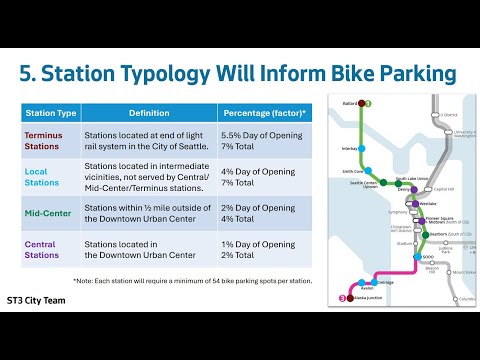
Design standards proposed in the code package would create one set of light-rail-specific standards to apply across the city’s varied zoning districts and reduce the number of site-specific modifications needed during permitting. Standards discussed include station-area street improvements, pedestrian lighting, facade transparency and blank-wall limits, landscaping and weather protection, signage and wayfinding, and tailored bicycle-parking requirements. Staff proposed four station typologies (terminus, central, midcenter and local) and minimum bicycle parking metrics that vary by typology; for example, central downtown stations would have a smaller day-of-opening bike-parking requirement (roughly 1% for central stations with 2% total reserve) while terminus and local stations would have higher initial and reserve requirements. Staff also proposed a new minimum of 54 bike parking stalls per station and a mechanism requiring Sound Transit to add reserved bike-parking capacity if utilization exceeds 85% (annual surveys would trigger additional activation of reserved space).
Staff proposed that the Seattle Design Commission serve as an advisory review body on architectural and urban design qualities, pedestrian circulation, public amenities, entry visibility, and public art integration for Sound Transit facilities. Staff said the advisory role would not replace regulatory review but would provide context-specific design review and public meetings early in the process.
Committee members asked about metrics and expected time savings, tree preservation and relocation alternatives, displacement and outreach for affected residents and businesses, and how universal design and accessibility principles will be integrated into station design. Sarah Maxanna of the Sound Transit–city team said the code amendments were informed by years of interdepartmental work and public engagement; Lindsay King summarized the PCMP and TVMP aims and the proposed design standards. Councilmembers emphasized that displacement mitigation, outreach, and long-term system reliability are important parts of the broader conversation and may involve Sound Transit actions beyond code changes.
Next steps: Staff said they expect to return to the committee in May with additional information, with a public hearing scheduled for May 29. Staff also noted a separate ordinance and resolution to adopt the West Seattle Link Extension project would follow key federal milestones and that permitting for West Seattle could begin in Q3 once those steps are complete.
Limits: The April 30 meeting was an initial briefing; the committee did not take a vote on Council Bill 120,975. This article reports staff descriptions and councilmember questions presented at the briefing and does not attribute future Sound Transit decisions or project outcomes beyond statements made at the meeting.