Get Full Government Meeting Transcripts, Videos, & Alerts Forever!
Get email alerts on the Downtown Transportation Mobility topic
No spam. Unsubscribe anytime.
West Palm Beach panel backs mobility fee, higher-frequency transit and safer bike lanes for downtown
Summary
City officials, consultants and private mobility partners told a public panel that a proposed mobility-fee ordinance and a set of multimodal projects will fund capacity improvements, safer bike lanes and higher-frequency transit as part of the Downtown Master Plan update.
At a public Downtown Master Plan panel in West Palm Beach, city staff, consultants and private mobility partners discussed steps the city will take to fund and expand multimodal transportation options in the downtown core.
Panelists and staff said they plan to introduce a mobility-fee ordinance so the city can collect developer transportation fees locally rather than having those funds go to the county. "Mobility fees are really going to change transportation for the city of West Palm Beach," said Jessica Keller, the city's mobility and transportation manager, adding that the city has identified about $97 million of capacity improvements over the next five years that the fee would help build. Keller said developers have paid about $50 million to the county in the past and that the new city ordinance will allow the money to be spent inside West Palm Beach.
The panel was convened by the city and a consultant team working on a downtown master plan update and zoning recommendations; the update will include refined transportation recommendations before a plan adoption process in the fall and winter. "We want you to be very forward thinking and aspire to think about what are opportunities that we can start to identify that would be ways to move around the city for the next 25 years," said Grace Perdomo of Siskovich Architects, who is working on the plan update.
Discussion and evidence: multimodal options, funding and safety
Panelists emphasized three broad priorities: build destinations close together, offer multiple travel choices and make the most space-efficient options attractive. "Build stuff close," said Jonathan Hopkins, head of WPB Go, a public-private mobility partnership, and added that high-capacity transit and closer connections from regional rail and bus terminals into the downtown are needed. He warned that relying on cars alone will increase congestion as the downtown grows.
Technology and data were discussed as tools to both improve operations and measure problems. "The city ... are in the process of creating something called a digital twin," said Jason Hallstrom, a professor at Florida Atlantic University and chief research officer for the Center for Smart Streetscapes, describing a real-time computational model that can forecast short-term movements and improve safety. Federico Mesa of Systematica emphasized that a range of vehicle sizes and modes — from e-bikes and scooters to bus rapid transit and trains — will be needed to serve different trip distances and demands.
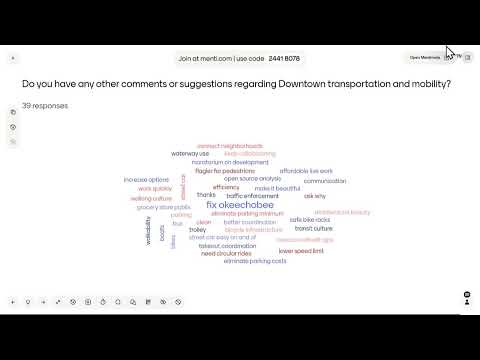
Panelists and staff also discussed practical project needs raised by residents: protected bike lanes, more shade trees, improved crosswalks, consistent bike racks at destinations, and more reliable on-demand services. Several members of the public told the panel they want more shade, clearer bike infrastructure, and improvements to the city’s circuit/on-demand service and the blue fixed-route vans that many said do not serve desired origins or destinations. One long-time resident said downtown parking loss has changed how they use the area; another asked that alleys be preserved for service and emergency access rather than infill construction.
Planned actions and timeline
City staff described near-term actions tied to the master plan update and other studies. Keller said a mobility-fee ordinance will move forward to first reading and that fees collected would be programmed for identified downtown capacity improvements. Perdomo outlined a schedule that includes recommended plan refinements in September–October and a plan-adoption phase in November–December. Staff also said the city is updating a downtown mobility plan (last produced in 2018), a bicycle master plan and related studies; those updates will inform project lists and funding priorities.
Panelists and public offered policy and operational suggestions
Suggestions from the panel and audience included piloting smart traffic signals, expanding frequent fixed-route service to reduce reliance on cars, deploying protected bike lanes to improve safety, improving on-demand vehicle tracking and reliability, adding bike racks at destinations, and pursuing public-private partnerships to deliver mobility hubs, parking management and autonomous-vehicle staging where appropriate. "If you want more people to be able to access your beautiful buildings ... you have to make the most spatially efficient choices the most desirable," Hopkins said.
Community concerns and constraints
Speakers and attendees repeatedly raised the limits of local authority and funding. Staff noted that many traffic signals remain county-controlled and that a citywide rollout of smart signals would require substantial funding and operational capacity. Residents urged low-cost, immediate actions — shade trees, crosswalk repairs, and bike racks — while panelists and staff stressed that larger capacity projects and systems (frequent transit, BRT/light rail, networked signal systems) require multi-year funding and coordination with county and regional agencies.
Next steps and public engagement
The consultant team and city staff encouraged continued public input through an online survey and future visioning panels; Perdomo said the next panel will be in mid‑June and the team will post materials on the city website. Staff described ride WPB (the city's stop-gap on-demand and fixed-route program) as a bridge toward a permanent, high-frequency system that staff say will expand access to tens of thousands more residents once implemented. The panel closed with staff inviting written suggestions and promising to post the presentations and survey results online.
Ending
The panel did not produce formal votes. City staff signaled the mobility-fee ordinance and plan updates as the primary near-term actions; residents and mobility partners urged a mix of quick visible improvements (shade, crosswalks, bike racks) and longer-term investments (frequent transit, protected lanes, signal modernization) to make downtown travel safer and less car-dependent.