Get Full Government Meeting Transcripts, Videos, & Alerts Forever!
Get email alerts on the State Legislation Vote Rundown topic
No spam. Unsubscribe anytime.
Arizona Senate advances wide package of bills after hours of debate on elections, unemployment and school water safety
Summary
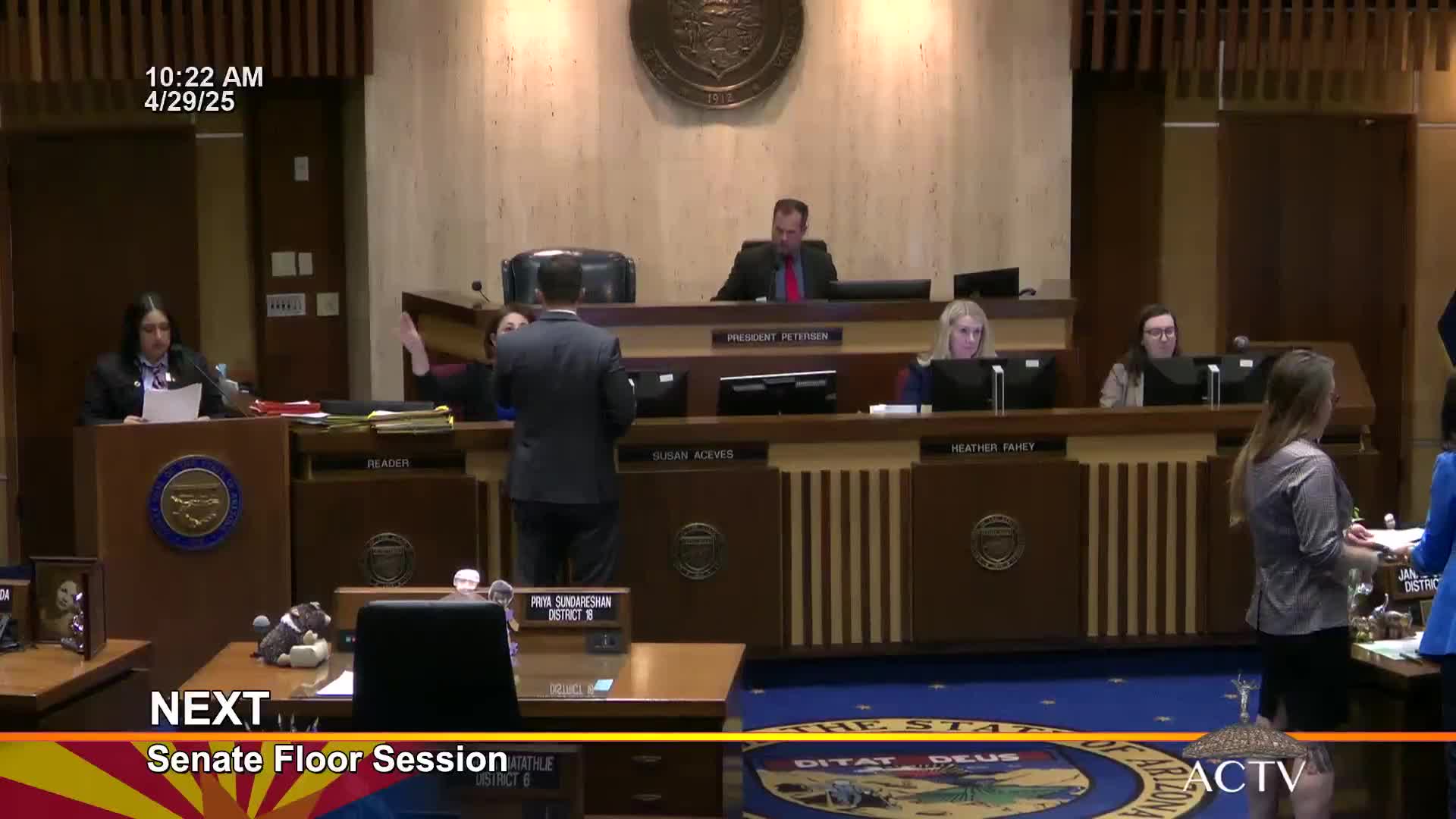
The Arizona Senate voted on a broad slate of legislation April 29, approving scores of measures and sending many to the governor, after several hours of floor debate that centered on public access to election data, changes to unemployment benefit procedures and a bill requiring schools to share water-safety resources.
The Arizona Senate voted on a broad slate of legislation April 29, approving scores of measures and sending many to the governor, after several hours of floor debate that centered on public access to election data, changes to unemployment benefit procedures and a bill requiring schools to share water-safety resources.
The most contested debate on the floor concerned Senate Bill 12‑80, which would make cast vote records more broadly available. Supporters said the measure increases transparency; opponents warned it could expose private information and be misused for harassment. "This bill could only be used to harass more voters," said Senator Kueb, who explained a no vote. "Very, very few people know how to use a cast vote record," she said, adding that the file can be misread. Senator Fensham, who spoke for the bill, said, "Elections belong to the people… The data belongs to the people. The government simply possesses it on their behalf," and urged colleagues to support the measure.
Unemployment-related changes in Senate Bill 12‑96 also drew extended remarks. Senator QB described unemployment insurance as an "essential safety net," arguing the bill would cause delays and hurt workers; Senator Finchem defended the measure as protecting the public purse from fraud, waste and abuse. The Senate approved SB 12‑96 on a roll call of 17 ayes, 12 nays and 1 not voting.
Sponsors and opponents also debated House Bill 20‑19, which directs the Department of Education to publish water-safety information and a list of local water-safety course providers for school families. The bill passed 28 ayes, 1 nay and 1 not voting. Some senators urged rules to ensure the Department uses objective criteria in listing private providers, to avoid effectively giving free advertising to some businesses over others.
Floor action proceeded through dozens of bills after those debates. Several election-administration measures and criminal-justice items were taken up, along with proclamations and ceremonial remarks. The body adjourned after the majority leader moved to recess until April 30.
Votes at a glance (selected measures and outcomes reported on the floor): - SB 10‑22 (small claims jurisdiction): Passed 27 ayes, 0 nays, 3 not voting; transmitted to governor. - SB 12‑24 (limited property valuation amendments): Passed 28 ayes, 0 nays, 2 not voting; transmitted to governor. - SB 12‑80 (cast vote records / election records access): Passed 16 ayes, 12 nays, 2 not voting; transmitted to governor. - HB 20‑19 (school water-safety information and local provider list): Passed 28 ayes, 1 nay, 1 not voting; transmitted to House. - SB 12‑91 (health insurers/proVIDER credentialing claims — final reading): Passed 29 ayes, 0 nays, 1 not voting; transmitted to governor. - SB 12‑96 (unemployment benefits requirements / determinations): Passed 17 ayes, 12 nays, 1 not voting; transmitted to governor. - SB 13‑48, 13‑58, 13‑70, 13‑72, 13‑75, 13‑78 (various education, public records, motor vehicle, voters/HOA adjustments): Each passed on final reading; several recorded vote tallies were in the 28–29 ayes range with few nays. - SB 14‑40 (emergency medications / epinephrine): Passed 29 ayes, 0 nays, 1 not voting; transmitted to governor. - SB 16‑04 and SB 16‑89 (corrections/population housing / school district finance notices): Both passed on final reading and were transmitted to the governor with recorded tallies reported from the floor. - HB 20‑17, HB 20‑46, HB 20‑50, HB 20‑52, HB 20‑67 and related election bills: A number of election-administration measures were approved; several sparked extended floor debate about voting-center models and the effect on rural voters and counties' ability to staff precincts. Outcomes were taken on the floor and bills were transmitted as recorded in the journal. - HB 21‑21 and HB 21‑22 (SNAP and related provisions): Passed; several senators spoke strongly in opposition, citing impacts on rural families and on people in crisis. - HB 23‑80, HB 23‑87 and multiple other health, public safety and administrative measures: Passed as read on the floor; vote counts recorded and journaled.
What the debates showed - Cast vote records and election data: Supporters framed SB 12‑80 as increasing transparency; opponents repeatedly warned about privacy, misuse and the technical skill required to interpret the data correctly. Several speakers asked for more careful design to avoid enabling harassment or inaccurate analysis. - Unemployment benefits: Opponents said SB 12‑96 would delay benefits and further strain workers already facing low weekly maximums; proponents said new checks are needed to prevent fraud and protect public funds. - School water-safety information: Senators generally praised the intent of HB 20‑19 (encouraging water-safety instruction) but several asked for follow-up rules so the Department of Education can set objective criteria for listing providers and avoid unintentional commercial endorsement.
Formal actions recorded on the floor and the official vote tallies above constitute the Senate's public journal entries for the April 29 session. The secretary of the Senate was instructed to record and transmit the bills and accompanying journal entries as required.
Ending note The Senate concluded its April 29 session after completing a lengthy roll-call sequence and moved to reconvene on April 30. Several of the measures approved on April 29 will now go to the governor or return to the House as required by procedure.