Get Full Government Meeting Transcripts, Videos, & Alerts Forever!
Get email alerts on the Psychedelic Regulation topic
No spam. Unsubscribe anytime.
Alaska task force hears public comment on psychedelic-medicine draft; debate focuses on 'trigger' law and state scheduling
Summary
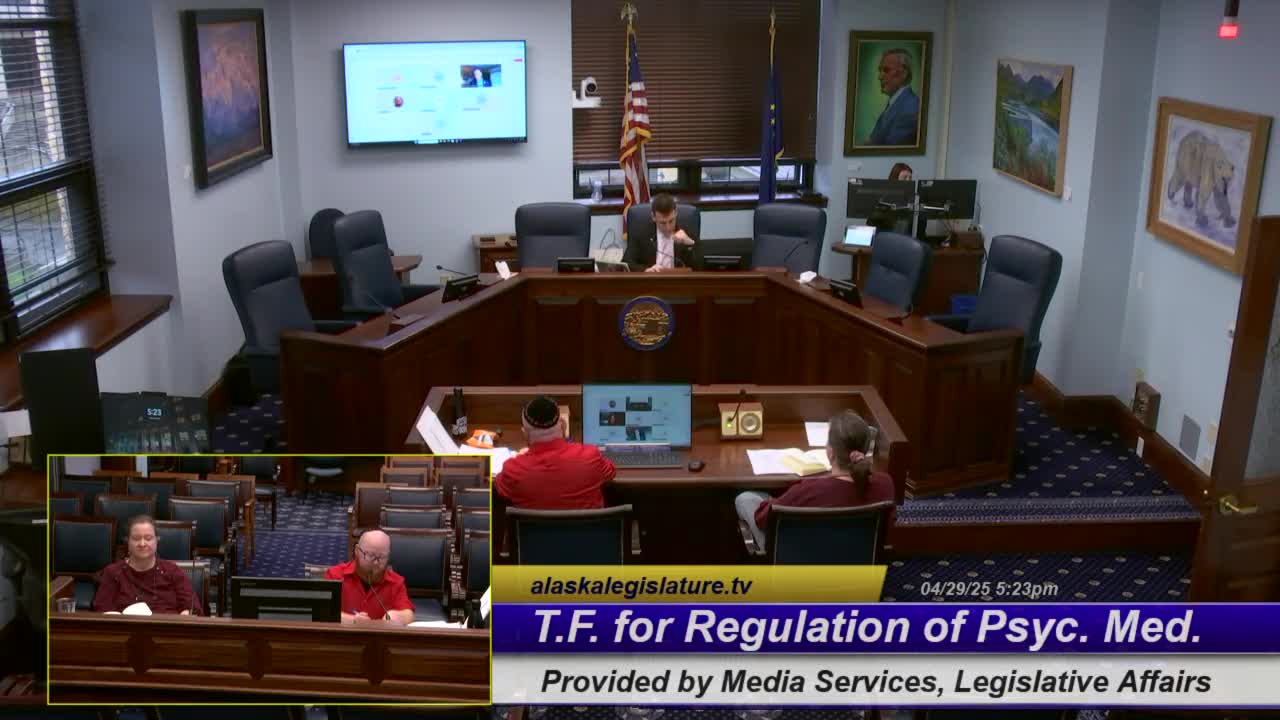
The Alaska Psychedelic Medicine Task Force held a public hearing on the group’s draft recommendations on April 29, 2025, in a hybrid session that included members in Juneau and participants online. The task force opened public testimony and then discussed whether the Legislature should prepare a “trigger” law to allow prompt state rescheduling and clinical use of psychedelic medicines if the U.S. Food and Drug Administration (FDA) approves a product and the U.S. Drug Enforcement Administration (DEA) reschedules it.
The Alaska Psychedelic Medicine Task Force held a public hearing on the group’s draft recommendations on April 29, 2025, in a hybrid session that included members in Juneau and participants online. The task force opened public testimony and then discussed whether the Legislature should prepare a “trigger” law to allow prompt state rescheduling and clinical use of psychedelic medicines if the U.S. Food and Drug Administration (FDA) approves a product and the U.S. Drug Enforcement Administration (DEA) reschedules it.
The issue drew two public testifiers and extended discussion among task force members. Eric Rasmussen, vice president of government affairs and public policy for Compass Pathways, told the task force the company is completing late-stage work on a synthetic psilocybin product and urged a state-trigger approach so manufacturers could ship products into Alaska promptly. Rasmussen said prompt rescheduling at the state level “is paramount to ensuring access for patients in Alaska.”
Nina DeWitt, an Alaska Native traditional healer and earlier member of the original research task force, testified in favor of examining psychedelic-assisted treatments as clinical options and said combining traditional practices and Western clinical care could help address high rates of trauma in Alaska. “We want to be on the forefront of health care and serving our people,” she said, describing historical and intergenerational trauma in Alaska Native communities and noting some people currently travel out of state to access ceremonial or clinical psychedelic treatments.
Several task force members raised questions about process and safety. Dr. Colescott urged caution about bypassing the state’s Controlled Substance Advisory Committee, saying that committee — a multidisciplinary, appointed body that evaluates scheduling issues under Alaska statute — has expertise the task force should not sidestep. “I am concerned about a trigger law without further evaluation,” Colescott said.
Dr. Lawrence and other members clarified a core technical point: federal action by the FDA and DEA would not automatically remove all state-level barriers. Alaska’s state schedule (codified in AS 11.71 and following) uses different categories and imposes criminal-law consequences separate from the federal scheduling framework. Dr. Lawrence asked the task force to add a finding to the report that explains the distinction between federal scheduling and Alaska’s state schedule and its statutory citation.
Other members voiced competing priorities. Dr. Dimelina, speaking from the perspective of working with veterans, emphasized urgency and the potential lifesaving value of new treatments for treatment‑resistant depression and PTSD; she cited national veteran suicide rates and argued delay could cost lives. Other members, including Dr. Kozap and Dr. Komska, referenced gaps in existing studies and VA materials that highlight limited sample sizes, exclusion criteria and safety considerations for many patients — points they said should inform Alaska’s implementation planning.
On procedure, the task force did not take final votes on policy tonight. Members voted by voice to adopt the meeting agenda and to approve the prior meeting’s summary notes. Representative Justin Ruffridge moved — and a member identified as Sarah seconded — to add a recommendation to the draft report proposing a legislative “trigger” mechanism; the chair sought unanimous consent to add that recommendation to the draft for members to vote on later, and no member objected. The task force authorized staff (facilitator Anna Brawley and Legislative Information Office staff) to make minor, technical conforming edits to the recommendation language.
The group agreed to a short, documented voting process to finalize the report: staff will publish a clean draft after the public comment period (which closes at 5 p.m. on Monday, May 5), then distribute an individual voting form to all 15 task force members. The process described in the meeting calls for voting on each finding and each recommendation individually using a named ballot (yes/no/abstain), with a simple majority of members (at least eight yes votes) required for inclusion in the final report. Staff proposed opening the ballot on Monday, May 12, and closing it Monday, May 19, to allow members representing agencies time to consult with offices before voting. Members may submit dissenting statements or appendices for publication with the final report.
The chair, Senator Forrest Dunbar, and co‑chair Representative Justin Ruffridge said staff will compile votes, prepare the final draft and transmit the task force report to the Legislature and governor per the statute that created the body. The meeting closed after the group confirmed the schedule for final edits and approval.
Ending: The task force did not adopt a final policy tonight; it added a trigger-law recommendation to the draft to be decided in the upcoming email vote and directed staff to circulate a final draft and the voting form following the May 5 public‑comment deadline.