Get Full Government Meeting Transcripts, Videos, & Alerts Forever!
Get email alerts on the Early Intervention Ilp topic
No spam. Unsubscribe anytime.
Senate committee hears bill to expand early intervention, lower eligibility to 25% developmental delay
Summary
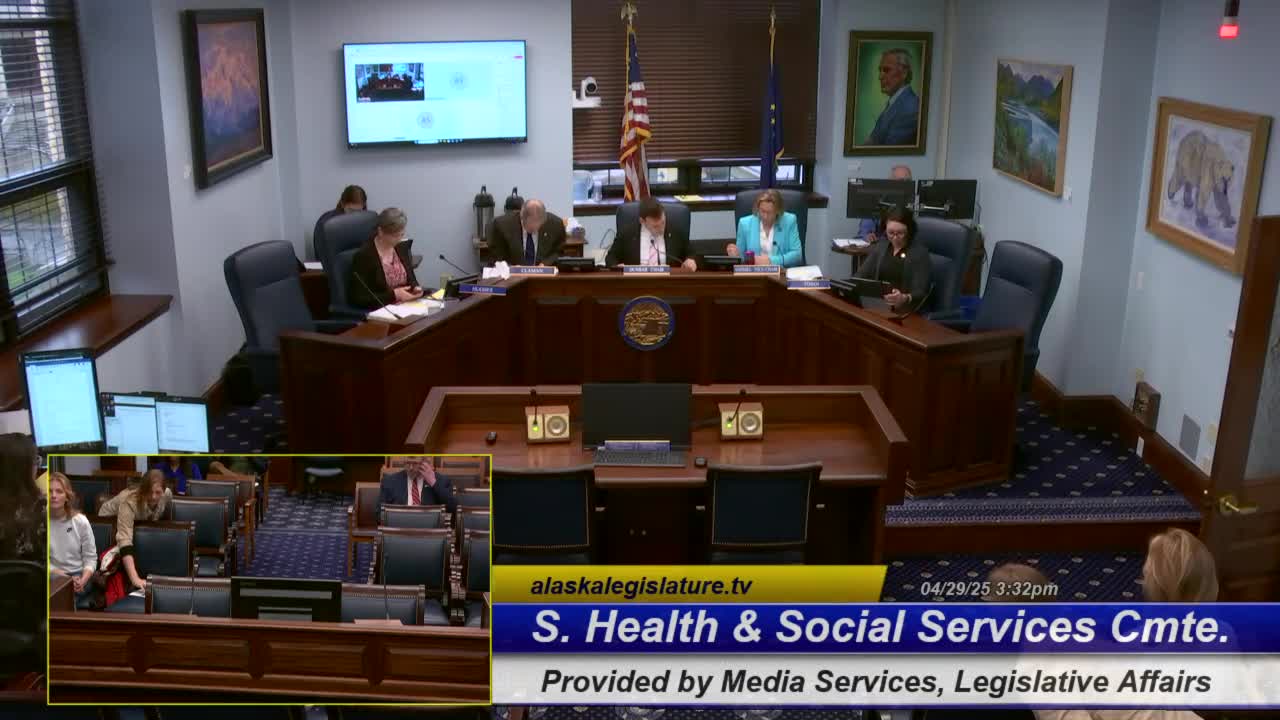
Senate Health and Social Services held an initial hearing April 20 on Senate Bill 178, a committee‑sponsored measure to expand Alaska’s Infant Learning Program by lowering the eligibility threshold from 50% to 25% and allowing broader Medicaid billing for Part C services.
Senate Health and Social Services held an initial hearing April 20 on Senate Bill 178, a committee‑sponsored measure to expand Alaska’s Infant Learning Program (ILP) by aligning state eligibility with federal Part B standards, permitting broader Medicaid billing for Part C services, and directing the Department of Health to review qualifying conditions and report to the Legislature.
The bill, introduced by committee staffer Ariel Wiggins on behalf of Chair Senator Dunbar, would (1) amend multiple Alaska statutes to add early intervention services for children with developmental delays to the Alaska Medicaid state plan, (2) lower the program’s eligibility threshold from a 50 percent developmental delay to 25 percent, (3) require the Department of Health to review and recommend updates to qualifying conditions at least once every five years, and (4) submit a detailed report to the Legislature by July 1, 2029. The act’s changes would take effect July 1, 2026 only if the U.S. Department of Health and Human Services approves the required federal plan amendment.
Why it matters: Early intervention providers and advocates who testified said the 50 percent threshold currently used in regulation prevents many children from receiving services in the most developmentally sensitive months and years. Supporters said expanding eligibility and enabling broader Medicaid billing could increase access to evidence‑based interventions, reduce long‑term special‑education costs, and allow some families to return to work.
Committee staff read a sectional summary that cites multiple statute changes in the bill, including amendments to statutes governing early intervention services, eligibility, individualized family service plans, and the list of covered services. The sectional review included repeated references to statute sections as spoken in the hearing (for example, provisions described in the hearing as amending AS 40.7.77030, AS 40.7.72060, AS 40.7.7270C, and AS 47.20.2906). The bill also directs the Department to amend the Alaska Medicaid state plan and conditions its effective date on federal approval.
Amy Simpson, Executive Director for Programs for Infants and Children, described the change in Medicaid billing as central to reducing reliance on state general funds. She told the committee: "The most important part of this bill... is expanding access to the ILP system by lowering the eligibility criteria to children with a 25 percent developmental delay." Simpson said that current allowable Medicaid billing covers occupational, physical and speech therapy but not the majority of services the ILP provides (special instruction and developmental therapies), which are currently paid fully with state funds.
Richard Seville, staff for the Governor’s Council on Disabilities and Special Education, said Alaska’s Part C eligibility is among the most stringent in the country and urged lowering the threshold. Seville testified that the bill could yield long‑term savings, stating, "Each child that doesn't need special education K through 12, we could be saving $229,000 a year," and argued those savings could be reinvested over time.
Providers from the Matanuska‑Susitna Infant Learning Program described cases they must turn away under the current threshold. Developmental specialist Cheryl Welcome said, "I've had evaluations where those children aren't meeting that 50% delay... we're forced to turn them away," and warned that children who are turned away often return later with more significant delays. Julia Smith, a developmental specialist who said her program serves roughly 85–95 children locally, described the ILP’s parent‑coaching model and credited early services with improvements in her own child’s development.
Producer Lauren Artin Cruz described filming ILP evaluations and recounted a case of a child exposed prenatally to alcohol who did not meet the 50 percent threshold and therefore lost services. She told the committee that program staff have repeatedly had to end services because of the existing regulatory benchmark despite clinical concerns.
Committee members asked about fiscal and operational impacts. Witnesses and staff acknowledged the state’s fiscal office predicted the department would need additional staff to implement Medicaid billing and handle greater enrollment; witnesses cited an anticipated 77 percent increase in children served based on prior research. During questioning, supporters noted that expanding eligibility will require additional staffing, contractor support and federal plan changes to implement Medicaid billing.
Action and next steps: The committee opened and closed public testimony and then set SB 178 aside for future consideration. No committee vote on final passage occurred at this hearing.
The committee posted a later, updated presentation online after the hearing; the bill will return for further hearings where fiscal and implementation details will be considered.