Get Full Government Meeting Transcripts, Videos, & Alerts Forever!
Get email alerts on the Public Safety topic
No spam. Unsubscribe anytime.
Kenmore hosts public-safety study session; judges, prosecutor, public defender, RACER and police outline community-court, crisis-response and enforcement trends
Summary
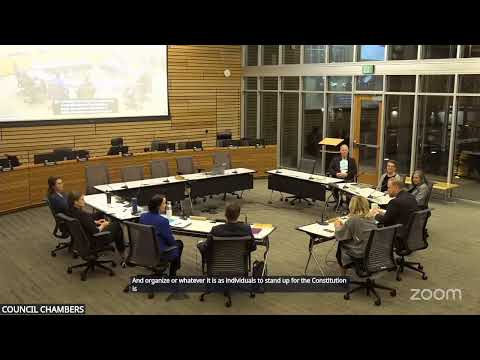
Kenmore City Council held a public‑safety study session where King County District Court judges, Kenmore’s prosecutor and public defender, the Regional Crisis Response Agency and Kenmore Police reviewed community court results, crisis‑response outcomes and local crime trends.
Kenmore City Council held a public‑safety study session that brought King County District Court judges, the Kenmore prosecuting attorney and public defender, the regional crisis‑response agency (RACER) and the Kenmore Police Department before the council to review local trends, programs and next steps.
King County District Court Judge Karama Hawkins and colleagues described the court’s work in Shoreline and Kenmore, highlighting community court as a voluntary, short‑term program that connects people who commit repeat low‑level offenses to services rather than moving them immediately into traditional criminal prosecutions. "The courts in King County District Court and in Shoreline, these are the people's court. That means it's your court," Judge Karama Hawkins told the council as she described the court's mission to provide access to justice and reduce recidivism through supervision and treatment referrals.
The court reported that in 2024 community court had nine participants graduate systemwide; one graduate came from Kenmore and there was a potential second graduate in March. As of Dec. 31, 2024, Shoreline/Kenmore community court listed 30 participants in total, three of them from Kenmore. The court said the program typically lasts only a few months for participants who opt in, and is aimed at repeat trespass, theft and related quality‑of‑life offenses, not violent cases.
Kenmore's contract prosecutor, Sarah Roberts, outlined how her office screens police reports and pursues misdemeanor and gross‑misdemeanor filings for the city. Roberts emphasized the prosecutor's professional standard: "The primary duty of a prosecutor is to seek justice within the bounds of the law, not merely to convict." She explained common case resolution options used in Kenmore, including stipulated orders of continuance (SOC), deferred prosecutions for certain DUI cases, and referrals to regional mental‑health and veterans courts when appropriate. Roberts said domestic‑violence arrests require mandatory booking and often prompt requests for no‑contact orders; she reiterated that community court is not designed for violent offenders or DUI cases.
Jeff McNichols, Kenmore's public defender, described the defense perspective and the critical role of the court's resource center. McNichols said most criminal cases in the district court arise from underlying substance‑use or mental‑health issues: "Most people do not get out of bed and decide I'm gonna go out and commit a crime," he said, arguing that successful outcomes require addressing root causes. He also noted staffing pressures in public defense statewide and said his firm ran one of the highest numbers of misdemeanor trials in Washington in 2024 (roughly 28–32 trials for the firm).
Brooke Bittner, executive director of the Regional Crisis Response Agency (RACER), reviewed RACER's model and 2024 results. RACER deploys civilian crisis responders alongside or instead of sworn officers for behavioral‑health emergencies and operates a small fleet that can ride with or replace an officer when appropriate. Bittner said RACER served 1,880 unique individuals across its partner cities in 2024, for 4,713 recorded encounters, and that RACER’s work aims to "capture people before they get to the point, where they need an arrest or a referral to a community court." For Kenmore specifically, RACER recorded 88 individuals and 66 encounters in 2024, more than double the 34 individuals served in 2023. Bittner also noted new state legislation (House Bill 1811) that defines core behavioral‑health first response and supports workforce development for similar programs.
Kenmore Police Chief Brandon Moen told the council the department continues to operate with roughly the same number of sworn positions as in past years while serving a growing population and a varied caseload. He described regular, operational collaboration with RACER, saying the crisis responders are now routinely on radio channels with deputies and are asked for on the air: "The use of RACER... is hourly," Chief Moen said, describing the rapid pace of cross‑agency deployments. Moen reviewed 2024 crime figures for Kenmore: residential burglaries fell sharply, commercial burglaries rose, motor‑vehicle thefts remained elevated compared with pre‑pandemic years, and pedestrian and bicycle collisions remained scattered across arterial corridors and trails. He also summarized the city's automated‑enforcement program, noting a large spike in camera reviews after the system expanded (from about 1,000 monthly reviews to roughly 11,000 in November 2024), and said those review counts have dropped since as drivers adjusted.
Across the presentations council members asked about community‑court eligibility (Roberts and Hawkins clarified that community court excludes DUIs and recent violent felony histories), RACER response coverage and data (Bittner said RACER and King County evaluation units can produce person‑level pre/post analyses showing jail‑booking reductions but that small local samples limit precision), and police staffing and how automated enforcement affects officer workload (Moen said officers handle reviews as time permits but the department may revisit internal review practices if review volumes stay high).
Council members and presenters emphasized coordination: the prosecutor, public defender and court staff said they consult regularly to decide who is appropriate for community court; RACER and police said improved radio access and vehicle availability increase RACER deployments to Kenmore; and the court and defense teams noted the resource center and recovery navigator programs are central to connecting defendants to care.
The council's consent agenda was adopted by unanimous voice vote earlier in the meeting. The session closed with council thanks to the presenters and staff.
Ending: The study session left councilors with multiple near‑term items to track: RACER staffing and vehicle additions to improve overnight coverage; ongoing outreach to increase community‑court referrals; monitoring of camera‑enforcement review workloads; and continued data sharing with King County evaluators to measure whether crisis response and community court reduce jail bookings and increase engagement with behavioral‑health services.