Get Full Government Meeting Transcripts, Videos, & Alerts Forever!
Get email alerts on the Budget topic
No spam. Unsubscribe anytime.
East Stroudsburg Area SD reviews four budget paths as 2025–26 deficit looms
Summary
District business staff presented four tax-and-spending options for the 2025–26 budget, showing possible deficits ranging from about $23 million (no tax increase) to smaller shortfalls with modest tax increases; board members asked questions about healthcare costs, use of fund balance and long-term forecasts.
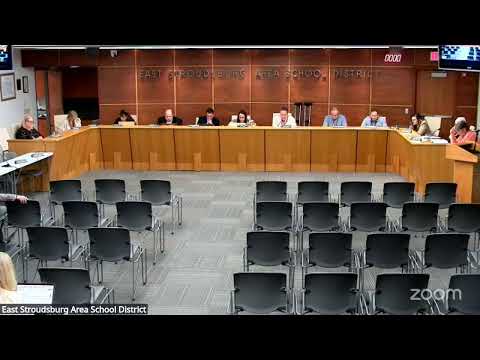
East Stroudsburg Area School District business staff presented four options for the 2025–26 budget at the board meeting April 28, laying out revenue and expenditure projections and the tax impact for Monroe and Pike counties.
The most immediate choices were: no tax increase (option 1), a 2% increase (option 2), a 3.5% increase (option 3) and the Act 1 index maximum (5.6%, option 4). The administration’s analysis showed a projected 2025–26 deficit of roughly $23.2 million under option 1; the deficit narrows under higher-rate options, and the 3.5% option was presented as a practical middle path to stabilize the fund balance over several years.
Why it matters: the district spans two counties with recent assessment changes — Monroe County assessment appeals reduced local taxable value by about $35 million — and that decline drives much of the local-revenue loss the budget must absorb. Board members pressed staff on health-insurance assumptions, how assigned fund-balance reserves would be used, and the interplay between one-time reserves and recurring operating costs.
Business office presentation and proposals
Peter (staff member, business office) reviewed the assumptions behind each option, including local income-tax trends, interest-earnings estimates, state aid assumptions and the scheduled expiration/issuance of debt. He told the board that state revenue in the governor’s budget included a $5.5 million tax-equity payment that the district expects to receive and that federal ESSER funds used in prior years will decline in 2025–26, reducing federal revenue in the draft budget.
“Monroe County assessment update has a $35,000,000 loss from the 2024 assessment value,” Peter said during the presentation, and he illustrated how that shortfall translates to roughly $1.6 million in lost local revenue under the zero-increase scenario.
Nut graf — long-term stakes
Board members and staff emphasized that any tax decision this year compounds in future years: raising revenue now smooths the district’s projected downward fund-balance trajectory, while relying on reserves without recurring revenue increases could lead to much deeper structural deficits later. Staff presented multi‑year forecast charts showing how different single‑year increases would affect fund balance through the end of the decade.
Discussion highlights and clarifications
- Health benefits: Peter and other staff told the board they expect health insurance costs to increase; the presentation used an 11% increase assumption, and staff said it could rise toward 13% based on insurer feedback. Board members asked whether assigned reserves for healthcare (an $18 million assignment in last year’s audit action) could be used to reduce the recurring budget impact; staff explained that the assigned fund-balance bucket is a one‑time resource to draw from if needed but does not directly lower annual premium increases absent plan design changes.
- Revenue assumptions: staff said local income‑tax receipts have trended higher in recent years and the budget assumes $5 million based on a multi‑year trend and Berkheimer projections; interest-earning estimates were raised modestly because current investment returns have exceeded prior conservative assumptions.
- Expense reductions: the administration reported about $4 million in identified expenditure reductions across departments since the March budget draft, including cuts in grounds, maintenance, special education and IU services, and one-time savings in debt-service timing.
Next steps
The finance committee will make a recommendation in May and the board will be asked to adopt a preliminary budget for 2025–26 consistent with state timelines. Peter told the board members they can request additional meetings or data, and he offered to meet individually to walk through building- and department-level changes.
Ending
Board discussion ended with a recognition that the district must balance short-term choices against longer-term fiscal stability: staff encouraged the board to weigh the tradeoffs — using fund balance now versus raising recurring revenue — and said the finance committee will present a recommendation at the next meeting.