Get Full Government Meeting Transcripts, Videos, & Alerts Forever!
Get email alerts on the Water Infrastructure topic
No spam. Unsubscribe anytime.
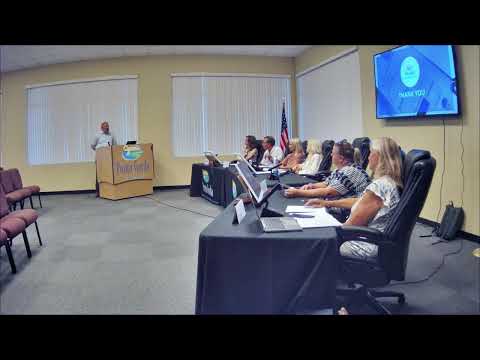
Punta Gorda officials outline water, wastewater shortfalls and plan to expand reverse-osmosis plant
Summary
City utilities staff told a utilities workshop April 29 that regulatory limits and recent peak demand have left Punta Gorda’s water system short of firm capacity, prompting a recommended expansion of the reverse-osmosis plant, distribution and wastewater upgrades, staffing additions and pursuit of grants and financing.
Tom Spencer, City of Punta Gorda utilities director, told a city utilities workshop on April 29 that the city’s drinking water meets regulatory standards but that limits set by the Southwest Florida Water Management District and rising peak demand have created a shortfall in firm supply.
Spencer said the city’s reverse-osmosis (RO) plant has 4,000,000 gallons per day (gpd) of treatment capacity and that the surface-water (service) plant can produce the remainder; together the plants currently can make about 8,000,000 gpd under the management rules the district enforces. He said recent peak-day use has exceeded 9,500,000 gpd and projected peak-day demand could reach about 12,000,000 gpd under some scenarios.
"Our drinking water continues to meet all required standards," Spencer said. "But lately, we've seen usage exceeding 9,500,000 gallons." He added that the city should expand the RO plant to add capacity quickly because the plants and well field were already laid out for a larger buildout and only equipment and additional wells are needed.
The workshop presentation described how the Southwest Florida Water Management District’s minimum flows and levels (MFLs) divide the year into three blocks; the most restrictive block — which Spencer said often overlaps the city’s highest usage months — sharply limits how much water may be withdrawn from the Shell Creek reservoir. Spencer said the city spent roughly a third of 2024 (119 days) in the most restrictive block and that the MFLs have been in effect long enough that the city is in restrictive conditions a substantial share of the year.
The utilities presentation summarized system assets and recent volumes: two treatment plants at Washington Loop Road, six production wells, storage tanks totaling about 7,500,000 gallons, roughly 291 miles of pipe, about 14,000 service connections, and approximately 1,400 hydrants. Spencer said the city produced about 2.5 billion gallons in 2024 (about 1.5 billion from the Shell Creek reservoir and about 1 billion from production wells) and delivered about 2.7 billion gallons, drawing about 200 million gallons via an emergency interconnection with the Peace River Regional Water Supply Authority.
To address capacity limits, Spencer said the city’s 2024 water supply plan (prepared with consulting engineers) recommends expanding the RO plant to 8,000,000 gpd and adding wells. "The plant was built with the capacity for 4,000,000 gallons," Spencer said. "We actually have the facilities in place — everything with the exception of some of the equipment and the wells — to expand out to 8,000,000 gallons." He said much of the engineering and siting is complete and that expansion is the most cost-effective near-term option.
Spencer also described a recommended re-rating and rehabilitation of the surface-water (service) plant to 6,000,000 gpd, saying the plant rarely exceeded that level in recent years with MFLs in place. He told the workshop that preliminary engineering would include a cost-benefit analysis for an aging elevated tank (about 1 million gallons) and that repainting alone would cost about $250,000.
On wastewater, Spencer said the city treats about 1 billion gallons a year and that the plant’s historic land-application practice for biosolids may be constrained by new Department of Environmental Protection rules. He said the city is evaluating replacement or upgrades for the sludge press, drying and hauling biosolids when required, and ongoing improvements at lift stations and force mains. Several wastewater projects — including a Henry Street force main upgrade under I-75 and a major basin replacement near Charlotte Park to address inflow and infiltration — were described as nearing procurement or already budgeted.
Spencer outlined near-term capital and staffing requests: adding distribution maintenance workers (two in FY2026 and two in FY2027), an additional utility-locate coordinator, a project manager, a funding/grants coordinator, an engineering technician, and four maintenance-worker positions (two water distribution and two wastewater collection). Spencer estimated the combined cost of new employees at approximately $558,000.
Kristen Semione, Punta Gorda finance director, said the city’s rate consultant is studying water and wastewater impact fees and that the two largest projects would likely be financed; she said the city would evaluate State Revolving Fund (SRF) 20-year financing, municipal bonds (longer terms but higher issuance costs) and pursue grants. "If we find grants for these projects that will help offset some of that cost," Semione said, "that will help." She noted grant applications have been submitted and that the city continues to pursue outside funding.
Spencer described meter and sampling programs: Lead-and-copper-rule sampling is expanding to include daycares, schools, hospitals and public facilities and the city is inventorying service connections using potholing. The city is working with a contractor, 120Water, on program management. The city is also testing AMI/AMI-like meter systems and has been reading meters with Olameter; staff said pilots and data analysis on radio frequencies and AMI network design are underway, with an expected 6–8 month timeline for parts of the AMI work.
Spencer said enforcement for irrigation violations will begin in May and reminded residents that state restrictions prohibit irrigation between 10 a.m. and 4 p.m. He said staff will issue door hangers for blocked meter access and pursue code enforcement if meter access remains obstructed.
Questions during the workshop addressed alternatives such as buying an allocation from Peace River, reuse or "toilet-to-tap" treatments, saltwater desalination and the feasibility of building large regional reservoirs. Spencer said the interconnection with the Peace River authority is for emergency uses only and that buying a permanent allocation is expensive; he said previous cost comparisons favored producing the city’s own water over purchasing allocations. He and others said desalination and potable reuse have higher costs and regulatory hurdles and that the city has limited siting options for a very large reservoir.
The utilities department said several projects will come to the council for procurement or approval on May 7, including force main work and master booster upgrades; staff also said contractor teams will apply for state and federal grants for some wastewater projects. Spencer recommended legislative and operational measures — including expanding RO capacity, completing targeted main replacements and securing grant and low-cost financing — to reduce the city’s exposure to MFL limits and rising peak demand.
Ending: Councilmembers and residents at the workshop urged conservation and noted the political and fiscal trade-offs ahead; staff said procurement and design steps are underway and that grant applications and financing analysis will continue before major construction begins.