Get Full Government Meeting Transcripts, Videos, & Alerts Forever!
Get email alerts on the Police Accountability topic
No spam. Unsubscribe anytime.
Seattle council committee hears oversight partners’ plans as consent-decree exit nears
Summary
The Seattle City Council Public Safety Committee on April 20, 2025 heard updates from the city’s oversight offices and Seattle Police Department on crowd management, use-of-force reviews, surveillance evaluations and contingency planning as the city prepares to exit its federal consent decree.
The Seattle City Council Public Safety Committee on April 20, 2025 received progress updates from the city’s three principal police accountability partners and the Seattle Police Department on a range of oversight projects as the city prepares for the end of federal court monitoring of SPD.
Inspector General Lisa Judge told the committee the Office of Inspector General (OIG) published its 2024 annual report that morning and is leading multiple reviews that would be relevant to a post-consent-decree future, including audits of vehicular pursuits, an equity assessment of SPD workplace practices, a review of crowd-management work tied to FIFA/World Cup planning and an evaluation of the department’s real-time crime center and camera, automatic-license-plate-reader expansions. “We are continuing to step up our engagements in collaboration with OPA and CPC,” Judge said, adding OIG is preparing multiple reports with staged timelines that extend through 2026.
The OIG update listed several published and planned products: a force review board memo due in May 2025, a vehicular-pursuits audit expected mid-2025, a controlled-substances research project with the University of Washington due December 2025, and a Real Time Crime Center and surveillance effectiveness evaluation due December 2026. Deputy Inspector General Alyssa Pettis Morrison said the office is reviewing crowd-management responses and has engaged Professor Clifford Stott as an international expert for protest- and crowd-management observations.
Bonnie Glenn, interim director of the Office of Police Accountability (OPA), described OPA’s continuing investigations work and outreach, and showed a short mediation program video intended to expand voluntary mediation for eligible misconduct complaints. “When you come together and it feels like it’s in neutral territory, you could just be your authentic self,” Glenn said of the mediation pilot. OPA reported it conducted one mediation in 2024 and said it is expanding complaint navigation, complaint-impact statements and website access to help complainants find resources and track case progress.
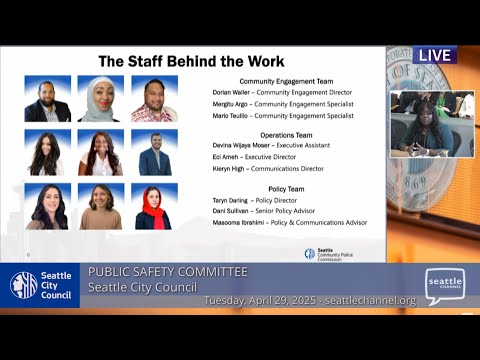
Isiame Ame, interim executive director of the Community Police Commission (CPC), briefed the committee on CPC staffing and engagement. Ame said CPC now has nine staff and 11 of 15 commissioner seats filled and has increased its citywide community outreach since February. She described CPC priorities that include building community capacity to review police-accountability proposals, preserving community voice in a post-consent-decree system, and restoring funding cut from CPC’s budget. “As we go into this budget deficit scenario…our investments are going to communicate our values,” Ame told the committee, saying CPC will seek restoration of 2024 cuts in a supplemental budget request.
SPD Chief Operating Officer Brian Maxey said the department revised its crowd-management policy after the council passed new restrictions on less-lethal tools and that SPD incorporated feedback from accountability partners where feasible. “If there’s something that’s important to one of our accountability partners or to the communities they represent, if we can get a yes on it, we’re going to do that,” Maxey said. Maxey and other presenters said the revised crowd-management policy has been transmitted to the Department of Justice monitoring team for review and that SPD will continue to consult OIG, OPA and CPC before finalizing implementation details.
Public commenters urged the council to plan now for long-term oversight once the consent decree ends and to complete unfinished accountability steps. Amy Summers and Agnes Govern, representing a local community group, asked what planning is under way to sustain oversight after the monitor leaves and why the 2017 accountability ordinance (Ordinance 125315) has not been fully codified into the Seattle Municipal Code. “We are not confident that to date there is coordinated planning going on for who is going to take over the roles of ensuring that we continue to have an operative system for oversight,” Summers said.
Other public speakers criticized the Community Police Commission’s outreach and independence. Howard Gale cited a June 2024 CPC-commissioned report that he said criticized CPC engagement and said the commission was “uninvolved and disconnected.” Valerie Florett cited reporting about the federal monitor’s contracting and asked the council to avoid relying on “glossy talking points” as Seattle exits the consent decree. David Haines made broader, sharply critical remarks about 2012 police reforms; committee members did not adopt his characterization.
Committee members pressed accountability partners on practical barriers and solutions. Council Vice Chair Teresa Saka and others asked what single barrier posed the greatest risk to each partner’s effectiveness. OPA and CPC identified budget- and case-management tooling shortfalls and said improved case-management systems and restored staffing are priorities. OIG emphasized the need for cooperative relationships with SPD leadership but noted the office’s mandate is to maintain systemic oversight even if relationships become strained.
The committee did not take formal policy votes on the briefings. Members directed the accountability partners to continue collaborative outreach and to return with more detailed budget and staffing requests, timelines for key reports and updates on how crowd-management rule changes are being operationalized. The committee also said it would consider additional hearings on ordinance implementation and post-consent-decree planning at future meetings.
Ending
The committee moved two CPC-related confirmations to a May 6 full-council docket and postponed a separate agenda item to the next committee meeting, which the chair said is scheduled for May 13. Accountability partners told the committee they expect overlapping project deliverables through 2025 and into 2026 and asked the council for clarity about resources and access that will allow them to sustain oversight functions once federal monitoring ends.