Get Full Government Meeting Transcripts, Videos, & Alerts Forever!
Get email alerts on the Emergency Management topic
No spam. Unsubscribe anytime.
Santa Fe emergency management shifts to ‘back to basics’ as federal funding becomes uncertain
Summary
City officials reviewed the Office of Emergency Management budget and heard that leaders plan to refocus on core readiness — training, exercised emergency operations center activations and public preparedness — as federal grants and disaster aid face growing uncertainty.
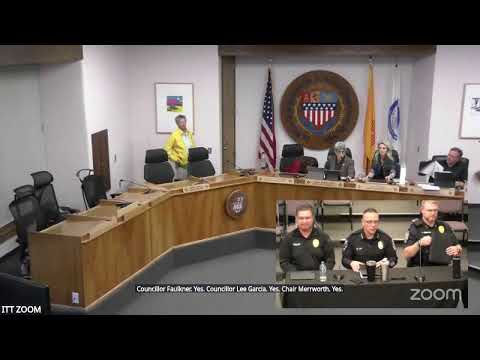
The Santa Fe Finance Committee heard a budget briefing April 29 from the Office of Emergency Management that framed a strategic shift toward core readiness after warning that some federal grant and disaster-declaration support has become less certain.
The Office of Emergency Management told the committee that its team is small — two full-time staff — and that roughly 20% of its modest budget pays staff salaries while the rest covers operations, services and equipment such as deployable barriers and CodeBlue kits. Director Hammond Paul said the office will emphasize “nuts and bolts” preparedness work including training, reliable emergency operations center activations and public readiness campaigns.
The move responds in part to changes at the Federal Emergency Management Agency and at least one recent trend the presenters described as raising the administrative bar for federal disaster declarations. “The standard for disaster declarations is going up,” Director Williams said, explaining that some state requests for federal help have been rejected recently. Williams and other speakers urged the city to reduce overreliance on federal money and invest more locally in preparedness.
Committee members pushed for concrete measures. Councilor Lee Garcia asked what other funding sources the city could pursue if federal grants decline; staff answered that state funding may pick up some costs, but details remain unclear and legislative discussions are underway. Garcia also recommended exploring permanent, fixed protections such as automatic bollards for high‑use downtown streets; staff said the city has instead been buying moveable “meridian” barriers that can be redeployed to special events or other locations.
Executives described several operational priorities: expand staff training so every city department understands its emergency role; maintain a well‑exercised emergency operations center; invest in relatively low‑cost digital and GIS tools that improve public information; and conduct targeted wildfire preparedness outreach. Director Hammond Paul said wildfire mitigation and public information are “top of mind” and noted returns from small digital investments such as interactive evacuation maps and geofencing notifications.
Committee members asked about surge sheltering and generators: staff said the city has 29 pallet shelters in storage and is working to identify priority facilities that lack backup generators. The cost to add generator capacity varies widely by facility; one large site (the GCCC) was described as a roughly $1,000,000 upgrade. Staff have not yet brought specific budget adjustments to fund those generators.
The office also flagged program risks and suggested operational steps to reduce them: maintain staff positions (the presenters said the 20% of budget that funds salaries is more valuable than it looks), reduce administrative complexity when possible, and pursue foundation or nonprofit “resilience” grants for innovation projects that are smaller than large federal recovery awards.
As the committee recessed, staff said they would continue to refine priorities and return with details on generator costs, how public outreach will be organized and how GIS and early‑warning investments could be staged.
Ending: The committee did not take a separate vote on OEM spending at the April 29 meeting; committee members signaled interest in following up on generator costs and public outreach plans as the budget process continues.