Chandler highlights CTE expansion and launches Chandler Career Center to connect students with employers
Get AI-powered insights, summaries, and transcripts
SubscribeSummary
City of Chandler leaders, Chandler Unified School District officials and local business groups described career-technical education expansions, a new Chandler Career Center platform and local scholarship funding aimed at linking students to jobs and credentials.
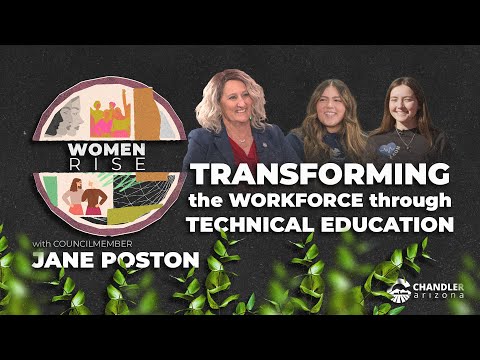
On the City of Chandler’s WomenRise podcast, Council member Jane Poston and guests described expansions in Chandler Unified School District’s career and technical education (CTE) programs and municipal workforce efforts, including the April 2024 launch of the Chandler Career Center, a virtual platform that connects job seekers and local employers.
Why it matters: Chandler officials and business partners said the combined strategy — K–12 CTE courses, earlier career exploration, industry-developed high school programs and a city-run job platform — is intended to move residents into local jobs more quickly and keep talent in Chandler.
Superintendent Frank Narducci said Chandler Unified serves “42,000 students, and 5,200 employees,” and described a districtwide effort to create a “portrait of a learner” that emphasizes adaptability, communication, collaboration, critical thinking and empathy. “We have a very vibrant selection of courses, over 21 courses that students can pick,” Narducci said, adding that “over 3,000 of students get credentials every year.” He said the district works directly with industry partners to design courses, citing a semiconductor program planned at Hamilton High School and a Google cyber security clinic at ACP High School.
Students who have completed or are enrolled in CTE described hands-on learning and short-term credentials. Ava Vigil, a student in the automotive program, said the class covers maintenance and electrical work and praised its practical approach: “It’s not as intimidating as people think… Everyone’s very welcome.” Elise Oxenhandler, in sports medicine and rehabilitation, said CTE training — including emergency medical response, CPR and first-aid — gives students a head start for employment and certifications such as lifeguarding and EMR that can be cited on applications.
City economic development staff described the Chandler Career Center as a city-funded, white-glove service intended to bridge employers and talent. Edie (economic development division) said the city contracted Pipeline AZ to design the platform after council funding made workforce a priority in fiscal year 2023–24. She reported that since the center’s launch the city has 41 companies registered and 77 companies using the service; the platform has had more than 460 positions posted and more than 625 job seekers registered. Edie said the city also hired a workforce development project manager to support employers and job seekers and that the city organized an advanced manufacturing career expo with Chandler-Gilbert Community College and the Chandler Chamber of Commerce.
Terry Eady of the Chandler Chamber of Commerce said workforce demand is the Chamber’s top issue in surveys of local businesses and emphasized partnership with educational institutions for upskilling, short-term certificates and employer-driven credentials. Eady cited local efforts including scholarship support and employer-retention visits that bring education partners to businesses to identify immediate and long-term needs.
On funding and scholarships, Edie said the council awarded one-time funding of $25,000 for 25 STEM scholarships at Chandler-Gilbert Community College and that the city’s workforce project manager is working with those students through onboarding on the Chandler Career Center.
Discussion versus decisions: attendees described program launches, partnerships and council funding decisions already made (for example, the April 2024 launch of the Chandler Career Center and the one-time $25,000 scholarship award). Speakers also discussed planned or upcoming programs (the semiconductor course at Hamilton High School and the Google cyber security clinic at ACP High School) and increased junior-high and K–6 career-literacy coursework; those were presented as planned or developing initiatives rather than newly passed ordinances or votes.
The podcast concluded with leaders urging continued collaboration among the school district, city economic development, community college partners and the Chamber to align training with employer needs and to expand short-term credential pathways that allow students to enter the local workforce quickly.