Get Full Government Meeting Transcripts, Videos, & Alerts Forever!
Get email alerts on the Water Supply Groundwater topic
No spam. Unsubscribe anytime.
Pinal County Water Augmentation Authority outlines regional groundwater work and options for Casa Grande
Summary
Joe Singleton, executive director of the Pinal County Water Augmentation Authority, briefed the Casa Grande City Council on the authority’s recent technical work, legal and program developments affecting assured water supplies, potential surface-water projects and a cloud-seeding study.
Joe Singleton, executive director of the Pinal County Water Augmentation Authority, told the Casa Grande City Council the authority has been pursuing technical and policy work intended to support long-term water planning in the Pinal Active Management Area. "Our goal is to support development of responsible, collaborative and sustainable water planning and management" in the Pinal AMA basin, Singleton said.
The presentation outlined four ongoing efforts: review and correction of the Department of Water Resources’ late-2019 groundwater model, participation in stakeholder work on Assured Water Supply administration, involvement in a feasibility study of a Bartlett Dam modification, and a regional cloud-seeding study. Singleton said the authority contracted Matrix New World to analyze DWR’s model and recommended corrections and different assumptions about well spacing to improve 100-year projections. He said the authority submitted a package of recommended changes to DWR and has been in technical discussions with department hydrology staff.
Why it matters: the state’s Assured Water Supply program requires 100-year water accounting for subdivisions, and changes to modeling or rules can affect whether new plats are accepted. Singleton said an "ADOS" — an alternative pathway to designation of assured water supply — passed about a year ago and has been sued twice; if implemented it could allow some subdivision work to continue in the AMA by recognizing certain non‑subdivision groundwater use and by requiring additional replenishment.
Council members pressed how these state processes connect to local reuse and effluent planning. In response to a question about treated wastewater, Singleton said effluent can be a reliable local source but must be matched to intended uses and sometimes requires distribution infrastructure or additional treatment, which raises cost. "The issue with using effluent is you have to match the water quality with what you want to do with the water, which may or may not require some additional treatment, which means money," he said.
Singleton described the Bartlett Dam modification work as one option partners are studying to replace lost capacity at Horseshoe Reservoir, and said the authority is a cost-share partner in the feasibility study. On cloud seeding, he said consultants found roughly 23 summer days potentially appropriate for seeding in the area and that the technique could yield additional water at a reasonable cost, though water distribution is not controllable; he also said tribal stakeholders have expressed concerns about seeding agents and the authority is asking consultants for cost proposals for a salt‑based agent.
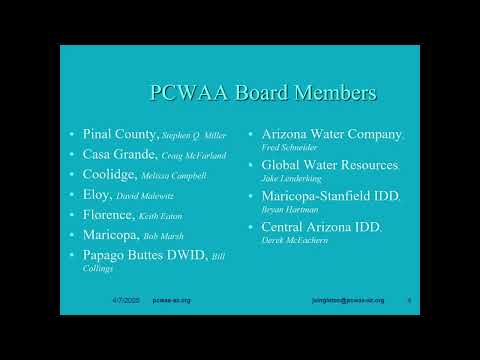
The presentation listed authority board membership and local representation, including Craig McFarland as the Casa Grande representative and Supervisor Steve Miller representing Pinal County. No formal council action was taken; staff and council thanked the presenters and asked staff to continue to brief the council as these state and regional processes evolve.
Singleton repeatedly framed the issues as long‑term: "When we talk about some of the water challenges that we're faced with, we're talking about math that goes out a hundred years."