Get Full Government Meeting Transcripts, Videos, & Alerts Forever!
Get email alerts on the Climate Action topic
No spam. Unsubscribe anytime.
Mesa highlights Climate Action Plan investments, youth grants and water programs; funds proposed for feasibility studies
Summary
City staff updated the council April 24 on the Mesa Climate Action Plan, reporting $17.8 million in investments over three years, a second round of youth grants funded by Bloomberg Philanthropies, proposed nonresidential water-conservation incentives, and funding for studies on regional water-supply options and airport energy planning.
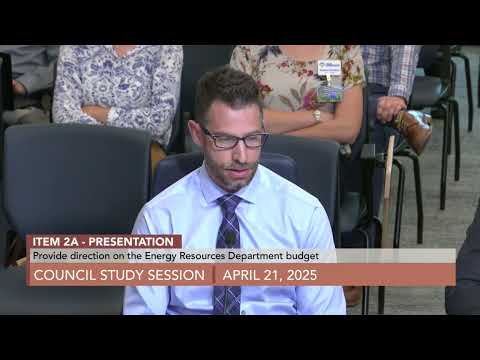
City environmental and sustainability staff presented an update on Mesa’s Climate Action Plan (MCAP) and department budget at the April 24 City Council study session, describing multi-year projects, youth grant programs, and proposed investments in water conservation, urban trees and airport sustainability.
Why it matters: MCAP-directed investments affect municipal energy use, urban heat, water demand and community resilience. The plan intertwines capital projects, grants and partnerships that alter city operations and offer incentives for residents and larger property owners.
Scott Boucher, who continued to present for the environmental and sustainability group alongside Deputy Director Laura Heinemann and management assistant Rachel Butler, said MCAP-related investments total about $17.8 million committed over the department’s three years of activity. Boucher framed the department as a city-wide consulting resource that helps other departments and community partners execute sustainability projects.
Laura Heinemann described four strategic focus areas — carbon neutrality, clean air/clean water/clean land, water stewardship and employee infrastructure — and highlighted programs and partnerships. She and Butler summarized the Bloomberg Philanthropies Youth Climate Action Fund that provides up to $5,000 grants to teams of 15–24-year-olds; round 1 awarded $50,000 collectively and the city secured $100,000 for round 2. Staff said they have 13 successful applicants in the current round and that the application deadline for remaining funds is May 13. "These students... had the ideas and we help them initiate it," Butler said.
Heinemann and Butler also listed community partners who supported tree planting and outreach: the Arizona Sustainability Alliance helped plant 94 trees in Sherwood Park; the Arizona Conservation Corps assisted with tree trimming; Amazon funded 60 trees in Heritage Park and provided volunteers; and SRPMIC provided funding used to print shade trees for schools and transit stops. Staff said SRP continues to provide rebates and that the department tries to use the maximum rebate amount available each year.
Staff described MCAP-funded project examples including the ongoing “flare-to-fuel” renewable natural gas project at the Northwest Water Reclamation Plant and downtown solar projects. On flare-to-fuel, Boucher said the team was at the commissioning stage for the renewable natural gas system but that a separate food-to-energy processing design is on hold pending updated financial analysis; he said an earlier feasibility study showed the project did not produce a near-term payback and that changing construction costs and tipping fees warrant a fresh look.
Water programs were a major focus. Heinemann outlined a proposed $270,000 incentive pool for nonresidential grass-to-xeriscape conversions (nonresidential meaning anything other than single-family residences, including homeowners associations and some commercial properties). Staff said incentives would partially fund desert-adapted plantings and that $20,000 of the package would be reserved for irrigation upgrades; staff estimated approximately 25 gallons saved per square foot after conversion. They also proposed funding phases of park irrigation improvements and noted that transportation and streets departments are pursuing separate right-of-way landscaping conversions.
The department sought funding for two water-supply feasibility studies: Bartlett Dam modifications to increase storage and a Salt River–Central Arizona Project (CAP) interconnect facility, both intended to assess long-term augmentation of Mesa’s water supply. Heinemann said WIFA (Water Infrastructure Financing Authority) funding had been used previously to expand grass-to-xeriscape programs and that demand for nonresidential conversions has been high.
Falcon Field Airport will pursue a sustainability energy planning study funded by MCAP, staff said, to examine energy use, fleet and ground-service electrification, public EV charging, and even electric aircraft charging and microgrid options. Staff described the SRP watershed protection/biomass agreement — a long-term partnership to thin forests in the Verde and Salt watersheds and generate renewable electricity from biomass — and said the city pays for electricity produced only when it receives it and has renewable energy credits retired in Mesa’s name. Heinemann said the watershed work serves as a preventive measure to reduce turbidity and other water-treatment impacts after major fires and storms.
Staff described recent budget adjustments in the sustainability department: two new positions (an urban forest program manager and a conservation specialist), reallocation of storage-tank funds into EV charging and a small set of proposed reductions in vehicle/equipment repair, underground storage tank costs, and event services capacity. Staff said some event programming has moved to Parks and Recreation as programs have grown and as partnerships help underwrite community events.
Councilmembers asked about ROI on LED fixture conversions and the watershed thinning commitment. Staff replied that payback periods vary by project but that they generally target five-to-seven-year returns and that the watershed partnership provides risk mitigation and indirect long-term water-quality and supply benefits rather than a simple project payback.
No formal council action was taken during the study session on the MCAP proposals; staff framed the items as budget requests and study funding proposals to be considered in the upcoming budget process.