Get Full Government Meeting Transcripts, Videos, & Alerts Forever!
Get email alerts on the Downtown Streetscape Monroe topic
No spam. Unsubscribe anytime.
Buckeye presents Monroe demonstration streetscape; staff to send public feedback to council
Summary
City of Buckeye staff reviewed the Monroe Demonstration Project pilot restriping, public outreach and three design scenarios, reporting modest drops in speeding citations and crashes, no detected harm to emergency response times, and asking residents to submit feedback that will go to City Council for budgeting decisions.
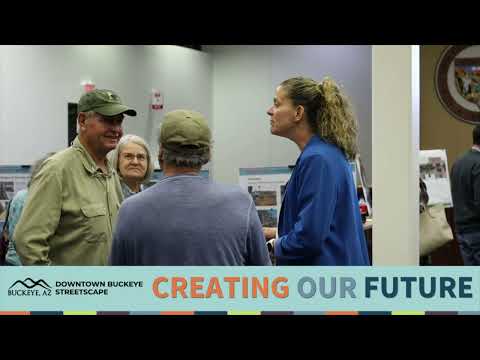
Brian Craig, development services director for the City of Buckeye, presented the Monroe Demonstration Project and longer-term downtown vision drawn from the Downtown Specific Area Plan (DSAP), describing a pilot restriping, interim parklets and staged capital improvements and asking residents for feedback the city will forward to City Council as it considers future budgets.
Craig said the DSAP was a roughly 12-month process begun in 2022 and adopted by council in 2023. He summarized outreach numbers tied to the plan, calling it an “action plan” that included short- and long-term strategies for land use, street design, sidewalks, bike connectivity and downtown branding. “This is our hometown main street,” Craig said as he framed Monroe as a place to prioritize people and businesses rather than vehicle throughput.
Staff described the Monroe Demonstration Project—a restriping and temporary streetscape installed in June 2024—and five-stage approach to a permanent rebuild. Stage 1 included restriping, preserved parallel parking and an area for temporary parklets and planters between Fifth and Sixth streets. Stage 4, Craig said, will be the most complex and costly because it involves underground utility work (storm, water, sewer, gas and fiber) that typically consumes a large share of project budgets.
The city shared preliminary metrics the presentation attributed to police and other city data. Comparing the first nine months of fiscal year 2024 and the first nine months of fiscal year 2025, Craig reported speeding citations fell (14 to 11) and reported crashes decreased (30 to 18). He said the city’s review showed no negative impact on emergency response: “it did not have a negative impact on the response times for priority 1 calls,” Craig said. The presenter cautioned the study interval compared nine months of data rather than full 12-month spans.
On business performance, Craig said the number of businesses in the study area increased from the low 30s in earlier fiscal years to about 40 in fiscal year 2024 and about 43 in the current fiscal year, and staff projected roughly $1 million in combined revenue across the section based on historic trends. Craig presented travel-time analyses from anonymized cell-phone data comparing a February 2024 baseline with February 2025: he said non-peak travel time increased by about 15 seconds in some periods, with the largest measured difference on the order of about 40 seconds, and that overall travel through downtown remained under a minute longer than before the pilot.
Craig also reviewed community concerns heard during the pilot: left-turn queuing and difficulty making mid-block left turns in some locations, visibility around parked cars, parking availability, and the durability of some temporary materials. As a near-term response, the city has activated shoulder pedestrian crossing signals at Ninth Street and ordered an overhead pedestrian signal for that crossing.
The presentation showed three permanent-design scenarios for Monroe: (1) a four-lane “highway” condition with narrow sidewalks and maximal parallel parking; (2) a two-lane main-street section with wider sidewalks (16–20 feet at narrow points), preserved parallel parking and parklet/streetscape space; and (3) a two-way section with a center-turn lane that preserves parking and provides a mid-block turn lane to reduce mid-block turning delay. Craig described trade-offs among the scenarios, including pedestrian space, parking retention and emergency vehicle access. He said council will consider the pilot feedback and design options during upcoming budget and capital planning.
Craig asked attendees to complete an on-site or online survey and said all presentation materials and the DSAP would be posted on the city website; staff will compile public input and submit it to council for consideration during the budgeting process.
Staff presented the details and solicited public comment; no council vote or formal action was taken at the meeting. The city will return to policy and budget processes if council directs capital investment for Monroe.