Get Full Government Meeting Transcripts, Videos, & Alerts Forever!
Get email alerts on the Utilities topic
No spam. Unsubscribe anytime.
Mesa energy staff report lower supply costs, seek new locating staff as fiber rollout increases work
Summary
City energy officials told the City Council April 24 that electric supply costs are expected to come in below SRP after recent contracts, that solar capacity downtown is expanding, and that utility locating workload has surged because of the fiber-to-the-home buildout, prompting a request for one supervisor and four locators.
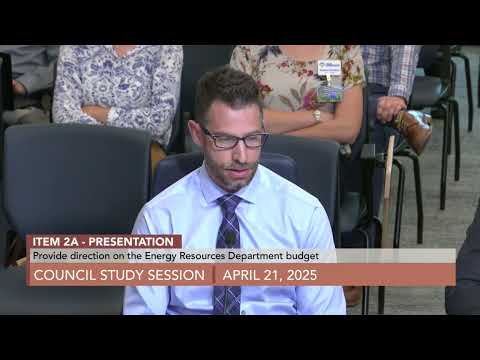
Scott Boucher, Mesa’s energy and sustainability director, told the City Council at a study session April 24 that the city is projecting lower electric supply costs for the coming fiscal year after executing new contracts and a long-term deal with Salt River Project (SRP). “I think this is the first year since, before the market disruption that we're actually gonna be below SRP,” said Anthony Cadorn, the department’s program manager.
Why it matters: changes in supply contracts and staffing requests can affect utility operations, response times, and future budgets for Mesa’s city-owned electric and natural gas utility. The department presented performance metrics, proposed budget adjustments and one-time equipment requests, and asked council to consider staffing additions to handle sharply rising field work tied to a major fiber rollout.
Boucher opened the presentation by listing the utility’s public purpose and performance objectives, then summarized reliability and safety metrics. He reported 2,443 days without a lost-time accident and said the system’s interruption-duration index compares favorably to other Arizona utilities. On gas emergency response, staff said the target is to respond within 30 minutes to reported gas-smell calls and that the city is meeting that target even as service calls have risen about 11 percent.
On commodity costs, Cadorn and John Petro, the department’s senior fiscal analyst, said the city executed multiple market contracts in fall 2024 and began a large SRP contract Jan. 1, 2025. Cadorn described the SRP arrangement as “a very reasonably priced contract,” and Cadorn later clarified the SRP deal stretches 10 years, with other market contract terms ranging from three to five years. Petro summarized recent forecast updates: electric supply is now projected to come in under budget by about $2.4 million due to favorable contracts; the gas-year estimate for FY 2024–25 dropped to about $14.7 million, in part because of a warm winter and favorable market conditions.
The presentation described ongoing local solar projects and capacity added downtown. Staff said an upcoming round of local projects totals about 2.8 megawatts; combined with existing rooftop and project arrays around downtown (about 806 kilowatts), the next round will bring roughly 3.6 megawatts to the downtown footprint when commissioned. Boucher said one downtown library array (about 555 kilowatts) is constructed and awaiting commissioning.
A substantive portion of the discussion focused on utility locating — the work of marking underground utilities before excavation. Boucher reported a 92 percent increase in annual locate tickets since 2021 and a 310 percent increase in bore-monitoring effort tied to fiber and other projects. The department currently has 24 locators and one supervisor, plus four temporary and four contract employees. Staff requested one additional supervisor and four full-time locators, estimating ongoing costs of about $537,000 and one-time equipment purchases of about $511,000 for field vehicles and locating gear. Boucher and staff said the fiber-to-home buildout accounts for roughly 40 percent of current locate tickets and that locate need will persist while sign-ups and construction continue; staff expect initial installs to remain active through about 2028.
On revenue and budget reductions, Petro said the department identified roughly $416,000 in net reductions and new revenue sources by reclassifying positions, moving some equipment purchases to a replacement fund, and retaining about 8 percent of certain developer contract fees (the department expects around $240,000 in new revenue from those retained administrative fees). He also reiterated that commodity purchases are treated as a pass-through to customers and so are not a practical source of a departmental 2 percent cut required of some budgets.
Councilmembers asked staff to confirm contract lengths and the sources of savings; Cadorn and Petro provided the contract-term details and the split in forecasted savings. Councilmembers also pressed on where the bulk of locating work is occurring (staff said about 40 percent fiber related, with the rest from typical construction such as pools, trees and subdivision work) and on whether temporary/contract staff could be reduced if work declines.
No formal council vote was taken on the staffing or budget enhancements during the study session; staff characterized the items as requests to be considered in upcoming budget deliberations.