House commission hears testimony on rights abuses, political prisoners and alleged ethnic cleansing in Azerbaijan
Get AI-powered insights, summaries, and transcripts
SubscribeSummary
The Tom Lantos Human Rights Commission convened a hearing to examine human-rights abuses in Azerbaijan, focusing on intensified repression since COP29, political prisoners and alleged ethnic cleansing in Nagorno Karabakh (Artsakh).
The Tom Lantos Human Rights Commission convened a hearing to examine human-rights abuses in Azerbaijan, focusing on intensifying domestic repression since COP29, the detention of political prisoners and prisoners of war, and alleged ethnic cleansing in Nagorno Karabakh (Artsakh). Chairman Smith said he is preparing legislation he called the Azerbaijan Democracy Act and that testimony at the hearing would inform that bill.
Why it matters: witnesses told the commission that Azerbaijani President Ilham Aliyev's government has used arrests, travel bans, and criminal prosecutions to silence critics at home and abroad, and that the situation has worsened in the run-up to and since COP29 in Baku. Several experts urged Congress and the administration to consider targeted sanctions, conditioning aid, international monitoring, and referrals to international justice mechanisms.
Chairman Smith opened the hearing by saying Azerbaijan is "a dictatorship under the rule of Aliyev who controls and exploits the country as a fiefdom for his extended family," and said Congress should consider specific policy responses, including legislation. He noted the commission would convey witness testimony to senior officials in the administration.
Artuk Beglarian, introduced by the chairman as a former State Minister of the Republic of Artsakh and a former human-rights ombudsman, described the displacement of ethnic Armenians from Artsakh following military operations in 2023. Beglarian testified that more than 150,000 indigenous Armenians had been forcibly displaced, that thousands of cultural and religious sites were threatened or damaged, and that at least 23 Armenian hostages remained detained. He called for formal U.S. recognition that the events in Artsakh constitute genocide, for international investigation and prosecution, for targeted sanctions, for a halt to U.S. military support to Azerbaijan, and for international monitoring to assess conditions for a safe return.
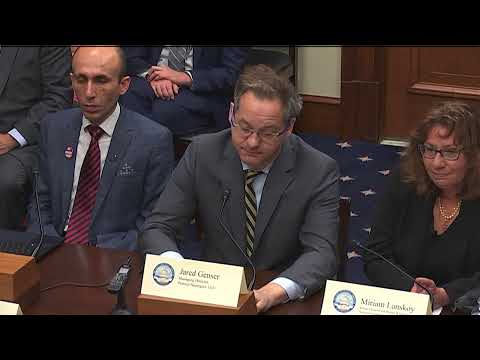
Jared Genser, a human-rights lawyer who said he represents Ruben Vardanian, described Vardanian’s detention as emblematic of what he called fabricated charges and due-process violations. Genser told the commission his client faces what he characterized as many politically motivated counts and "faces life in prison if convicted by the Baku military court on more than 40 fabricated charges," and recounted alleged ill-treatment, denial of counsel and restricted access during hunger strikes. Genser urged coordinated international pressure and named possible diplomatic and sanctions measures.
Miriam Lanskoy, senior director for Russia and Eurasia at the National Endowment for Democracy, described Azerbaijan’s international influence tactics—often called "caviar diplomacy"—and cited reports from Freedom House, Transparency International and Reporters Without Borders showing deteriorating political rights, corruption, and press freedom. Lanskoy and other witnesses said Azerbaijan has intensified arrests of journalists, NGO leaders and activists since 2013 and particularly after COP29.
Andrea (Brazo/Prasow in the record), representing Freedom Now, detailed a campaign she helped coordinate beforehand called Demand Rights at COP that aimed to highlight human-rights concerns. She provided case examples of recent sentences handed down to activists and journalists, and recommended five concrete steps for U.S. policy: public and private diplomatic pressure; conditioning certain foreign assistance on measurable human-rights improvements and the release of prisoners; targeted sanctions (travel and financial restrictions); repeal or reform of restrictive NGO laws; and funding to support independent media, lawyers and defenders in exile.
Witnesses and commissioners cited multiple counts reported by civil-society monitors: references to roughly 350–357 political prisoners in Azerbaijan, more than 6,000 Armenian cultural and religious monuments threatened or damaged in the region, about 23 confirmed Armenian hostages, over 200 missing persons, and roughly 150,000 displaced from Artsakh. Witnesses attributed those figures to groups including Maidan TV, Freedom House and the Center for Truth and Justice; the article reports those figures as presented to the commission.
Several panelists recommended the International Criminal Court or a hybrid tribunal as a mechanism to investigate alleged crimes against humanity or genocide, noting the Rome Statute contains crimes such as forcible transfer of a population. Commissioners discussed the use of the Global Magnitsky authorities and the International Religious Freedom Act as tools for targeted sanctions and visa restrictions.
Commission members repeatedly urged bipartisan action. Chairman Smith said he planned to pursue an Azerbaijan Democracy Act and to press the administration on designation and sanctions; he and witnesses encouraged multilateral coordination with European and other partners. No formal vote or committee action was taken at the hearing.
The hearing record will include full statements submitted by the witnesses and the chairman said the commission would continue to follow the issue and use testimony to shape proposed legislation and diplomatic engagement.