Get Full Government Meeting Transcripts, Videos, & Alerts Forever!
Get email alerts on the Land Use Development topic
No spam. Unsubscribe anytime.
Council gives direction to advance Cul de Sac plan for Site 17 after presentation on phased purchase and development terms
Summary
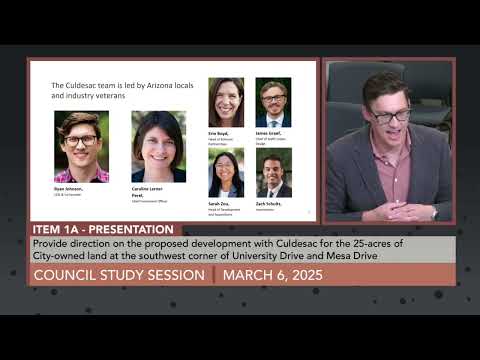
The Mesa City Council on March 6 heard a presentation from Cul de Sac and city staff about a proposed mixed‑use redevelopment of city‑owned Site 17 at the southwest corner of University Drive and Mesa Drive and provided direction to staff to finalize purchase and development agreements for council review this spring.
The Mesa City Council on March 6 heard a presentation from Cul de Sac and city staff about a proposed mixed‑use redevelopment of city‑owned Site 17 at the southwest corner of University Drive and Mesa Drive and provided direction to staff to finalize purchase and development agreements for council review this spring.
The proposal, presented by Ryan Johnson, co‑founder and CEO of Cul de Sac, would deliver a multi‑phase project across the 25‑acre site that Johnson said could include up to 1,000 residential units, 25,000–50,000 square feet of retail and a similar amount of resident amenity space while emphasizing “community, mobility, and open space,” Johnson said.
City staff described a phased property sale and development structure intended to reduce risk for both parties and to protect city interests. Jeff McVay, manager of Urban Transformation, and Jimmy Turacchio, Downtown Transformation project manager, told council the draft deal would require a development agreement and building permits before the city will close on each phase. Under the structure discussed, Cul de Sac would have roughly 24 months after executing a phase purchase agreement to close on that phase and then 12 months after closing to commence construction; option payments and time windows were described for phases 2 and 3.
Why it matters: Site 17 is a large, downtown infill parcel across from the Delta Hotel and adjacent to a historic single‑family neighborhood; the council and staff said they view a successful project as a catalyst for additional downtown development and as a rare opportunity to add for‑sale housing in the core.
Key terms and program minimums discussed
• Minimum program: staff said the development agreement will include minimums of about 1,000 total residential units across the full site, buildings two to five stories high, at least 25,000 square feet of commercial retail and at least 25,000 square feet of residential amenity space. Jimmy Turacchio characterized those retail and amenity numbers as minimums that could be exceeded.
• Phase 1 product: staff said Phase 1 would include for‑sale townhomes intended to add homeownership options downtown; staff and the developer described 140 for‑sale townhomes in Phase 1 as the working assumption.
• Parking and open space: the development agreement will set a minimum parking supply (staff said the concept included at least 800 spaces across the site) and require publicly accessible open space and streetscape improvements.
• Phased purchase and entitlements: staff described three separate phase purchase agreements. City staff said they would not close on a phase until each phase had an approved development agreement, required zoning and building permits; the city also proposed option payments and prerequisites for later phases (for example, evidence of financial capacity or construction progress on prior phases).
• Land sale proceeds and reimbursement for public improvements: staff said Cul de Sac requested that 100% of the Phase‑1 land purchase proceeds (approximately $2,740,000 as presented) be returned to the project to reimburse enhanced public improvements such as streetscapes and parks. City staff said the city intends those reinvestments to fund enhanced, publicly accessible improvements and that the percentage for reimbursement would step down on later phases.
Appraisals and price discussion
Staff reported two appraisals on the full property: one procured by Cul de Sac at about $9,700,000 and a city appraisal at about $11,200,000. Councilmember Jen Duff asked staff to reconcile those figures with the phase‑level prices shown in the presentation; staff explained the slide deck mixed a total‑parcel appraisal with a phase‑level purchase price and apologized for the confusion. The city described the Phase‑1 purchase price shown in the presentation as an estimate tied to the developer’s appraisal and the anticipated acreage for Phase 1.
Council concerns and public‑benefit emphasis
Several council members praised Cul de Sac’s Tempe project and said they liked the proposal’s emphasis on local retail, public space and homeownership. Councilmember Julie Spilsbury asked whether each phase would return for separate zoning and development agreement approvals; staff confirmed each phase will require separate entitlements and that the council will receive the purchase agreement and the development agreement as exhibits when asked to authorize the sale.
Councilmembers raised neighborhood compatibility, parking enforcement and infrastructure costs as issues to carry forward. Councilmember Kevin Adams said parking enforcement and plans to minimize spillover into adjacent streets must be addressed; staff said the Downtown Mesa Association and neighborhood parking tools could be used if needed. Councilmember Adams and others also asked staff to keep electrical infrastructure and other utility impacts in mind as the project is refined.
Quotes
“Cul de Sac Mesa could bring energy and people to Downtown Mesa,” Ryan Johnson, Co‑Founder and CEO of Cul de Sac, said, adding the developer’s Tempe project had attracted more visitors daily than residents and created space for local businesses. McVay described the proposed three‑phase structure as “a way that gives Cul de Sac the standing in the land that gives them the confidence to spend the money, but still at the same time protect the city’s interests.”
Council action and next steps
Council did not vote to sell property or approve a development agreement at the March 6 meeting. Instead the council gave staff direction to finalize negotiations on a purchase agreement and development agreement consistent with the terms discussed and return to council this spring with the formal documents for approval. Staff said they expect Cul de Sac to sign the purchase agreement once council approves it and to begin entitlement work immediately.
Context and history
City Manager Chris Brady reviewed decades of prior proposals for Site 17, noting the city acquired the land years ago for a stadium or other large civic projects and that the parcel has been the subject of repeated selection processes. Staff said Site 17 had been specifically left out of Mesa’s earlier form‑based code so that a bespoke entitlement could be applied to a large, master‑planned development.
Ending
Staff will return to the council with the draft purchase and development agreements; the council will consider authorizing the city manager to execute a purchase agreement and the accompanying development agreement will be presented as an exhibit when council is asked to authorize the sale. If council approves a purchase, staff said they will begin public engagement and the entitlement process for Phase 1 promptly.