Get Full Government Meeting Transcripts, Videos, & Alerts Forever!
Mesa reviews $26–30 CIP outlook, weighs Bartlett Dam, reuse pipeline and developer capacity fees
Summary
City staff presented the five-year capital improvement program and the water resources operating budget, saying staff will pursue Bartlett Dam feasibility, a SRP-CAP interconnect and a developer-focused capacity fee while flagging inflation-driven cost pressures and gaps in bond-authorized projects.
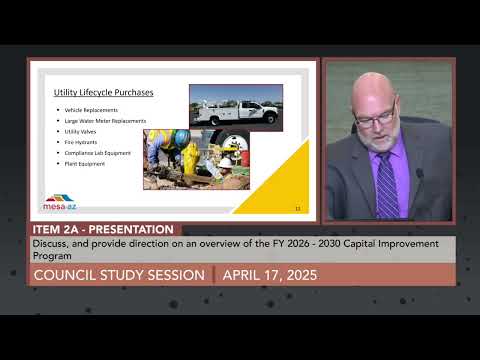
Mesa City Council study-session presenters on April 17 outlined the city's five-year capital improvement program (CIP) and water resources operating budget, describing a package of projects intended to expand water supply and upkeep aging infrastructure while warning of inflation-driven cost pressures and unfunded items.
"The program is really a planning document," Brian Richel, director of the Office of Management and Budget, told the council, opening an overview of the FY2026–2030 CIP that staff said focuses on bond-funded projects and other priorities.
The presentation covered recent, current and planned utility projects, including emergency repairs at the Northwest Water Reclamation Plant, water-transmission and well projects, smart-metering expansion and Energy Resources gas-line work tied to growth in the Magma and Southeast Mesa areas. Staff highlighted both utility funding sources (utility revenues, revenue obligations and taxable utility obligations for projects such as the LG power/battery plant) and non-utility sources (local revenues, regional grants, general obligation bonds and excise-tax obligations).
Why it matters: Mesa faces a set of near-term choices about how to pay for both replacing worn pipes and building new capacity for growth. Council members pressed staff for more detail on what is funded, what is not, and how future bond authorizations or developer fees would be structured.
Key details and context
- Bond and allocation status: Staff summarized prior bond authorizations (2013, 2018, 2020, 2022, 2024), noting some authorizations are fully allocated (for example, the 2018 parks and culture allocation was listed as 100% complete) while other bond-authorized projects have been reprioritized because construction costs rose. Staff said the 2022 public-safety authorization is about 77% allocated and that remaining funds are expected to be assigned to a…
Already have an account? Log in
Subscribe to keep reading
Unlock the rest of this article — and every article on Citizen Portal.
- Unlimited articles
- AI-powered breakdowns of topics, speakers, decisions, and budgets
- Instant alerts when your location has a new meeting
- Follow topics and more locations
- 1,000 AI Insights / month, plus AI Chat