Citizen Portal
Sign In

Mesa reviews $26–30 CIP outlook, weighs Bartlett Dam, reuse pipeline and developer capacity fees

3153627 · April 17, 2025

Loading...

AI-Generated Content: All content on this page was generated by AI to highlight key points from the meeting. For complete details and context, we recommend watching the full video. so we can fix them.

Summary

City staff presented the five-year capital improvement program and the water resources operating budget, saying staff will pursue Bartlett Dam feasibility, a SRP-CAP interconnect and a developer-focused capacity fee while flagging inflation-driven cost pressures and gaps in bond-authorized projects.

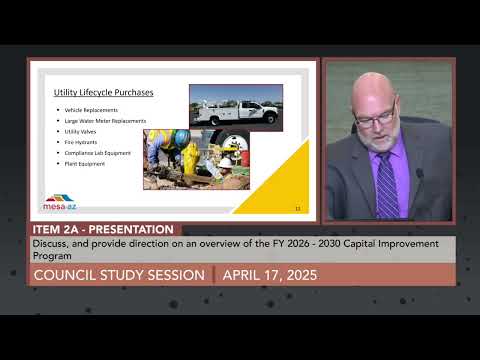
Mesa City Council study-session presenters on April 17 outlined the city's five-year capital improvement program (CIP) and water resources operating budget, describing a package of projects intended to expand water supply and upkeep aging infrastructure while warning of inflation-driven cost pressures and unfunded items.

"The program is really a planning document," Brian Richel, director of the Office of Management and Budget, told the council, opening an overview of the FY2026–2030 CIP that staff said focuses on bond-funded projects and other priorities.

The presentation covered recent, current and planned utility projects, including emergency repairs at the Northwest Water Reclamation Plant, water-transmission and well projects, smart-metering expansion and Energy Resources gas-line work tied to growth in the Magma and Southeast Mesa areas. Staff highlighted both utility funding sources (utility revenues, revenue obligations and taxable utility obligations for projects such as the LG power/battery plant) and non-utility sources (local revenues, regional grants, general obligation bonds and excise-tax obligations).

Why it matters: Mesa faces a set of near-term choices about how to pay for both replacing worn pipes and building new capacity for growth. Council members pressed staff for more detail on what is funded, what is not, and how future bond authorizations or developer fees would be structured.

Key details and context

- Bond and allocation status: Staff summarized prior bond authorizations (2013, 2018, 2020, 2022, 2024), noting some authorizations are fully allocated (for example, the 2018 parks and culture allocation was listed as 100% complete) while other bond-authorized projects have been reprioritized because construction costs rose. Staff said the 2022 public-safety authorization is about 77% allocated and that remaining funds are expected to be assigned to a large training campus project but likely will be insufficient for the original scope.

- Unfunded projects and cost pressures: Staff identified a list of planned projects that currently lack construction funding, including phased water-transmission improvements, the Brown Road Water Treatment Plant expansion, and other life-cycle replacements. Richel cited higher labor and commodity costs since the pandemic and supply-chain delays as major drivers of overruns.

- Water-supply strategy: The water resources presentation, led by Seth Weld (deputy director, enterprise finance) and Chris Lynch (budget coordinator for CIP), described several supply-side options staff are pursuing: - Bartlett Dam feasibility: Mesa is paying for feasibility and environmental review work to evaluate expanding storage at Bartlett Dam. Staff said Mesa's tentative allocation from a future Bartlett expansion would be roughly 28,000 acre-feet of new storage; using the planning convention for available annual yield this translates to roughly 8,000 acre-feet per year for assured-supply purposes. Staff recommended continuing feasibility funding (a one-time request staff put at $100,000) to stay "at the table" during studies and to keep Mesa eligible for future water shares. - New-conservation-space (NCS) water and Roosevelt: Staff noted Mesa already participated in raising Roosevelt Dam; the new-conservation-space water behind Roosevelt costs the city roughly $42 per acre-foot, compared with municipal CAP water priced at more than $300 per acre-foot. That lower-cost storage lets Mesa replace a portion of expensive CAP orders and reduce operating costs in the near term. - SRP-CAP interconnect facility (SCIF): Staff described a feasibility step to move SRP (Salt River Project) canal water into the CAP canal so it can be treated at Brown Road or Signal Butte at a far lower unit cost than treating at Val Vista and pumping east. Staff estimated a one-time feasibility request of about $97,000 for federal permitting and engineering work to confirm treatability, permitting requirements and routing. - Central Mesa reuse pipeline and Gila River Indian Community exchange: Staff said the reuse pipeline will increase reclaimed-water deliveries used in exchange agreements (where reclaimed water is supplied for irrigation and Mesa receives CAP water in return) and could roughly double current exchange volumes; staff said that exchange helps reduce Mesa's CAP purchases.

- Regulatory and water-quality work: Weld and staff flagged ongoing and near-term compliance work, including lead-and-copper service-line inventories and sampling for PFAS (per- and polyfluoroalkyl substances). Staff said the council's environmental-compliance fee (a line item on utility bills) and the environmental compliance fund cover much of this monitoring and sampling work; staff included an expenditure request for analytic services to measure PFAS at parts-per-trillion levels.

- Developer/impact fees concept: Staff described a proposal to replace the old impact-fee model (which has largely sun-setted) with a growth-focused "capacity fee" similar to models used in other Arizona cities. Staff said the fee would be tied to the capital items specifically needed for growth (for example, capacity expansions such as Signal Butte plant upgrades) and would be collected and spent in phases as development occurs. Staff indicated the concept will go first to a council subcommittee and sought direction to pursue details and public outreach this fall.

Council direction and follow-up

Council members asked for and staff promised several follow-ups: - A detailed list of funded vs. unfunded CIP projects (staff said they would provide a fuller list beyond the short highlights presented). - The draft code change for subdivision plats and the forthcoming change to subdivision/submittal processes that staff said will move approvals currently requiring council review into an administrative/planning review process (staff anticipate returning to council with code language in coming months). - More detail about public-safety bond shortfalls (staff said the large training-campus master plan will return with costs and phasing options; some funding shortfalls may require future bond proposals). - Further feasibility documentation for Bartlett Dam and the SRP-CAP interconnect (SCIF) including permitting steps and cost estimates.

Formal actions

Council approved a routine motion to acknowledge and receive minutes from the Economic Development Advisory Board; the motion was made by the vice mayor and seconded by Councilmember Spilsbury and passed (vote tally not specified in the transcript).

What remains unresolved

Staff repeatedly emphasized that many CIP projects are conceptually in the city's 8-year planning document but that only the first year is appropriated in the budget; the outer years are a funding plan that depends on future revenues, bond sales, and grants. Staff said the fifth-year forecast shows reserves under pressure absent adjustments and that the city is taking incremental budget-reduction steps to mitigate that risk while seeking additional revenue options for capital needs.

Ending

Staff told council they would return with more detailed lists of funded and unfunded projects, draft code language for the planning-process changes, feasibility updates for Bartlett Dam and SCIF, and a capacity-fee proposal for council committee review. Councilmembers said they wanted continued public engagement on future bond packaging and stressed that project lists shown in voter materials are illustrative of expected uses within broad categories rather than irrevocable promises for specific parcels or projects.